
Most training programs look complete on paper. They have a defined curriculum, a timeline, and a delivery format. Yet the second it ends, behavior patterns stay the same.
Content is usually not where programs break down. A single delivery channel, whether it’s a self-paced course, a live session, or a workshop, gets learners part of the way there and stops.
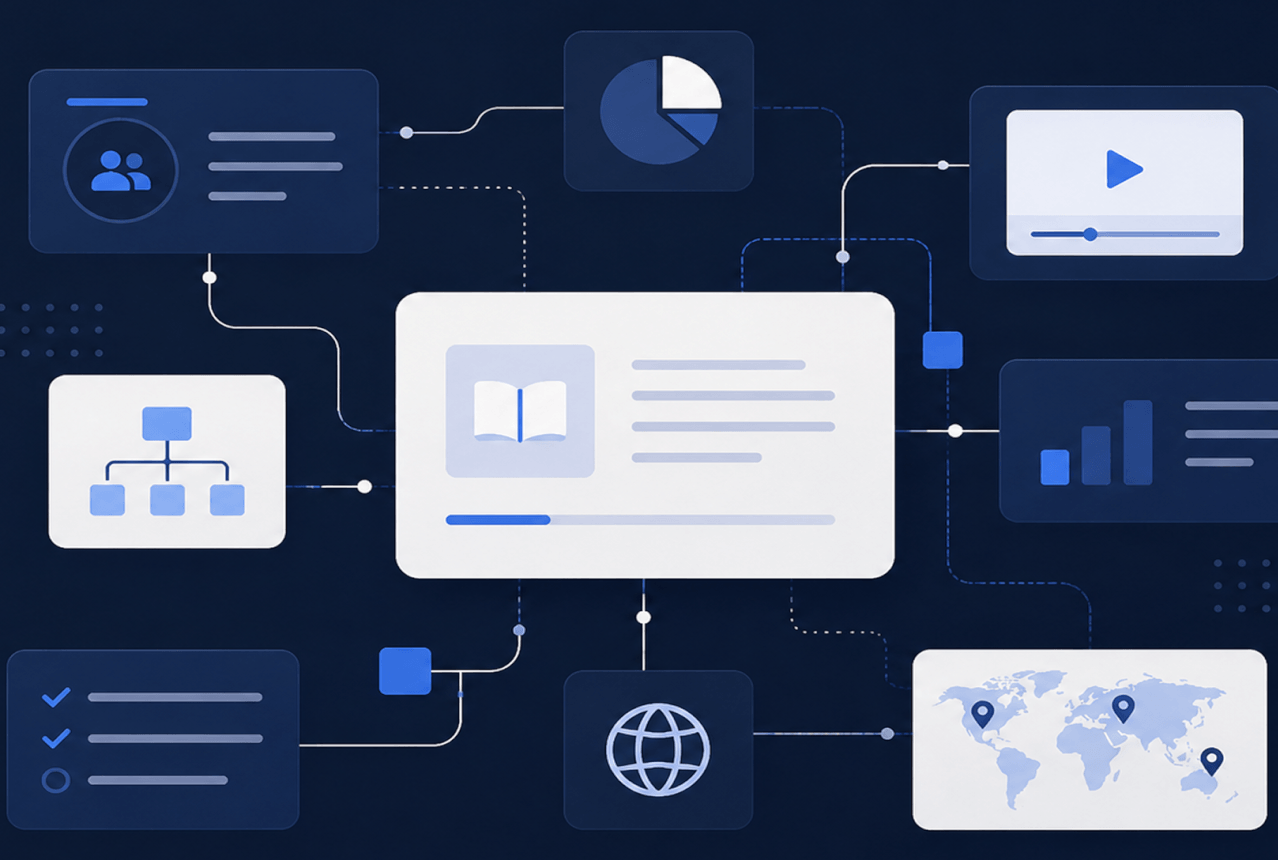
Blended e-learning solves this by assigning each format a specific job in the sequence, rather than asking a single channel to carry the entire program.
According to the ATD 2025 State of the Industry report, blended approaches combining synchronous and asynchronous elements have reached 40 percent adoption among corporate training organizations.
The programs driving that growth are sequencing them, not just mixing. This article walks through eight blended e-learning examples, each built around a specific problem.
You’ll learn to combine modalities, sequence them correctly, and see what makes each blend work through documented cases. 🤩
Summary
- When does blended learning actually work?
- 8 top blended e-learning experience examples
- Example 1. The flipped classroom blend
- Example 2. The simulation-anchored blend
- Example 3. The microlearning-reinforced blend
- Example 4. The job-embedded blend
- Example 5. The coaching-integrated blend
- Example 6. The cohort-based blend
- Example 7. The global rollout blend
- Example 8. The layered rollout blend
- How to choose the right learning blend
- Conclusion
When does blended learning actually work?
A blended e-learning experience is not just a module plus a webinar.
Blended e-learning (or hybrid learning) is a structured learning journey that combines digital content, live interaction, practice, and reinforcement to help learners move from understanding a topic to applying it in real work.

What makes the top blended learning examples work as intended are these three pillars:
- The sequence matters.
What comes first prepares the way for the behavior change that follows. - Each modality has a clear purpose.
No format should duplicate what another already does. - Reinforcement is built in by design.
Without it, even well-designed programs fall to the forgetting curve within mere days.
These principles are easier to understand when viewed in context. The examples below show how different blends solve different training problems: saving live time for practice, helping learners make better decisions, reinforcing skills after a session, or connecting training directly to workplace tasks.
8 top blended e-learning experience examples
Each example starts with the learning problem, then shows the blend pattern, modality sequence, and the context where it fits best, along with a real case. This makes the examples easier to adapt when you plan your own program.
📌 Example 1. The flipped classroom blend
The problem: live session time is used for basic content delivery rather than for discussion, practice, and feedback that learners need.
The flipped classroom blend moves knowledge transfer out of the classroom. Learners review video lessons or read before the session. The live workshop (in-person or via virtual instructor-led training, VILT) is reserved for discussion, role-playing, case analysis, and peer feedback. Any follow-up reflection happens asynchronously afterward.
In practice, this model works best when live training is treated as a space for application rather than presentation.
Deloitte University is a strong example: Deloitte’s $300 million leadership development facility (Frank Kalman. Corporate Classrooms: Adapting to Change. 2013) in Texas combines pre-work, live instruction, team-based learning, and networking, allowing in-person sessions to focus on leadership practice rather than basic content delivery.
Best for: leadership development, strategy training, and any topic where the learning happens in a real conversation
📌 Example 2. The simulation-anchored blend
The problem: employees can recite the policy, but freeze when a real situation hits.
Standard compliance training is often criticized for low behavioral change while maintaining high completion rates. Learners read the rule, pass a quiz, and return to work without practicing.
Simulation-anchored blend addresses these issues by replacing passive comprehension with active decision-making.
In practice, it runs like this: the learner first works through a self-paced module to get the core concept. A branching scenario then puts them in a situation close enough to the real job where the decision actually costs something. A VILT debrief follows to unpack how the group reasoned through those choices. Microlearning nudges at 30 and 60 days to keep the skill from fading.
This pattern is well-known, but it becomes more powerful when simulations are placed inside a larger learning sequence.
A more technical version of the same sequence appears in Blue Carrot’s Studio SE module. The course combined instructional content, an AI SME avatar, and a custom-made simulator into a single adaptive learning unit.
Best for: compliance training, customer service, safety, and ethical decision-making.

Studio SE Case Study
View demo📌 Example 3. The microlearning-reinforced blend
The problem: skills trained in a workshop disappear within two weeks.
The forgetting curve is well documented. What training events tend to produce is short-term recall. A week later, most of it is gone.
The microlearning-reinforced blend works against this by making repetition part of the program structure rather than something bolted on afterward. A workshop or VILT session handles the core skill. Short modules land at spaced intervals over the following weeks, with a check-in session to close it out.
A 2024 review published in Microlearning and Its Effectiveness in Modern Education (Ahmed Mostrady, Eva Sanchez-Lopez, Andres Filipe Gonzalez-Sanchez. Microlearning and its Effectiveness in Modern Education: A Mini Review. ResearchGate. 2024) put numbers to this: learners in spaced repetition conditions recalled key terms with 16 to 25 percent greater accuracy compared to those who covered the same material in one sitting.
Best for: soft skills, sales skills, communication training, and customer-facing roles where behavior is sustained over time.

📌 Example 4. The job-embedded blend
The problem: training occurs in a classroom, while the actual work takes place in a different flow, conditions, and with different responsibilities.
Most people finish a course knowing more than when they started. But that doesn’t always mean they’re ready to handle real tasks on the job.
The job-embedded blend is designed to address exactly this gap: when people have the right information in their heads but hesitate the moment they face a real task, a live customer, or an unfamiliar tool.
The on-the-job training sequence embeds the workflow into the learning path. A self-paced pre-work covers the concepts. A live walkthrough clarifies the application. Job aids provide in-the-moment support, and a 30-day reflection closes the loop.
IBM’s New2Blue onboarding program (Jair Ribeiro. What Happens When We Say: Congratulations and Welcome to IBM. LinkedIn. 2017) applies this model at scale. Before day one, new hires access the “Soon 2B Blue” pre-hire online community. Over those first 100 days, new hires move through online modules, video content, guided activities, work-based practice, and access to expert networks, with a two-year development program continuing after that.
Best for: employee onboarding, ERP and software adoption, process training, and operational upskilling.
📌 Example 5. The coaching-integrated blend
The problem: a leadership program can give someone a solid framework, but it cannot tell them what to do with their specific team, in their specific situation, with their specific gaps.
Leadership development often goes wrong when it assumes every manager is starting from scratch. A module on delegation or feedback gives learners a vocabulary and a framework. But what happens on Monday morning, with that team, on that project? Most programs leave the learner to figure it out on their own.
The coaching-integrated blend makes a smooth transition. Learners work through a self-paced video or read independently. Then, a manager conversation uses that content as a shared reference. The learner then applies what they discussed to a real project. A follow-up session reviews what changed.
GE’s Crotonville program (Noel M. Tichy. GE’s Crotonville : a staging ground for corporate revolutions : lessons for the CEO. ResearchGate. 2006), operating from 1956 till 2020, is the original case. The company combined coursework, immersive action learning projects drawn from real business challenges, and direct interaction with GE’s senior leadership.
Best for: leadership development, performance management, and professional growth programs.
📌 Example 6. The cohort-based blend
The problem: asynchronous learning is skipped or rushed due to a lack of social accountability.
The cohort-based learning blend solves this by making learners accountable to a group, rather than an LMS deadline.
Learners consume async content individually. Synchronous cohort discussions follow as live sessions where the groups apply and debate what they read or watched. A group case study replaces the typical group project. And the facilitator’s feedback closes the program.
That group structure is what makes AWS re/Start (Training and Certification. AWS Re/Start Graduate Series: ‘AWS Cloud? I Got This!’ | Amazon Web Services. Amazon Web Services. 2020) relevant here. Their full-time 12-week program is strictly cohort-based: learners move through cloud computing labs and soft skill training as a unified group.
Best for: culture change programs, strategic upskilling, DEI initiatives, and manager development.
📌 Example 7. The global rollout blend
The problem: distributed teams cannot attend the same live sessions, and async-only delivery creates inconsistent knowledge across regions.
The global rollout blend separates live and self-paced learning. A core VILT or ILT session builds the foundation, whether it happens live or is recorded. Self-paced modules follow for role-specific application. The recurring Q&A sessions glue the whole process together, allowing regional teams to raise context-specific questions. A final assessment measures consistent outcomes across all locations.
The structure works particularly well when content is localized, not just translated for the regional audience. Microsoft deployed this model through Viva Learning (Jason Kellington. Creating Learn-It-Alls at Microsoft with Viva Learning and LinkedIn Learning Hub – Inside Track Blog. Inside Track Blog. 2023), integrated with Microsoft Teams and LinkedIn Learning Hub.
Since launch, the number of engaged quality learners, meaning employees consuming more than two elective courses per month, has increased by 58 percent.

Best for: technical training, product knowledge rollouts, global team upskilling, and sales enablement.
📌 Example 8. The layered rollout blend
The problem: high volumes of content delivered all at once overwhelm learners and produce shallow retention.
This is a common problem in product onboarding, technical certification, and large-scale rollouts.
The layered rollout blend aids in revealing content in a sequence that builds pillars step by step before introducing complexity.
A microlearning intro series establishes core concepts. A full e-learning module gives depth once that foundation is in place. A live VILT deep-dive covers special cases and complex applications. And finally, an applied task or simulation puts the full program to use.
It’s important to note that a reference library should remain accessible afterward for on-demand support.
As a blended learning provider, Blue Carrot used a layered rollout blend to build a scalable training program for a medical client. Our team delivered 20 hours of complex medical content per month over three months, totaling 70 hours.
Based on our observations, the layered delivery allowed learners to build on each phase rather than absorbing everything at once. The variety of content is the key to success, and our e-learning video examples page shows a range of formats used across similar programs.
Best for: product onboarding, technical certification, large-scale software launches, and programs with high content volume and a distributed learner base.
The examples show a simple thing — there is no universal blended format. That’s why the next step should not be choosing between VILT, microlearning, simulations, or coaching, but deciding which fits your learners best.
How to choose the right learning blend
The right blend depends on the outcome the program needs to produce. A few practical cues worth keeping in mind when you plan your own program or when selecting a learning experience platform:
- Live time is expensive. If your workshops are being used to deliver information that learners could absorb in a pre-work video, the flipped classroom blend is worth considering before you redesign anything else.
- Completion rates are not a behavior change. If your compliance or safety numbers look fine but nothing is shifting on the floor, the problem is usually that learners have never practiced making a decision. That is what the simulation-anchored blend is designed to fix.
- One session is rarely enough. The microlearning-reinforced blend exists because training events fade over time. If your program ends with a workshop and no follow-up, you are investing in short-term recall.
- For large teams and global rollouts, the question is not live versus async — it is which parts need to be consistent and which parts need to flex. The global rollout blend separates those two requirements. The layered rollout blend handles a different version of the same problem: too much content, delivered too fast.
- The cohort-based and coaching-integrated blends are worth a separate mention because they solve a different kind of problem, mainly accountability. Use them when the learning goal requires reflection and commitment to change, not just comprehension.

For a closer look at how the two approaches differ, our overview of e-learning vs. blended learning is a useful reference.
Conclusion
There is no single blended format that works everywhere. What the examples of blended learning experience in this article share is a design logic. Each program began with a specific training problem and selected modalities to address that addressed it step by step.
When a program runs on a single format, and results keep falling short, the format is usually what needs to change, not the content.
Whether you’re designing a program from scratch or reworking one that isn’t delivering results, Blue Carrot’s team handles blended e-learning end-to-end, from instructional design and video production to localization and rollout.
Browse our educational content development services or get in touch to walk through your project.