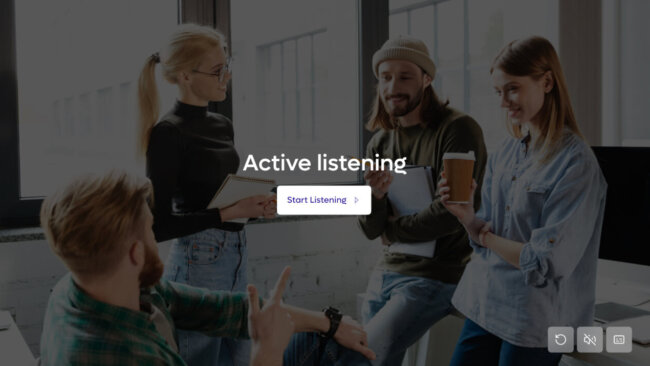
Exploring modern science-based learning: revamping active listening module

View demo
Type:
E-learning development
Technique:
Interactive slides and video
Scope:
1 module

About the project

This project originated from an RFP submission, where our challenge was to transform an outdated Active Listening module into a cutting-edge digital learning experience. We set a goal to show how modern technologies and science-based instructional design can improve online learning.

The result is a 20-minute Active Listening module, designed as a benchmark for what a high-impact, engaging, and scalable digital learning experience can look like.

Goal

The goal was to design and prototype an ideal online learning module that:

Reflects modern instructional design principles

Uses technology to enhance both production and learning experience

Moves beyond passive content delivery toward active, practice-based learning

Project-specific challenges:

Improving existing content without traditional filming: The client requested updates to a pre-existing course library, but prohibited live video shooting.

Demonstrating emotional and interpersonal scenarios: Learners needed to experience realistic emotional reactions in conflict resolution scenarios.

Instructional design challenges:

  • On-screen text and voice-over delivered the same content simultaneously, increasing cognitive load rather than aiding comprehension.
  • Interactions such as single-answer drag-and-drop created an appearance of engagement without supporting meaningful learning.
  • Scenario decisions produced no visible consequences, limiting the learner’s ability to connect choices to real-world outcomes.
  • Lengthy, undifferentiated content reduced learner engagement before key concepts were introduced.
  • Inconsistent navigation and visual design across courses left learners unclear on what action was expected of them.

Screenshots

Our approach

Scenario-based learning experience

Our learning design centers on an immersive, scenario-based experience that transforms learners from passive observers into active participants, enabling deeper understanding and real-world skill application. This approach is grounded in established learning science principles, ensuring both engagement and measurable learning outcomes.

We structured the experience to mirror real workplace situations, allowing learners to practice decision-making in context rather than abstract theory.

Guided learning through a leading character

At the focal point of this journey is a leading character who acts as a trusted guide and mentor. They foster a sense of connection, which aligns with the principles of social learning theory, where observing and interacting with others, even fictional characters, can facilitate learning.

Character acts as a consistent guide, providing insights, prompting reflection, and offering feedback throughout the journey. This support keeps learners engaged while reducing cognitive load and maintaining focus on key challenges. 

Progressive scaffolding for skill development

We designed the learning journey as a multi-stage progression, where learners are supported at each step while steadily moving toward independence:

  • Reflective foundations (initial scaffolding):
    The journey begins with reflection-based activities that activate prior knowledge and set a personal context for learning.
  • Immersive participation (intermediate scaffolding):
    Learners step into realistic scenarios, assume roles, and make decisions that shape outcomes. Different character paths introduce varied perspectives and challenges.
  • Mastery and creation (advanced scaffolding):
    As support is gradually removed, learners apply their knowledge independently, constructing solutions and demonstrating true understanding.

Real-world assessment

The learning journey concludes with a scenario-based assessment that mirrors real-life challenges. Learners apply their knowledge in a new context, demonstrating practical competence rather than theoretical recall.

This approach allows us to evaluate not just what learners know, but how effectively they can use that knowledge in practice.

Our accessibility approach

We implemented a dual-path accessibility strategy to support different learning preferences and needs:

  • Audio-first experience with playback controls
  • Text-first experience via transcripts and screen reader compatibility

Narration follows the redundancy principle: voice-over and on-screen text are never used simultaneously unless it serves a deliberate instructional purpose. Audio levels, tone, and pacing are standardized across all modules to ensure a focused, coherent experience.

This ensures the course remains fully accessible without compromising the immersive experience.

Why we used AI avatars?

For a topic like active listening, visual nuance is essential, especially facial expressions. While live-action video would be ideal, AI avatars strike the right balance between expressiveness and scalability. They outperform animation in conveying emotional cues.

Exploring modern science-based learning: revamping active listening module
View demo
Exploring modern science-based learning: revamping active listening module
View demo

Let’s talk
about your
project

Book a call
(Name missed)
(Email missed)
(Wrong Email format)
(Description missed)

By submitting this form you agree that you are familiarized with our Privacy Policy and accept that your personal data will be processed in accordance with such policies.

This site is protected by reCAPTCHA and the Google Privacy Policy and Terms of Service apply.

Book a call