According to the Chapman Alliance benchmark (Bryan Chapman. How Long Does it Take to Create Learning? A Chapman Alliance. 2026.), one finished hour of e-learning content can require roughly 72–184 hours of production work, depending on complexity. ATD’s findings (Robyn A. Defelice. How Long Does It Take to Develop Training? New Question, New Answers. ASTD. 2021) back that up, claiming that an hour of full engagement content could take up to 155 hours.
Yet product launches don’t wait, compliance deadlines don’t move, ILT-to-e-learning conversions don’t stop, while onboarding cohorts keep growing.
This gap between timelines and execution calls for a different production approach, built around scope discipline, modularity, and AI-assisted workflows rather than traditional sequential development.
That is what rapid e-learning content development is: a method for compressing the development cycle from months to weeks without reducing instructional quality. 🤓
Summary
- What is rapid e-learning content development?
- When does rapid e-learning development make sense?
- The rapid e-learning development process step by step
- Tools that power rapid e-learning content development
- Best practices for rapid e-learning content development
- How Blue Carrot delivers rapid e-learning content development at scale
- Conclusion
What is rapid e-learning content development?
Rapid e-learning content development is a structured approach to building digital training that compresses the course production cycle through iterative design, reusable components, and AI-assisted production.
While traditional instructional design follows a linear ADDIE (Analyze, Design, Develop, Implement, and Evaluate) model completed in sequence over months, rapid development runs in short iterative cycles. Stakeholders could see reviewable output in the first week.
Speed isn’t the only practical difference. The discipline that makes this acceleration possible is quite unique, too:
- Learning objectives are defined before any content is built.
- Modular content architecture allows individual modules to update without rebuilding the whole course.
- Structure review cycles prevent late-stage revision loops from blowing the flow.

👉 What does rapid e-learning content development NOT mean
Rapid development compresses timelines, but it does not remove the thinking behind them.
The principles of action mapping (Catherine L Franssen, George S Lowry, R Adam Franssen. Using Action-Mapping to Design a Non-Majors Neuroeconomics Course to Teach First-Year Collegiate Skills. National Library of Medicine. 2017) include dedicating instructional time and resources to the essential information needed to complete activities on the path to the stated outcome.
A fast build still needs to answer three questions before any content is produced:
- What should learners do differently after the course?
- What content is truly necessary to support that behavior?
- How do you know if the training works?
These take roughly 30 minutes in a structured stakeholder kickoff. Skipping them does not save time; it redirects development effort toward a course that does not address the actual performance gap.
When does rapid e-learning development make sense?
The decision to use rapid e-learning development should follow from the characteristics of the training problem, not from deadline pressure alone.
Three conditions make a project a strong candidate: content with a short shelf life, clean and available source material, and a learning goal focused on knowledge transfer or procedural application rather than deep behavior change.
📌 When to use rapid e-learning
The strongest use cases share the characteristics mentioned above. Namely, these are:
✏️ Compliance and policy updates
Regulatory content changes frequently, distribution is wide, and training must reach every employee before a deadline that does not move.
Unlike a scheduled classroom session, a self-paced compliance module can be updated and redeployed the day a regulation changes: no rescheduling, no travel, no instructor availability required.
✏️ Product and feature launches
These require sales enablement and customer education that lands at launch, not a month after. Rapid development turns product documentation, demos, and SME briefs into structured learning content on a compressed timeline. The shorter the launch window, the stronger the case.
Salesforce’s Trailhead platform is the most documented large-scale example (Andy Bergman. What is Trailhead? All About Salesforce’s Free Online Learning Platform. Salesforce. 2025) of this model in practice: modular, role-based learning paths built on reusable content units that allow new product features to be added as standalone modules the day they ship.
✏️ Microlearning libraries
Short modules built with reusable interaction templates reduce per-module production time once the template system is in place.
Research published in the Journal of Undergraduate Neuroscience Education confirms that microlearning leverages spaced repetition, (Catherine L Franssen, George S Lowry, R Adam Franssen. Using Action-Mapping to Design a Non-Majors Neuroeconomics Course to Teach First-Year Collegiate Skills. National Library of Medicine. 2017) which has been proven to enhance long-term retention in training contexts.
✏️ ILT to e-learning conversion
This works well when an organization already has documented source material, such as facilitator decks, scripts, worksheets, or recorded sessions.
McDonald’s e-learning implementation (McDonald’s eLearning Implementation. Scribd.) is an instructive early case: the company shifted from classroom-based training to digital delivery specifically because training materials were becoming outdated faster than they could be redistributed. The shift ensured every employee accessed the same current version.
✏️ Onboarding refreshes and M&A integration
Hiring waves, restructuring, and post-merger changes are quite frequent these days, and require training content to stabilize quickly. Rapid development helps standardize onboarding at scale without waiting for a full design cycle.
✏️ Multi-language rollouts
According to the Synthesia AI in L&D Report 2026, based on 400+ L&D practitioner responses, 84 percent of teams report faster production (AI in Learning & Development Report 2026 | Synthesia. Synthesia Logo. 2026) as AI’s primary value, with translation and localization among the top current use cases (38 percent).
AI-assisted voiceover, dubbing, and subtitle generation have made multilingual delivery a parallel workstream rather than a sequential add-on. This is a common practice in custom e-learning content development services.
The more complex and high-risk the task becomes, however, the greater the chance that fast workflows create more problems than they solve.
📌 When NOT to use rapid e-learning
The same conditions that make rapid development effective (tight scope, clean source material, knowledge-focused goals) are also what define its limits. Below are three examples of training contexts that consistently produce worse outcomes when compressed.
✏️ Complex behavior change programs
These programs require deep scenario design, nuanced branching logic, and extended reinforcement over weeks or months.
The same action mapping research that describes efficient, rapid scope discipline also makes clear that highly complex instructional problems require more thorough analysis than a rapid kickoff allows.
✏️ High-risk safety simulations
Such simulations need careful design, realistic practice conditions, and thorough testing. The cost of an inadequate training outcome in a safety-critical context is too high a trade-off for a faster build.

✏️ Deep skill mastery programs
These require learners to build judgment over time through sustained practice and feedback, not recall a process or complete a short module. Agile instructional design compresses the production timeline; it cannot compress the learning process itself.
The rapid e-learning development process step by step
The main idea here is that speed comes from process discipline. A compressed development cycle breaks down into five steps that deliver a quality output:
👉 Step 1: Action mapping
Define what learners need to DO upon completing the training before a single slide is built. Action mapping connects training design to real performance gaps.
It helps to cut the scope early, which is where most projects lose time, by removing any content that isn’t tied to a performance action before it ever comes to life.
👉 Step 2: SME sprints
Instead of weeks of back-and-forth, arrange structured sprint sessions for subject matter experts (SMEs) of 60 to 90 minutes with a prepared question set and a defined expected output.
Raw SME output (a recorded session, slide deck, or a simple document) can then be converted into a structured draft course outline using AI. The instructional designer (ID) then reviews it and makes corrections.
👉 Step 3: Storyboarding with templates
Once the course outline is approved, the next step is to turn it into a storyboard. A storyboard locks the structure, content, and interaction logic of a course before any real development begins.
Rather than starting from blank documents, use pre-built templates as the storyboard framework. It simplifies the task for both IDs and SMEs and ensures that every screen has a defined interaction type before it reaches the authoring tool.
See our e-learning storyboard examples for how this looks across different course types.

👉 Step 4: SAM model
SAM (Successive Approximation Model), Agile instructional design, and lean prototyping approaches all share the same core logic: produce something reviewable in the first week, absorb stakeholder feedback in short cycles, and prevent revisions from stacking into a single late-stage round.
SAM fits most rapid projects well because its phases, preparation, iterative design, and iterative development align naturally with a sprint-based workflow.
For larger programs where development is contracted out, a modified ADDIE with iterative checkpoints built in may serve better.
Neither model is universally superior. The right choice follows from the project structure.
👉 Step 5: Build, QA, deploy
Once the prototype is approved, the team can move into full development. Building with modular content architecture means individual modules update independently without touching the rest of the course.
Quality assurance covers three areas: design review, media QA, and LMS technical testing. All the time we’ve cut on the previous steps allows us to ensure quality during full development.
Tools that power rapid e-learning content development
Rapid e-learning tools matter most when they support the workflow above: faster drafting, faster building, easier review, and fewer manual production tasks.
📌 Authoring tools
A choice of authoring tools defines how fast a course can be built and how much custom interactivity it supports. Based on the content type, team technical skill, LMS compatibility, and how much interaction complexity the program actually needs, the participants of Synthesia State of ID Survey 2024 (Instructional Design Trends: 2024 Survey Insights. Synthesia Logo. 2026) name the following tools as their top picks:
- Articulate Rise 360 (top choice for 43 percent of IDs surveyed, best for fast compliance and knowledge-transfer);
- Storyline (37 percent, best for branching and custom interactivity);
- iSpring (8 percent course building, PowerPoint presentations);
- Synthesia (5 percent, best for video creation);
- Lectora (3 percent, WCAG accessibility, regulated industries).
Naturally, the fastest build is always the one that matches the tool to the course.
📌 AI accelerators
The four production tasks where AI compresses time the best are:
- AI voiceover (ElevenLabs, Murf) eliminates hours of studio time for narrated courses;
- AI-generated content (ChatGPT, Claude) drafts scripts, quiz questions, and scenario variations from SME source material;
- AI avatars and localization (Synthesia, HeyGen) handle video production, lip-syncing, voice cloning, and subtitle generation.
Blue Carrot used this AI approach to localize 70 hours of e-learning across four languages in just two months. This is an online e-learning course development timeline that would simply not be possible with traditional dubbing.
In global rollout scenarios, scalability and time-to-launch are simply incomparable.
However, leaving AI output as is won’t be effective at all. AI accelerates production tasks, but the design decisions regarding sequencing, learning objectives, and behavior change architecture remain the responsibility of the ID.
📌 Reusable templates and component libraries
A template library, be it branded slide masters, pre-built interaction types, or a standardized quiz format, is the highest-leverage investment a rapid development team can make.
Blue Carrot builds client-specific template systems as part of rapid program engagements. Our overview of custom e-learning content development services covers when templates make sense versus fully custom builds.
Best practices for rapid e-learning content development
Five principles distinguish the rapid programs that deliver fast and good results from the ones that accelerate failures:
- Lock learning objectives before anything moves
Action mapping’s core principle is to dedicate development time only to the minimum essential content needed to support measurable performance actions (Lisa Zhang, Paulina M Schenk, Micaela Santilli, Alison J Wright, Marta M Marques, Marie Johnston, Robert West, Susan Michie. Linking behaviour change techniques to mechanisms of action: Using the Theory and Techniques Tool alongside the Behaviour Change Intervention Ontology. National Library of Medicine. 2025).
A 30-minute stakeholder kickoff that defines the performance gap, the target audience, and the success metric is the minimum entry point for any rapid project.
- Build modular from day one
Reusable components enable updates without rebuilds. Courses built like a single monolith are expensive and difficult to update.
Modular architecture means that product changes and localization edits happen at the module level, meaning there’s no need to update the entire system.

- Protect SME time
Unstructured SME involvement is like a snow slope of timeline delays in rapid content development projects.
Sprint sessions of 60 to 90 minutes with a prepared question set, asynchronous review tools, and a defined number of revision rounds keep expert contribution focused and timed.
- Human-in-the-loop with AI
Synthesia’s 2024 survey (mentioned above) found that designers using AI-assisted production reported a 50 to 60 percent reduction in task completion time, but that gain depends on instructional review at every stage.
Based on our experience, this is what separates fast programs that work from fast programs that don’t. AI handles the production load; the instructional designer handles the learning architecture.
- QA is non-negotiable under deadline pressure
The same logic applies to QA. Build checkpoints at every sprint, not just at the end. The closer the program is to launch, the more expensive the error becomes.
How Blue Carrot delivers rapid e-learning content development at scale
Rapid e-learning content development works when instructional design discipline and production speed run as one workflow, not in sequence. That is how we approach it at Blue Carrot: instructional design, AI-accelerated production, and multilingual delivery handled in parallel, not handed off between teams.
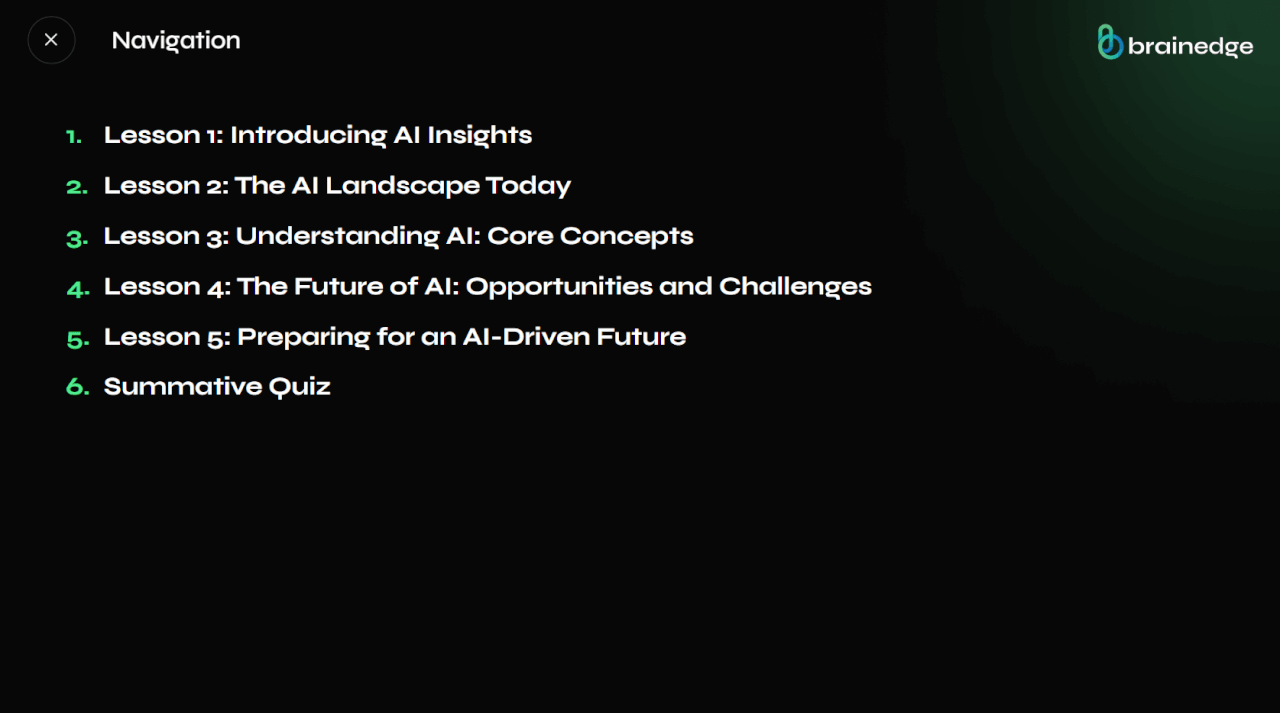
For Brainedge, that approach produced 94 courses in four months using content reuse, AI tools, and templated assets. The client described the result as “something that would have been impossible using traditional methods”.

AI course localization case study
View demoIn a separate engagement with a medical client, Blue Carrot built a scalable training program delivering up to 20 learning hours of complex content per month within a four-week production cycle, totaling more than 70 learning hours. All materials were production ready with minimal revisions, supporting faster rollout and consistent quality.
Both programs followed the practices we’ve described in this article: objectives defined before production began, modular architecture built for localization and updates, and AI output reviewed by instructional designers at every stage.
If you have a tight timeline and want to understand what is achievable, explore our rapid e-learning solutions or get in touch to walk through your project.
You can also browse our overview of the best custom e-learning development companies to partner with to see how Blue Carrot compares when evaluating vendors for a rapid build.
Conclusion
Rapid e-learning development compresses the production cycle, not compressing the design thinking that makes a course work. The teams that consistently deliver on tight timelines do so because they resolve the instructional architecture before production opens, not during it.
Five principles determine whether a rapid build succeeds or stalls:
- Learning objectives must be defined before any content is produced.
- Modular architecture is not optional at speed. Modularity is what makes a fast program sustainable beyond its first deployment.
- AI accelerates production tasks but does not replace instructional judgment.
- SME involvement must be structured and time-bounded. Unstructured expert contribution is the most common source of timeline delays in rapid projects.
- Quality assurance belongs in every sprint cycle, not at the end. The closer a program is to launch, the more expensive an error becomes. QA deferred is risk compounded.
Rapid development works when these principles run as a single, disciplined workflow.