

The use of artificial intelligence in learning and development is no longer a recent trend. These days, AI in instructional design has become a standard tool that helps teams research topics, draft initial course content, analyze learner data, and speed up the production process. According to the Association for Talent Development (ATD Research: AI Tools Are Benefitting Instructional Designers. ATD. 2025), nearly two-thirds of instructional designers (IDs) began using AI tools in 2025, and 96 percent of those users rely on generative AI in their daily work. Given the need to develop training quickly, the demand for instructional designers to use AI continues to grow.
However, speed is just one aspect. Even though AI can help with a number of production activities, it cannot determine whether a particular training will be beneficial in solving business problems and improving employee performance. 🧐
Summary
- What does AI in instructional design actually mean?
- What AI does well vs. what instructional designers still own
- AI across the instructional design workflow (through the ADDIE lens)
- Practical AI use cases in instructional design
- Accelerating research and SME knowledge synthesis
- Creating learning objectives and course outlines
- Designing assessments and scenario-based learning
- Supporting content localization and adaptation
- Improving quality assurance and content reviews
- Scaling large learning programs with AI-assisted workflows
- AI tools instructional designers commonly use
- How the instructional designer’s role is evolving
- Limitations and risks of using AI in instructional design
- A practical framework for adopting AI in instructional design
- How Blue Carrot integrates AI into instructional design
- Conclusion
What does AI in instructional design actually mean?
Using AI in instructional design is all about the artificial intelligence technologies performing analysis of learning needs, designing the learning experience, developing training materials, and improving learning results. Instead of replacing instructional designers, AI serves as a productivity and decision-making tool, automating routine tasks, enabling fast development of learning content, and supporting well-informed team decisions.
Contrary to general AI in e-learning, which is associated with the creation of AI tutors or study materials, its use in instructional design helps with the development of the overall structure and matrix of the course. It is supposed to help the course designers at all stages of the course development process:
- Perform the analysis of needs and synthesis of SME knowledge.
- Develop learning objectives, course outlines, and storyboards.
- Generate assessments, scenarios, and other learning materials.
- Analyze learner feedback to identify opportunities for improvement.
- Help with localization, content updates, and quality control.
AI can generate ideas and training materials — but it can’t tell if your solution actually fixes the problem, matches business goals, or changes behavior. Those decisions should be a part of instructional designers’ responsibility.
What AI does well vs. what instructional designers still own
While some fear AI will make instructional designers obsolete, the opposite is true. AI automates routine tasks, freeing designers to focus on complex problems.
Understanding how to use AI in instructional design effectively means treating it as a tool that enhances human expertise rather than replaces it.
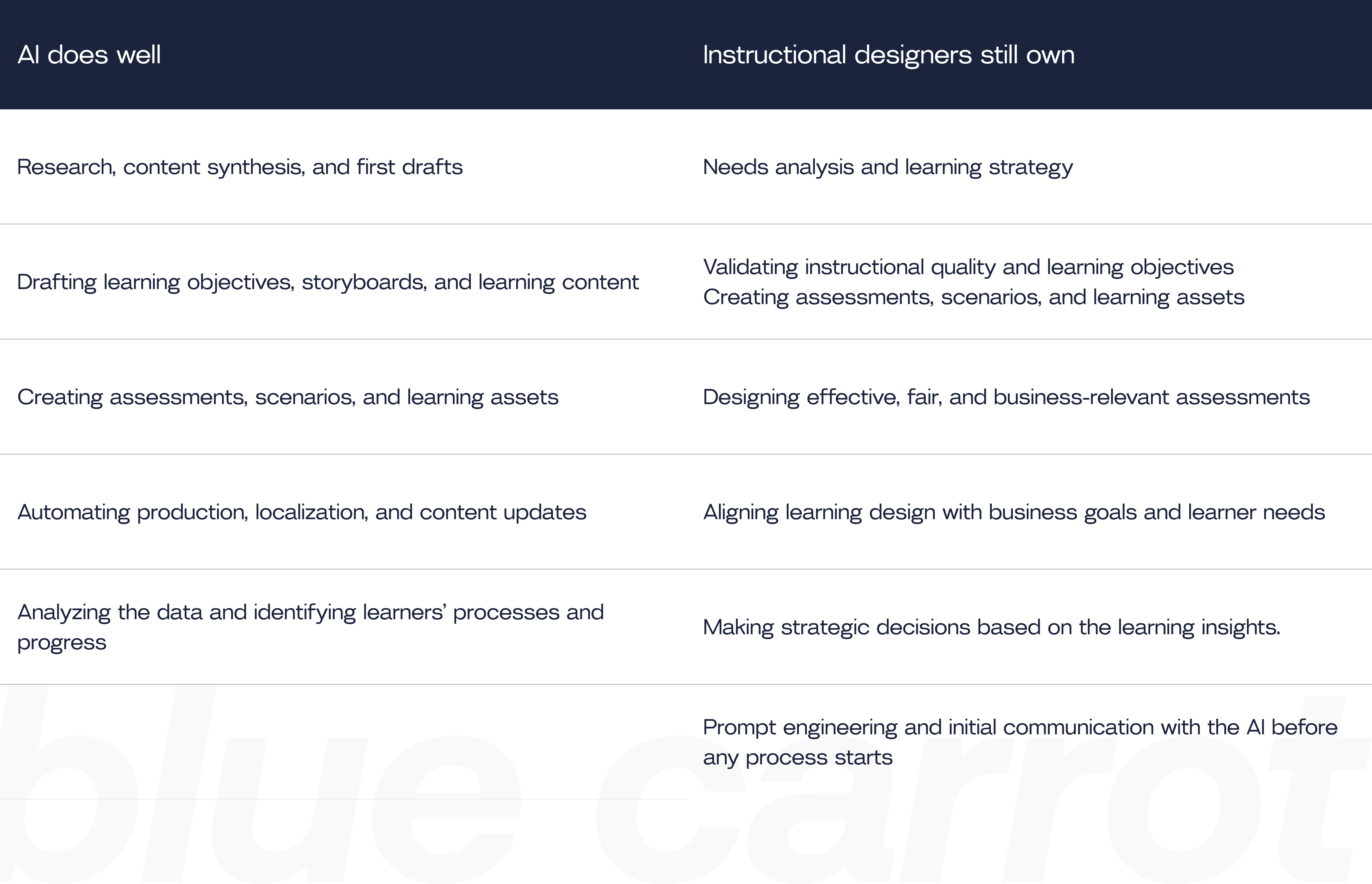
This comes down to the following distinction: AI creates content, while instructional design deals with learning processes and experiences. The best results for businesses will be achieved through the use of AI for instructional design to speed up the content creation process. Meanwhile, instructional designers will continue making key decisions and working together with stakeholders and SMEs to ensure the learning leads to behavior change and does not become simply a course completion checkmark.
AI across the instructional design workflow (through the ADDIE lens)
ADDIE stands for analyze, design, develop, implement, and evaluate. It is one of the most popular frameworks for instructional design, which can be supported and enhanced by AI. The keywords here, however, are enhanced and supported, as it is only the instructional designers who choose the direction, make decisions, and determine whether a solution is relevant and effective.
👉 Analysis
This is the first stage of any successful learning initiative. With the help of AI, designers can process large amounts of information to better understand what business problems should be solved and what learning opportunities already exist. For example, AI is able to:
- Summarize interviews with subject matter experts (SMEs).
- Analyze surveys and learner feedback.
- Identify skill gaps using documentation.
- Compile research reports from various sources.
However, it is not capable of an effective needs analysis. Only instructional designers determine if there is a need for training or another solution to a certain performance issue. Thus, they define learning problems and set goals for the project.
👉 Design
In this phase, AI acts as an assistant to the designer for brainstorming and draft writing. Using various algorithms, AI can suggest learning objectives, course structure, e-learning storyboard examples, learning activities, and alternative learning pathways for different personas. Thus, it is a great tool to accelerate the design process, but instructional designers still need to review and refine the output to ensure that it aligns with business requirements and goals.

👉 Development
In the development phase, AI delivers the greatest productivity because much of this work involves content creation. It suggests ways of creating lessons, assessment questions, scenario-based learning activities, narration scripts, visuals, helps with localization, and supports fast rewrites. In other words, it saves time, but still requires human review for appropriate results.
👉 Implementation
During this phase, AI focuses on personalized learning and efficient delivery. Many modern platforms use AI to recommend content, create AI tutors and chatbots, respond to learners’ queries, and optimize rollout of courses in accordance with engagement data. Still, instructional designers are to guide the overall process by configuring learning pathways and coordinating with stakeholders.
👉 Evaluation
This is the stage at which AI finds valuable insights based on large amounts of learning data. It is able to analyze learner feedback, find out how the completion rate changes, identify gaps in knowledge, and find trends in learning analytics.
Someone needs to interpret the data. High completion rates and test scores don’t prove learning worked or changed performance. Designers evaluate AI suggestions using broader evaluation criteria.
Practical AI use cases in instructional design
The best AI tools for online course creation add value to instructional design by supporting particular activities rather than replacing instructional designers. Used wisely, AI in e-learning design can help teams complete course development faster, reduce redundant activities, and deliver high-quality, large-scale projects.
📌 Accelerating research and SME knowledge synthesis
Course development requires extensive research and analysis of hundreds of pages of documentation, technical manuals, policies, and interview scripts. AI tools can summarize information instantly and detect recurring themes and important insights, which is extremely helpful during the initial phase of any project.
However, it does not allow the separation of what is interesting from what learners need to know. Instructional designers will still have to validate information, resolve contradictions in expert opinions, and prioritize information according to business goals and learner needs.
📌 Creating learning objectives and course outlines
AI can rapidly generate a first draft of learning objectives, course outline, storyboarding materials, and high-level structure based on documentation or inputs of SMEs. Thus, it is an excellent source of inspiration during the brainstorming stage of design.
However, those are not just something to put a check next to. Learning objectives define what learners should be able to do at the end of training. Therefore, instructional designers will still need to monitor this process themselves, validate it against business needs, and design a course architecture following best instructional design practices.
📌 Designing assessments and scenario-based learning
AI supports assessment design, knowledge checks, branching scenarios, role plays, and other interactive activities very quickly from the information present in the existing training material. Moreover, it can provide multiple versions of chosen materials to suit various target audiences or adapt questions if the content changes.
At the same time, assessments are often developed to measure competency, compliance, or certification of learners. They need to be carefully thought out in terms of validity and reliability and their alignment with learning objectives. Therefore, it is safer to consider AI as a tool that generates the first draft, and instructional designers are responsible for further development and validation of every assessment.

📌 Supporting content localization and adaptation
Global companies need to translate materials into many languages and adapt content to specific countries where the training will take place. AI can greatly increase productivity in terms of localization, translation, and adaptation of content, making large-scale localization easier, but material relevance and accuracy remain the responsibility of the IDs.
📌 Improving quality assurance and content reviews
Another area where AI can significantly save time for instructional designers and reviewers is quality assurance. It can detect inconsistencies in terminology, grammatical errors, duplication of content, accessibility issues, and deviations from the style guide prior to human review. As a result, people involved in the process spend much less time fixing formatting issues and can concentrate on evaluating instructional quality and content relevance.
📌 Scaling large learning programs with AI-assisted workflows
One of the biggest advantages of working with AI in instructional design is the ability to scale production. Large-scale projects often involve the development of dozens, and sometimes hundreds, of learning modules. AI can help with the first drafts, terminology management, updates, and adaptation of the content to new languages.
AI tools instructional designers commonly use
With an increasing number of companies incorporating AI into their business processes, the range of available tools for instructional designers is rapidly expanding. These AI applications in instructional design support everything from research and content creation to localization and quality assurance. Unlike several years ago, when specialists were trying to use one tool throughout the course development process, most instructional designers prefer to combine multiple AI tools.

👉 General-purpose AI assistants
LLMs, such as ChatGPT, Claude, and other general-purpose AI assistants, are widely used by instructional designers today. They help with ideas, summarizing SME interviews, drafting first copies of texts, designing activities, explaining topics to learners, and prompt-based problem-solving at all stages of the development process.
General-purpose AI tools are especially helpful as collaborators, not as pure or sole content generators. Effective prompt engineering allows people to generate more accurate materials, but it is a must to always review the generated content before incorporating it into a learning experience. This is needed to make sure the materials meet learning goals and standards of instructional design services.
👉 AI writing and editing tools
Writing assistants like Grammarly or QuillBot help improve grammar, readability, tone, and consistency of all learning materials. They can be used for reviewing course scripts, learner guides, facilitator notes, instructions for assessments, and other supporting documentation.
👉 AI image, video, and voice generation
Generative AI like Midjourney and DALL-E makes creating visual and audio materials for e-learning more efficient. It allows generating illustrations, editing images, creating synthetic voiceovers, creating avatars, and helping in producing videos for course introductions or demonstrations.
👉 AI-powered authoring tools and LMS features
Today, many authoring tools and learning management systems incorporate AI capabilities into their services (take Articulate 360, for instance). In particular, they allow you to automatically generate quizzes, suggest interaction types, personalize paths and recommendations, and give AI-powered assistance to the learners.
How the instructional designer’s role is evolving
The use of AI is transforming the role of an instructional designer into a learning strategist, a shift that is reflected in the areas IDs focus on.
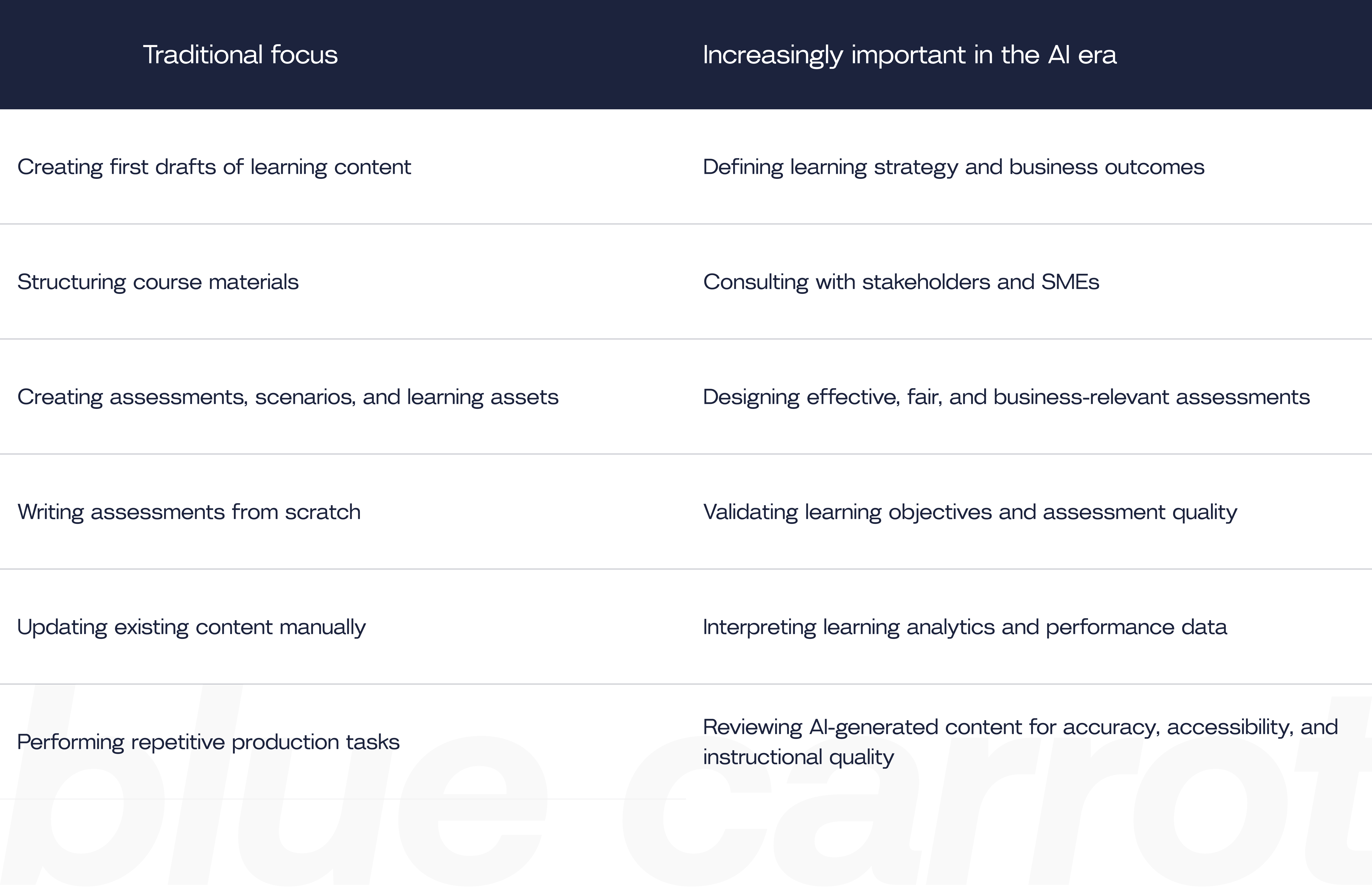
The more advanced AI technology becomes, the more valuable the role of the instructional designer will be, not in creating learning materials but in making sound judgments.
Limitations and risks of using AI in instructional design
Artificial intelligence in instructional design has the potential to enhance productivity dramatically but should not be regarded as an authority or a substitute for an instructional designer due to several issues and limitations.
- AI hallucinations and factual errors. AI can invent facts; thus, all content needs to be validated and reviewed before being used in the learning material.
- Lack of industry-specific knowledge. AI systems are trained on general datasets, and they lack sufficient knowledge regarding industry-specific issues such as those that arise in the healthcare, engineering, finance, or other fields where compliance matters.
- Risk related to learning science and pedagogy. AI is capable of generating great-looking content without making sure that it meets pedagogical standards. According to the systematic review on “Artificial Intelligence in Elementary STEM Education,” current models do not understand teaching well, so they can create mathematically correct solutions that are not good for learning. Creating science content is even harder because systems struggle to create real investigative experiences that go beyond simple memorization questions. (Memari M, Ruggles K. Artificial intelligence in elementary STEM education: A systematic review of current applications and future challenges. arXiv. 2025.)
- Lack of consideration of learning transfer. AI is designed to generate content but is not capable of analyzing whether it would result in improved performance.
- Risk of compromising privacy. Sharing confidential information about the business or the learner with AI systems that are publicly available may compromise this information.
- Ownership of the AI output. AI-generated content might present copyright and licensing issues depending on the tool and context of use.
To avoid these issues, it is best to use AI as a productivity tool and not to trust it in decision-making. Every instructional designer should validate facts, apply learning science, ensure that content is quality and unbiased, protect sensitive information, and make sure that every learning experience contributes to business outcomes.
A practical framework for adopting AI in instructional design
The successful incorporation of AI into instructional design depends more on embedding it within current workflows than selecting the appropriate technology. This can be accomplished by beginning on a small scale and then expanding AI use as confidence increases, with a proper review process in place.
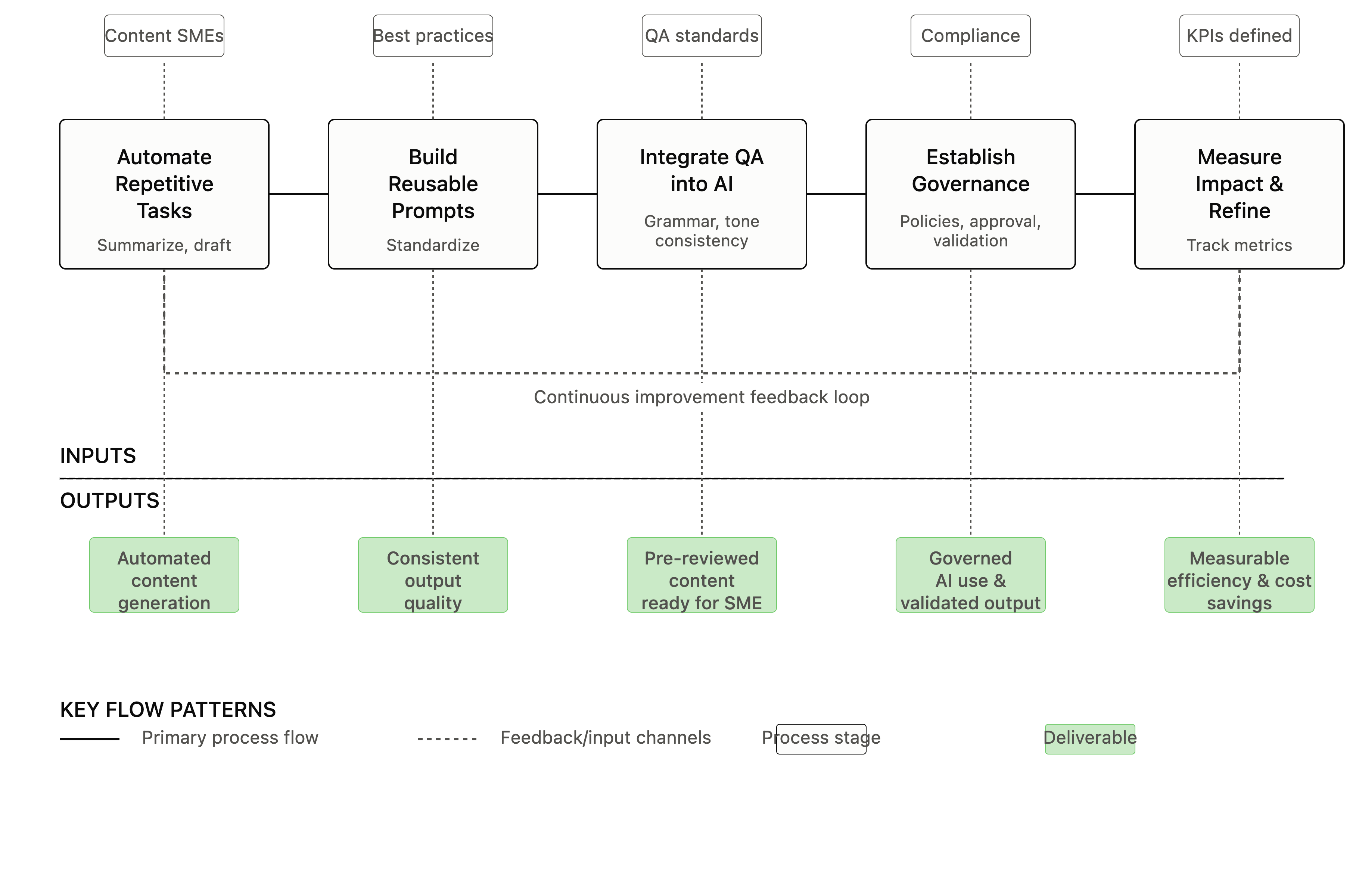
Continuous improvement of the workflow while maintaining the responsibility of strategic decision-making on the shoulders of instructional designers is critical for the success of any organization.
How Blue Carrot integrates AI into instructional design
At Blue Carrot, we follow trends and adopt new technologies, but we do it consciously. The use of AI in instructional design comes with numerous ethical questions; at the same time, its time-saving value is undeniable. Thus, we are doing our best to balance these two aspects and get everything we can from AI for our e-learning content development services without stepping on thin ice.
In any situation, human expertise is integral for any work that we do. Our instructional designers ensure courses are accurate, compelling, inclusive, and effective by validating any AI-generated content and applying learning science.
Conclusion
AI accelerates course development, but technology alone cannot ensure learning designs transform behavior or improve performance. Success requires combining AI with instructional design skills and critical thinking.