The use of AI in e-learning is becoming normalized. Several years ago, implementing artificial intelligence-powered solutions in L&D was a bold move. Now, it’s something that leadership and users expect — and it puts pressure on the decision-maker.
Reading that 71 percent of L&D professionals are already experimenting with AI (2025 Workplace Learning Report | LinkedIn Learning. LinkedIn Corporation 2026. 2026) and remembering the “AI pilot graveyard” reality is not exactly the perfect calm atmosphere for strategizing. The good news, though, is that there already are multiple ways e-learning AI projects can secure ROI.
Based on our experience as a provider of e-learning content creation services, we’ll outline the most impact-heavy use cases and address some of the common anxieties about the topic. 🤩
Summary
- What does “AI in e-learning” actually mean?
- Key applications of AI in e-learning
- Benefits of using AI for e-learning
- Limitations and risks of AI in e-learning
- Real-world examples of AI in e-learning production
- How to apply AI to your e-learning program
- Conclusions
What does “AI in e-learning” actually mean?
AI in e-learning refers to the use of artificial intelligence technologies to design, develop, deliver, personalize, and improve digital learning experiences. In other words, while AI can help create the learning content itself, it can also recommend personalized learning paths, serve as a tutor, automate assessment, or work with analytics. “AI for e-learning” is an umbrella term for any of these use cases.
This means that we’re not dealing with a single technology or feature, even though each of us probably thinks about some “archetypal” use case first. In reality, AI can be used across the entire learning lifecycle, even before content production (at the instructional design stage) and long after assessment (for iterative optimization).
Broadly speaking, we can identify two major categories of AI applications in e-learning:
- Traditional AI — predictive models, recommendation engines, and pattern recognition. These are the “siblings” of similar models used in other industries but applied to educational contexts: personalized experiences, identifying gaps, etc.
- Generative AI — large language models (LLMs) and multimodal foundation models that create new content (texts, scripts, illustrations, voice-overs, quizzes, etc.)
In practice, a modern implementation will likely use a combination of both.

Key applications of AI in e-learning
Different organizations apply AI to solve different challenges. In some cases, it’s speeding up course development cycles. In other cases, it’s finally nailing personalization. Some organizations need to link L&D to operational outcomes. Here are the “building blocks” of such approaches that we at Blue Carrot have found to be most impact rich.
👉 AI-assisted learning content creation
Using generative AI for content creation is one of the more obvious — and often the most rewarding — types of AI-powered e-learning. However, unlike some entertainment content genres that are now mostly AI-generated, education primarily prefers to create online courses with AI by accelerating individual production tasks:
- First drafts of scripts;
- Quiz questions;
- Illustrations;
- AI voiceovers;
- Graphic design, etc.
Meanwhile, instructional designers, SMEs, and other people on the team keep working — refining, fine-tuning, and tailoring the content to the end audience. For example, in our experience, using AI for video production (synthetic video, avatars, automated rendering, design templates, etc.) reduces the time needed to produce an e-learning video from scratch by two-thirds.
👉 Personalized learning paths
Personalization has long been a hallmark of good one-on-one tutoring — and notoriously difficult to scale to entire groups of learners. AI has turned out to be the missing piece of the puzzle. It can continuously analyze quiz results, repeated attempts, time spent on topics, and the like for patterns and take action — from recommending the next lesson to adjusting the difficulty or even sequence of materials. This helps course authors combine the advantages of e-learning with those of in-person training.
Research supports this approach. A 2025 meta-analysis of 32 studies (3,029 learners) found that AI-supported learning produced improvements in learner autonomy: self-regulation, planning, reflection, and motivation (Achuthan, 2025, Artificial Intelligence and Learner Autonomy: A Meta-Analysis of Self-Regulated and Self-Directed Learning, Frontiers in Education, 10, Article 1738751, DOI: 10.3389/feduc.2025.1738751).
👉 AI tutoring and learner support
AI tutoring systems combine LLMs with access to learning materials and learner’s individual context. This allows them to be more than just chatbots: apart from the obvious topic constraints, AI tutors can adapt their responses based on the learner’s performance. Plus, an AI tutor doesn’t just answer questions but also encourages problem solving.
In a 2025 randomized controlled trial involving 233 students, researchers found that learners working with an AI tutor achieved significantly higher learning gains while spending a median of 49 minutes on the task compared with 60 minutes in an active-learning classroom session — around 18 percent less time (Kestin et al., 2025, AI tutoring outperforms in-class active learning: an RCT introducing a novel research-based design in an authentic educational setting, Scientific Reports, 15, Article 17458, DOI: 10.1038/s41598-025-97652-6).
👉 Automated assessment and feedback
As opposed to mechanically checking (answers[i]==correctAnswers[i]), AI-powered assessment automation can now do three important things:
- Evaluate open-ended responses;
- Provide meaningful feedback immediately;
- Generate extra assignments.
Technologically, such assessment systems combine generative AI with structured evaluation frameworks, where the system is calibrated against examples of what counts as “good” vs. “bad” responses in this particular context. For instance, assessment can differ between compliance and soft skills modules within a given company.
👉 Learning analytics and predictive insights
In both academic and corporate L&D contexts, one of the big challenges is understanding whether e-learning actually improves anything. Traditional learning analytics show basic metrics — completion rates, scores, etc., but AI can help organizations extract deeper insights.
One of the most useful capabilities of AI is analyzing large amounts of data and detecting patterns — which modules consistently cause difficulties and what they have in common, what groups of learners need support, or where the gaps between the available and the required skills are.
One step above that are predictive models, identifying learners with a high risk of disengaging from a program or modeling outcomes imposed on actual operations.

Brainedge – AI course case study
View demo👉 AI-powered simulations and role-playing
True interactivity in e-learning has long been tricky to implement. It’s one thing to make a program that outputs CORRECT! or TRY AGAIN after a quiz question, and quite another to model an actual simulation process.
With traditional branching scripts, writing every possible path in advance was mathematically next to impossible. AI, however, can generate contextually appropriate responses on demand instead of playing back pre-recorded scripts. This means that suddenly, it is possible to simulate different situations (from sales calls to surgical procedures) and teach different skills:
- Applying various communication styles;
- Negotiating;
- Resolving conflicts;
- Reassuring, etc.
The underlying framework, of course, is still created by SMEs and instructional designers.
👉 AI-powered localization and accessibility
Localization and accessibility have traditionally occupied a peripheral place in many e-learning projects. In global organizations, the former is often left to local branches, while the latter can be almost an afterthought.
With AI, though, much of this gets easier: automated translation, voice-over generation, adapting visuals (like synchronizing lip movements), captioning, etc. are all within the scope of capabilities.
Importantly, it is finally affordable to treat localization as more than just translation + obvious Celsius/Fahrenheit conversions. Cultural references, terminology, and regulatory contexts are also within the scope, making localization more comprehensive.
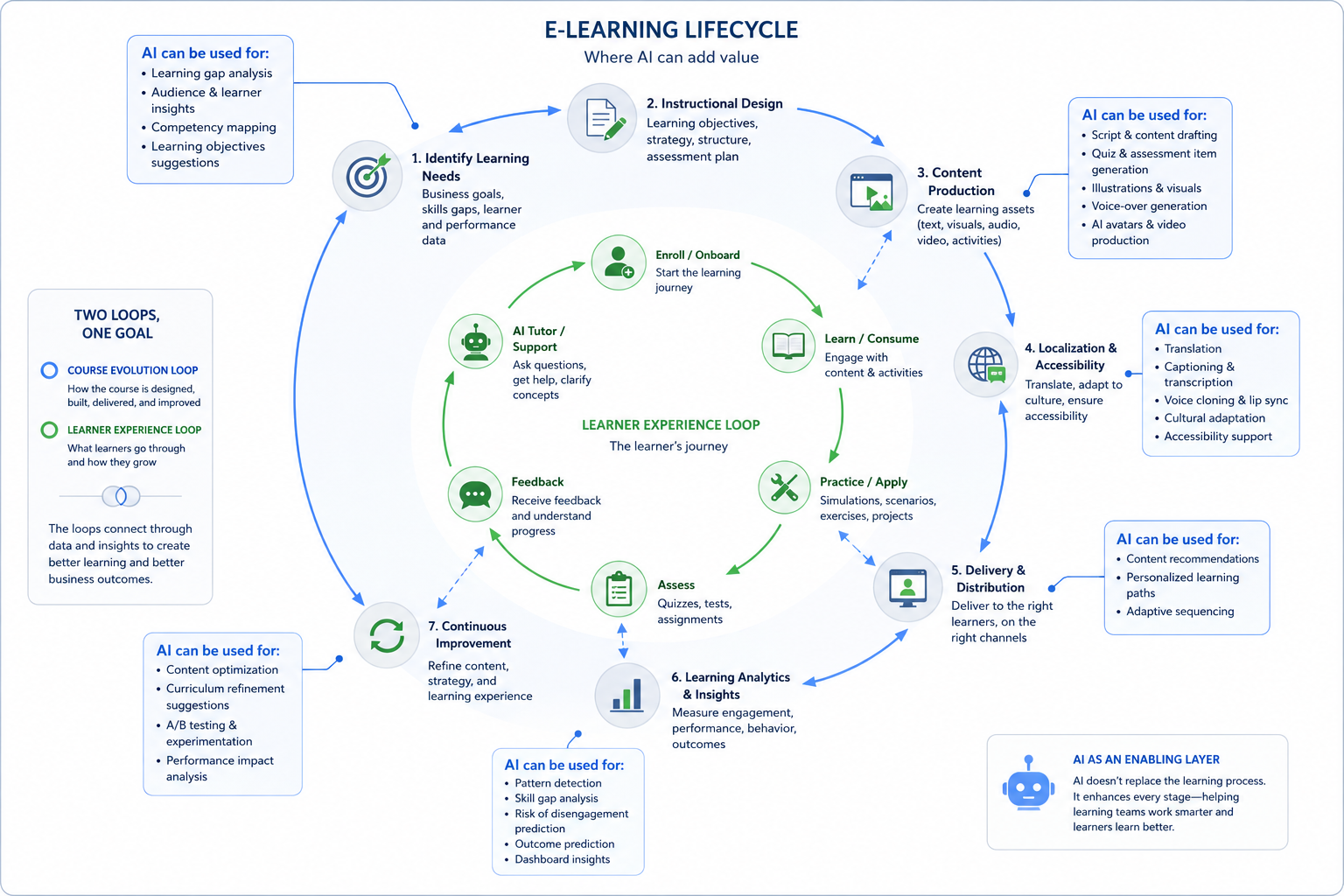
Benefits of using AI for e-learning
We’re getting out of the stage where AI was implemented out of curiosity or for hype. There are documented benefits — and it makes sense to clearly define expectations in order to formulate the correct project roadmap.
With thoughtful implementation, AI can provide benefits under four groups.
- More efficient course development
- Generating drafts of learning assets in minutes rather than hours;
- Reducing production cycles for multimedia-heavy modules. For example, in our experience, updating a 3-minute explainer video with AI-generated narration or AI avatars will typically take 1–4 days instead of several weeks, (no need to schedule presenters, book a studio, or re-shoot footage).
- More effective learning experiences
- Delivering personalized learning paths;
- Providing immediate feedback and AI tutoring;
- Enabling realistic practice through simulations (which improves knowledge retention and secures results in real life).
- Better scalability without sacrificing quality
- Supporting more learners;
- Maintaining a consistent learning experience across departments and regions.
- Better visibility into learning outcomes
- Identifying recurring knowledge gaps and disengagement risks earlier on;
- Connecting learning analytics with operational KPIs, so that L&D teams can demonstrate business impact.
Based on our practice, the greatest ROI comes from removing repetitive production bottlenecks and shortening iteration cycles, plus finally allowing for things like personalization, simulation, or proper use of e-learning vs. blended learning that were previously under the “too difficult” category.
📌 What does successful implementation of e-learning AI look like?
Successful AI is almost invisible. A good recommendation engine doesn’t feel like one; an AI-generated localization doesn’t make you think about AI; a synthetic voice-over sounds like a human speaker. The main question is still “how to create an online course,” not “how to use AI in the process.”
Meanwhile, the truly useful metrics are not inherently AI-related:
- Course development time;
- Cost per localized course;
- Learner engagement and completion rates;
- Assessment performance;
- Time to competency;
- Manager or employee satisfaction;
- Related business KPIs (sales performance, compliance incidents, support resolution time, etc.).
A useful rule of thumb here is this:
If the only metric improving is “content produced,” the AI initiative is probably not mature yet. 🤓
The strongest implementations improve both operational efficiency and learning effectiveness at the same time.
Limitations and risks of AI in e-learning
Any technology introduces some trade-offs alongside opportunities. The question is not whether to fear AI, but rather how these associated challenges should impact the implementation of the project. Here are some of the common risks and what specialists do to mitigate them:
- Accuracy and hallucinations. Generative AI can excel at being plausible but incorrect.
- Solution: keep SMEs in the review loop, and ground AI on approved source materials.
- Data privacy and security. Learning platforms often have to process user information and proprietary knowledge, so “just using AI as is” may be irresponsible.
- Solution: make clear AI governance policies and avoid the exposure of confidential information to public models.
- Bias and fairness. AI systems can inherit biases from training data.
- Solution: audit AI outputs, calibrate systems against transparent evaluation criteria.
- Overreliance on AI. If AI becomes the default answer to every learning challenge, organizations risk automating weak learning strategies rather than improving them.
- Solution: treat AI as an enabler of good instructional design, and not a full substitute for learning expertise/strategic planning.

👉 Is “content sprawl” a valid concern?
A common anxiety among educators, content sprawl is the unchecked growth of learning materials — undermining quality because who will check and update them all?
In practice, successful e-learning and AI combinations don’t immediately jump to producing content. They begin with instructional design: what do we want to teach, to whom, and why → now, how are we going to teach it?
Which means content sprawl is avoidable if AI is in its place as a facilitator, and the decisions lie with the course designers. At Blue Carrot, we aim to produce courses, not content. A good course with 15 videos is better than a poorly designed one with 85.
Real-world examples of AI in e-learning production
Let’s look at just four curated examples that represent different aspects of AI use. This will allow us to see how best practices are, in reality, context dependent.
📌 Khan Academy: AI tutoring at scale
In 2023, Khan Academy introduced their AI-powered learning assistant Khanmigo. On the surface, it looks like a chatbot, but instead of just answering questions, it has its own agenda of leading the learner through the material properly — and encouraging thinking rather than just giving ready information.
📌 LinkedIn Learning: AI-powered personalization
In corporate contexts, the challenge is often to find the content that’s actually relevant to the user’s role and skill gaps. LinkedIn Learning picked exactly this problem — and are now using AI-powered skills insights and recommendations. This sets the tone for the current corporate training evolution: from blanket assignment of courses to targeted improvements.
📌 Pearson: AI-assisted assessment and feedback
Pearson has had quite a history of using AI for one particularly tricky purpose: assessment. For example, in language learning, there’s a need to evaluate open-form assignments. Since 2009, Pearson has developed a system that’s scaled enough to ensure frequent feedback where needed — a continuous loop combining AI with human oversight.
📌 Studio SE & Blue Carrot: scaling expert-led technical training with AI and simulation
Some subjects are so reliant on expert guidance and hands-on experience that moving them online seemed impossible until recently. Blue Carrot worked on transforming part of a 50-hour program in Systems Engineering by Studio SE into an online format. The solution combined an AI SME avatar with a custom JS-based simulator to allow users to interact with the material in realistic scenarios.

Studio SE – Online course
View demo📌 Key learnings: what the success cases have in common
We intentionally provided very diverse examples. They have some underlying principles in common, though:
- They start with a real learning challenge, not the technology. No one thought “Where can we add AI?” but rather “How can we scale expert support?” or “How can we provide better feedback?”
- They combine AI with human expertise. AI handles what it does best, while SMEs and learning designers define goals, context, and quality standards.
- They focus on measurable outcomes. They are not about producing volumes of content, but what changes after the course.
How to apply AI to your e-learning program
At the heart of successful AI adoption, there’s a valid learning strategy. Here’s a brief implementation framework before actual development starts:
- Define the learning goal first. Pick what you really want to improve: is it faster content production? Assessment? Something else?
- Identify where AI can create the most value. AI is good at three things: repetitive work, patterns & predictions, and quick draft content generation. Define how your bottlenecks map to these.
- Choose the right level of AI involvement. Don’t try to make AI do everything; keep human oversight and judgment and plug in AI where necessary.
- Prepare your content and data. Review your existing content: what should be updated, what can be reused, and what needs to be redesigned.
- Consider security, privacy, and ownership. Check where AI models process information, who owns AI-generated assets, and what governance rules are needed before deployment.
- Start with a focused pilot and measure results. Track outcomes like production time, learner engagement, knowledge retention, completion rates, or business impact, depending on the goals from #1.
A well-designed e-learning process still begins with instructional design: defining objectives, structuring content, selecting the right format, and evaluating results. AI expands parts of the process, but the scaffolding is still the understanding of how humans learn.
Conclusions
AI in online learning is not about replacing learning experts with automation. The organizations seeing the strongest results are those that use AI strategically — applying it where it improves learning quality, scalability, or efficiency while keeping human expertise at the center.
Looking to explore where AI can create real value in your e-learning initiatives? Blue Carrot can help you identify the right opportunities and design AI-enhanced learning experiences tailored to your goals.