Self-paced learning abilities are getting stronger with trends and technologies such as AI-customized content, microlearning that fits into any schedule, and video-based courses scaled globally with minimal marginal cost.
Despite this, the instructor-led training (ILT) segment still holds 43.99 percent of the corporate leadership training market — the largest share by revenue in 2026 (Corporate Leadership Training Market. Fortune Business Insights. 2026). So, why do organizations still opt for live instruction? What are the benefits of instructor-led training?
On the learner side, effective instructor presence cultivates trust, satisfaction, and engagement while reducing learner anxiety (McNeill & Bushaala. Meaningful Connection in Virtual Classrooms: Graduate Students’ Perspectives on Effective Instructor Presence in Blended Courses. Frontiers in Education. 2023). On the organization side, it produces business outcomes including skill transfer by practice, performance gains from live coaching, and behavior change that sticks.
Based on Blue Carrot’s experience designing live training for global clients, human presence is the variable that turns a training event into a business outcome. This article discusses ILT benefits, when it outperforms other formats, and how to implement them. 🤓
Summary
- What is instructor-led training? A quick recap
- 8 key benefits of instructor-led training
- 1. Real-time feedback narrows skill gaps
- 2. Active engagement drives better retention and ROI
- 3. Peer learning accelerates team alignment
- 4. Adaptive instruction speeds up time to competency
- 5. Live practice drives soft skills development
- 6. Hands-on practice reduces production errors
- 7. Built-in accountability ensures completion
- 8. Live sessions produce strong transfer of learning to on-the-job behavior
- When instructor-led training outperforms other formats
- How to capture the full benefits of instructor-led training
- Conclusion
What is instructor-led training? A quick recap
Instructor-led training is any format where a live facilitator guides learners through content in real time. It can be delivered in a physical classroom or on a virtual platform, called virtual instructor-led training (VILT). The benefits of virtual instructor-led training are similar to classroom training. In either case, learners have the opportunity to ask questions, receive immediate feedback, and interact with classmates during the session.
According to the 2025 Training Industry Report (Lorri Freifeld. 2025 Training Industry Report. Training Magazine. 2025), 28 percent of U.S. corporate training hours were delivered by stand-and-deliver classroom instructors, and another 24 percent through virtual classrooms or webcasting. L&D teams expect to spend 34 percent of their budgets on classroom tools in 2026, so we could say that live instruction is not going away any time soon.
8 key benefits of instructor-led training
We’ve already shown you a glimpse of instructor-led training benefits. Let’s jump in for more on how the training helps both learners and an organization.
👉 1. Real-time feedback narrows skill gaps
Skill gaps always cost more than training itself. Especially in technical or clinical settings, misunderstanding can lead to compliance penalties, safety incidents, or damaged client relationships.
The good news is that ILT catches and corrects misunderstandings before they leave the training room.
When a learner doesn’t understand something, they can always ask a teacher to clarify it before it becomes permanent. Research also shows that frequent access to immediate feedback creates an encouraging learning environment and a sense of ongoing interaction and assistance (O. Pishchukhina. Monitoring large class practice in a virtual learning environment: online formative assessment experience. IEEE. 2023).
In other words, reframe ILT as a risk management tool. You can avoid preventable mistakes and the higher cost of fixing them later.

Studio SE – Online course
View demo👉 2. Active engagement drives better retention and ROI
To achieve ROI of training, learners need to be able to apply and retain what they learn on the job — not just once, but consistently.
ILT sessions are built around active learning, discussion, hands-on exercises, and instant problem-solving. The activities result in better knowledge retention than passive content consumption. The ongoing, in-session feedback that ILT facilitators provide substantially increases learner satisfaction and engagement intentions, which in turn positively influence learning outcomes (M. Das. Impact of formative assessment on learning outcome. Asian Education and Development Studies. 2026).
Improvements at the learner level add up to business results. They mean less retraining, faster application on the job, and a more visible return on the ILT investment.
👉 3. Peer learning accelerates team alignment
In a self-paced course, learners watch, click, and move on independently. When the same content is delivered through ILT, the peer learning event itself creates shared understanding within a team.
Group dynamics, whether in virtual breakout rooms or small groups in physical classrooms, expose learners to different perspectives. They explain their reasoning, debate with peers, and stress-test their understanding with colleagues.
Interestingly, research shows that peers can have as much of an impact on a learner’s understanding as the instructor, sometimes even more (Swan & Shih. On the nature and development of social presence in online course discussions. Online Learning. 2005).
You can offer blended learning with classes for employees to complete alone, but ensure they have a synchronous learning environment where they can work together with classmates and an encouraging instructor. This can help improve process alignment, create shared mental models, and foster collaboration.
👉 4. Adaptive instruction speeds up time to competency
Of course, AI personalization can adjust content based on a learner’s quiz scores or preferences, but skilled educators go beyond that. They can read the room, sensing hesitation or uncertainty. When participants look confused, the facilitator slows down or adds an example. When the group is ahead, the facilitator skips the review and goes deeper.
This ability to adapt means learners reach competency faster, without wasting time on material they’ve already grasped. It matters when you want to train staff with mixed experience levels, such as when onboarding employees from different departments.
👉 5. Live practice drives soft skills development
The World Economic Forum’s Future of Jobs Report 2025 (The Future of Jobs Report 2025. World Economic Forum. 2025) identifies leadership, resilience, and social influence among the top skills employers need. These kinds of skills require learning by doing, and a live setting is perfect for role-playing exercises.
- Employees practice realistic scenarios (a difficult performance conversation or a tense client negotiation), and an expert is in the room to correct and guide them.
- Real-time coaching catches subtle mistakes in tone, timing, and body language.
- Peer and expert presence pushes learners past comfort zones faster than solo practice.

revamping active listening module
View demo👉 6. Hands-on practice reduces production errors
ILT gives participants a safe space to try a new technique, get it wrong, receive immediate coaching, try again, and improve. This loop repeats before they face a real-world situation.
Scenario-based learning plus supervision is critical for safety training, clinical skills, and technical certification. Self-paced formats can simulate decisions through branching scenarios, but a human expert provides nuanced, context-specific feedback that an automated system misses.
👉 7. Built-in accountability ensures completion
ILT integrates accountability into the format itself. Scheduled sessions create non-negotiable learning time. Imagine you have a training schedule on your calendar (with a facilitator and peers waiting), or a facilitator who actively pays attention to each participant; you feel motivated to show up prepared and engage.
With accountability and peer commitment, students tend to complete the program and apply what they’ve learned, resulting in a higher training ROI.
👉 8. Live sessions produce strong transfer of learning to on-the-job behavior
Many training ROIs are lost between training and on-the-job application. ILT is one way to close that gap. It blends practice directly into the session or connects lessons to participants’ projects.
L&D teams can even use ILT to support implementation:
- Pre-session materials set expectations;
- Live sessions create shared momentum; and
- Post assignments solidify learning concepts.
This way, students don’t just receive information. They engage with it before the class ends, and that helps the lesson stick afterward.

When instructor-led training outperforms other formats
The benefits of instructor led training deliver strong results under circumstances when:
- The subject is challenging (risky or sensitive) or requires proof of competency (think of security guidelines, clinical procedures, and technical certifications).
- Learners want to develop soft skills or leadership skills (training in management, workshops on negotiation, and coaching in presentation).
- Peer interaction is part of the learning design (new hire orientation, team alignment workshops, and diversity and inclusion training).
- Behavior change is the objective (coaching programs and sales methodology training).
That said, ILT is not always the most efficient format for large-scale knowledge transfer. The table below maps common training goals to the format most likely to deliver results.
|
Training goal |
Best format |
Why |
|
Policy rollout/awareness |
E-learning |
Scalable, consistent, low facilitation cost |
|
Compliance certification (knowledge) |
E-learning |
Self-paced works for knowledge checks at scale |
|
Compliance certification (behavior/high stakes) |
ILT or Blended |
Requires practice, feedback, and proven competency |
|
Leadership coaching |
ILT |
Changing behavioral patterns requires real-time feedback and social context |
|
Technical skills with physical equipment |
ILT |
Hands-on practice requires in-person supervision |
|
Global onboarding (knowledge transfer component) |
Blended |
Online learning covers content, while ILT handles culture and Q&A |
|
Product knowledge/sales enablement |
Blended |
Self-paced for product content, and live for objection handling |
|
Safety certification |
ILT or Blended |
High-stakes error consequences require supervised practice |
From our observations, the most effective programs combine formats. Self-paced modules can cover core knowledge, while live sessions focus on application, discussion, and skill practice. When video is part of the asynchronous component, organizations may also work with a training video production company to turn demonstrations, expert explanations, or other repeatable content into reusable learning assets. That’s why our blended e-learning development services aim to mix self-paced modules for core knowledge and live sessions for applications and skill practice, instead of using one delivery method.
How to capture the full benefits of instructor-led training
To gain the full advantages of instructor-led training, apply these best practices drawn from our experience.
📌 1. Match the format to the goal and audience
Format choices should be based on the defined learning objective, not on assumptions or convenience, for example:
- A senior leadership workshop offsite for 15 executives needs high-touch facilitation in a classroom setting.
- A technical equipment orientation for Field Technicians can be done through on-site ILT.
- A new manager onboarding across time zones is suitable for VILT, which enables live interaction without requiring travel.
- A product training program for a distributed sales team often works best as a blended learning program. Our blended e-learning experience examples show how this works in practice.

📌 2. Invest in facilitator quality
Clearly, the facilitator is the most important element of ILT. Several of the studies previously mentioned keep pointing this out: a good instructor develops trust, keeps learners engaged, and reduces the stress in the room. What kind of instructors do students prefer? Those who are accessible, communicate quickly, provide useful feedback, and actively listen.
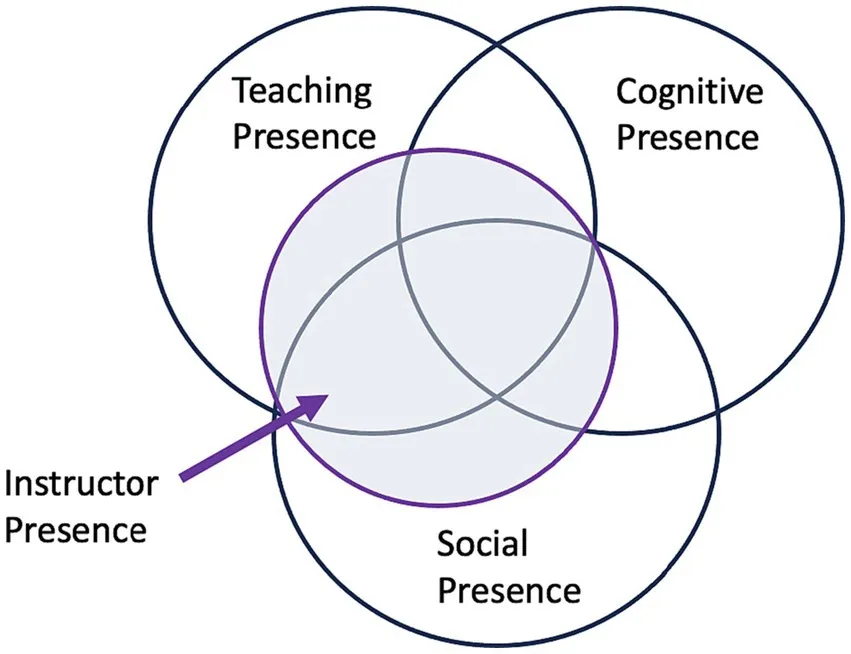
Source: (McNeill & Bushaala. Meaningful Connection in Virtual Classrooms: Graduate Students’ Perspectives on Effective Instructor Presence in Blended Courses. Frontiers in Education. 2023)
Disconnected instructor presence, on the other hand, leads to frustration and negative emotions. Even worse, instructors who lack subject matter expertise lower learner trust and program execution.
Looking at a corporate setting, an experienced coach ties concepts to your organization’s context. This relevance helps participants see how classes solve their real problems or team challenges.
📌 3. Design for interaction on a deliberate cadence
Interaction is the main mechanism that drives learner engagement, attention, and retention, but instructional design services need to adapt their approach for each format:
- In VILT, build in a structured interaction every 5 to 10 minutes (polls, chat responses, and breakout room discussions).
- In classroom ILT, build in a structured interaction every 15 to 20 minutes (think-pair-share, small-group activities, and hands-on exercises).

For both formats, keep in mind that learners feel more connected when instructors encourage involvement, share relevant examples, and use tools that make participation visible and expected (McNeill & Bushaala. Meaningful Connection in Virtual Classrooms: Graduate Students’ Perspectives on Effective Instructor Presence in Blended Courses. Frontiers in Education. 2023).
📌 4. Build pre-work and post-work to extend the live session’s impact
Experienced e-learning content providers design the full learning journey — not just the live session but also the pre-work and post-work.
- Pre-work prepares learners with basic knowledge upfront so they can spend their live classes on active learning activities.
- Post-work includes action plans, group check-ins, and manager follow-ups. When done well, it’s an excellent way to get the most out of your training.
📌 5. Measure behavior change and business results
If you look at our latest e-learning trends, you’ll see that it’s no longer enough to just look at completion rates and call it a day. Similarly, ILT needs stronger metrics to prove a return.
The better way to do so is to connect training metrics to business KPIs, measuring what changed after the session. Did error rates drop? Did sales conversations improve? Did safety incident reports decline? In fact, post-work is the perfect time to find out.
Conclusion
It’s no wonder that ILT is in the mainstream. It beats other delivery formats in certain areas: skill transfer through practice, performance improvement from live coaching, and behavior change after the training ends.
However, it doesn’t mean you should choose ILT over asynchronous learning; we believe that the most effective programs use both when appropriate. For example, use self-paced modules for core knowledge or pre-class instruction and then switch to live sessions for application, discussion, and skill practice.
Drawing on our years of delivering over 500 learning projects, we’ve found that effective ILT and VILT solutions depend on three things:
- Skilled instructional design that structures sessions for interaction;
- High-quality facilitator materials that support expert delivery; and
- Production values that match the professionalism of the live experience.
Blue Carrot helps L&D teams design and produce live instruction programs with measurable results. If you are considering investing in ILT, book a call with us to discuss your business goals.