
Establishing HIPAA compliance training for employees is essential to protecting sensitive patient health information. HIPAA (the Health Insurance Portability and Accountability Act), a federal law in the US, requires covered entities to train their workforce on appropriate policies and procedures for processing protected health information. It’s also recommended to repeat workforce training annually.
A well-planned HIPAA compliance training program can make recurring training more consistent and manageable. Yet many organizations still treat HIPAA training primarily as a compliance requirement, asking employees to complete courses simply to document completion. This checkbox approach can leave gaps in employees’ ability to recognize and respond to real privacy and security risks. Those gaps can become costly: IBM’s 2026 report puts the global average cost of a data breach at $4.99 million (Cost of a Data Breach Report 2026 | IBM. IBM. 2024).
This article provides detailed guidance on HIPAA training program development. Read about the main requirements, topics to include, and instructional design approaches that work best. 🤩
Summary
- HIPAA training program explained
- HIPAA training requirements — who, what, and when
- Audiences to train separately in a HIPAA program
- Core topics a HIPAA training program typically covers
- The role of HIPAA compliance officers
- Definitions and terminology
- The main HIPAA regulatory rules
- HIPAA compliance for staff and its importance
- Consequences of HIPAA violations and ways to prevent them
- PHI disclosure guidelines and emergencies
- Threats to patient data
- Guidelines for protecting electronic PHI
- Recent HIPAA updates
- Content formats that actually change HIPAA behavior
- How to build a HIPAA training program step by step
- Custom vs. ready-made HIPAA training: what do you need?
- Documentation and recordkeeping for HIPAA training
- How to measure HIPAA training effectiveness
- Summarizing HIPAA training
HIPAA training program explained
A HIPAA training program educates employees in healthcare and related fields on handling protected health information safely under United States federal law. It governs covered entities, including healthcare providers, health plans, and clearinghouses, and business associates that handle Protected Health Information (PHI) on their behalf. HIPAA training is a legal obligation under 45 CFR §164.530 (HIPAA Privacy Rule) and §164.308 (HIPAA Security Rule).

HIPAA training requirements — who, what, and when
HIPAA doesn’t prescribe one specific standardized training course. It outlines general requirements organizations rely on to develop training suitable for their employees’ roles and their HIPAA obligations. Find a detailed overview of what HIPAA requires for PHI training below.
📌 Who must be trained
HIPAA training program development must cover everyone within an organization who comes into contact with or has access to PHI based on their job functions and security responsibilities. These are all the employees, volunteers and interns, contractors, temporary staff, and trainees.
“A covered entity must train all members of its workforce on the policies and procedures with respect to protected health information…, as necessary and appropriate for the members of the workforce to carry out their functions within the covered entity.” (§164.530(b)(1) of the HIPAA Privacy Rule) (Federal Register : Request Access. 2026.)
📌 When training must happen
The rules for the timing generally boil down to the following requirements:
- Every new member of the workforce must receive training within a reasonable period of time after joining the covered entity’s workforce. It usually happens as part of onboarding.
- Employees need annual HIPAA refresher training to recap the key points and cover minor updates. Although not regulatory required, it’s a common best practice to reinforce knowledge.
- Employees must receive HIPAA training within a reasonable period after major updates to HIPAA regulations affecting their functions or guidance from the Department of Health and Human Services (HHS).
📌 What content is required
HIPAA doesn’t have a fixed course curriculum. The content must cover an organization’s policies and procedures related to PHI. Learn more about the core topics every HIPAA training program covers in a separate section below.
📌 How training must be documented
The covered entity must maintain the PHI policies and procedures in written or electronic form. It’s also necessary to keep records that the required training was provided. HIPAA has a standard six-year retention requirement (Steve Alder. HIPAA Retention Requirements – 2026 Update. The HIPAA Journal, 2026).
📌 Difference between covered entities and business associates
Covered entities are organizations directly regulated by HIPAA as they handle PHI. The main types of covered entities include healthcare providers, health plans, and healthcare clearinghouses. Business associates are organizations that perform certain functions for covered entities that involve the processing of PHI.
WHO
Workforce members who handle PHI within covered entities and business associatesWHEN
During onboarding and after relevant changes. Regular refreshers are recommendedCONTENT
HIPAA rules, policies, PHI handling, privacy, security, and reportingDOCUMENTATION
Completion and training records
Audiences to train separately in a HIPAA program
Launching a HIPAA compliance course for the first time may be challenging. One of the most common mistakes along the way is creating or buying an off-the-shelf solution without taking into account the unique needs and workflows of the intended audience. Lack of customization harms efficiency and makes people more likely to mess up and expose protected health information.
A useful approach is separating employees into role-based groups. Here’s what to focus on when creating HIPAA training for the main audiences:
- All workforce members: Basic understanding of HIPAA and PHI, including how HIPAA applies to their everyday work, ways to prevent common violations, and reporting mechanisms;
- Business associate staff: Roles of covered entities, business associates, and subcontractors, basic PHI security training, and the place of employees in the PHI processing workflow;
- Clinical/care-delivery staff: Practical training on accessing, using, and disclosing PHI while they provide patient care, including permitted uses, minimum required access, and common mistakes;
- Managers and supervisors: Approaches to support HIPAA compliance at an organizational level, awareness of security risks, and the importance of creating a corporate culture with strong security awareness.
- Administrative staff: Best practices of identity verification, appropriate disclosures, processing requests for records, online and offline conversations, and patient privacy;
- Students, trainees, and interns: Introduction to HIPAA and PHI, understanding the covered entity’s HIPAA policies and procedures, and disclosure guidelines.
This list is not exhaustive. You may also need separate training for IT and system administrators, compliance and legal staff, billing specialists, and other departments. Therefore, the best approach is to analyze your potential audiences, their impact on HIPAA compliance, knowledge gaps, and then decide how to organize training.

Core topics a HIPAA training program typically covers
Some topics are universal for all HIPAA training programs and should be included in most courses. They introduce learners to HIPAA and outline the main requirements for compliance.
👉 The role of HIPAA compliance officers
You should provide information on the obligations of HIPAA Compliance Officers, HIPAA Privacy Officers, and HIPAA Security Officers within an organization. Instruct employees on when to contact them and how. The module can be optional for staff who have already worked in healthcare and understand the role of compliance officers.
👉 Definitions and terminology
Include definitions of the main terms related to HIPAA. These are typically terms like PHI, ePHI, Covered Entity, Business Associate, Minimum Necessary, and Healthcare Operations. This module can also be optional for training for staff who already know HIPAA terminology.
👉 The main HIPAA regulatory rules
Add an overview of the HIPAA Privacy Rule, HIPAA Security Rule, and HIPAA Breach Notification Rule. Explain how each of them affects employees’ daily workflows, with practical examples.
👉 HIPAA compliance for staff and its importance
Explain why team members must follow HIPAA requirements, including the importance of personal responsibility. You can first share information on the impact of HIPAA on patient safety and regulatory compliance, and then focus on how to meet the rules.
👉 Consequences of HIPAA violations and ways to prevent them
Make sure employees know what happens in case of HIPAA violations and data breaches, including reputational losses and penalties.
👉 PHI disclosure guidelines and emergencies
Provide clear instructions on when PHI disclosure is acceptable with situation-specific scenarios. Explain the difference between required and permitted disclosures as well as disclosure during medical, man-made, and physical emergencies.
👉 Threats to patient data
List the main types of threats to patient data and ways to minimize related risks within an organization.
👉 Guidelines for protecting electronic PHI
Outline specific everyday steps that workforce members must follow to protect electronic PHI and escalate a security incident.
👉 Recent HIPAA updates
Summarize recent updates and how they impact existing workflows. This module can be used both in onboarding and annual refresher training.
Content formats that actually change HIPAA behavior
Passive slide decks may be the reason most HIPAA training fails. Employees listen to the information, pass tests, and then forget to follow the rules in their everyday work.
To be truly effective, HIPAA training must keep students engaged and provide lots of practical exercises and scenario-based learning. As an e-learning services provider, we recommend the following formats:
📌 Scenario branching
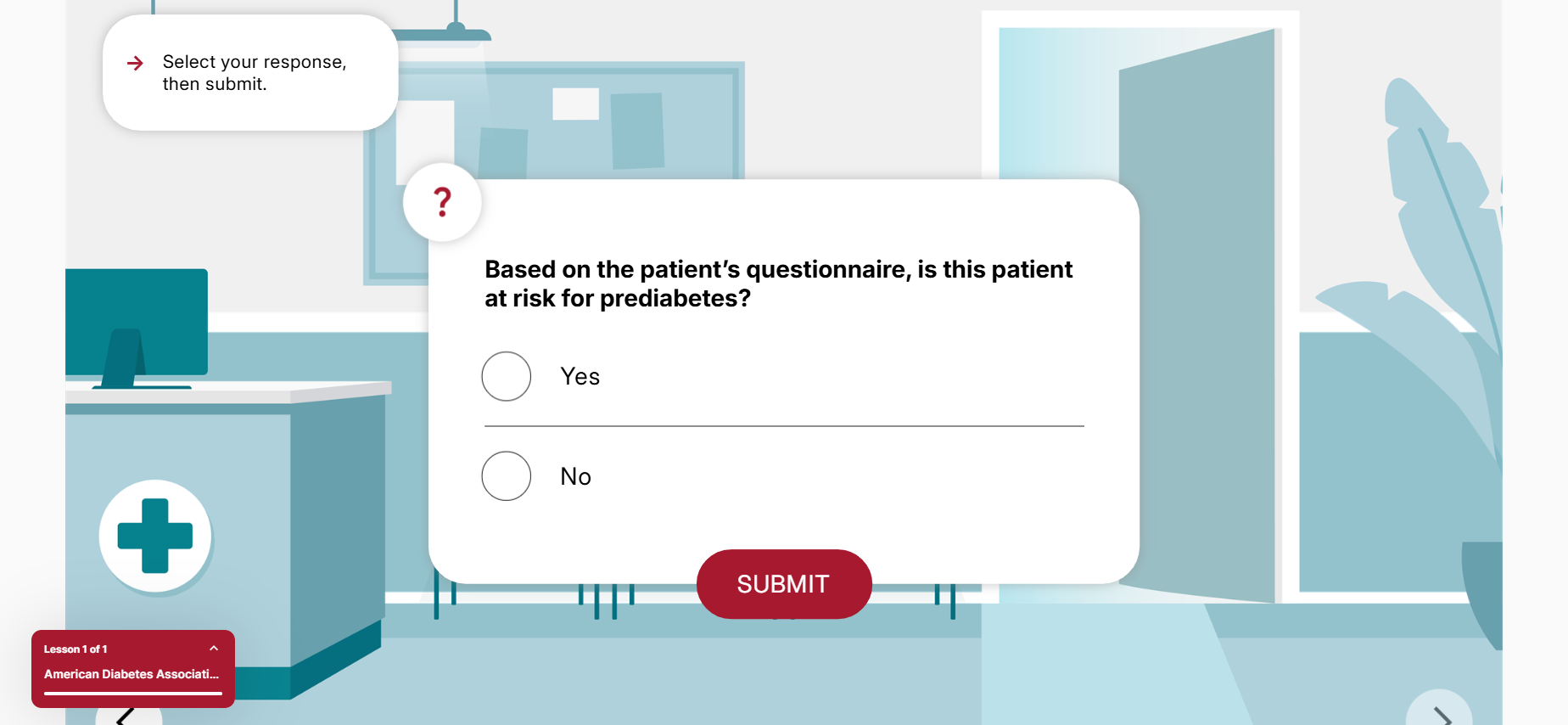
Learners end up in real-life situations like a patient asking for their medical records. They make a choice and immediately see the consequences of their actions. Such training is typically created with specialized e-learning software like Articulate for non-linear simulations. It’s a great format to train staff on privacy decisions, disclosures, incident reporting, and other decision-making activities.

📌 Role-based simulations
Role-based simulations are similar to scenario branching, but customization happens once a student chooses their role. The next steps are tailored to job responsibilities, which increases training efficiency. Rather than studying everything, people receive the information and exercises directly related to their everyday tasks.
📌 Microlearning modules
Microlearning is a commonly known best practice for healthcare training, including HIPAA. This format consists of multiple 5-to-10-minute modules that fit perfectly into the busy schedules of medical staff. Each module covers a specific topic, skill, or concept and functions independently. This way, employees can complete the modules whenever they have time and also benefit from spaced learning. Microlearning modules are also a good option to reinforce privacy rules as an annual reminder.
📌 Interactive animated videos
Animated videos effectively explain complex concepts in simpler words and visualizations. By adding interactive activities like asking learners to make decisions or discuss tasks in groups, they keep people engaged. You can also show videos to demonstrate realistic workplace interactions.
📌 Gamified learning
By teaching HIPAA compliance through points, badges, challenges, and levels, you make training feel like a game. Employees can relax and complete different tasks while learning. It reduces the pressure of compliance training, encouraging people to participate and put in more effort. But the key goal is to reinforce correct behavior, not just reward completion.
📌 Blended learning
Blended learning can be either a combination of online and offline activities or happen fully online. Blended HIPAA training relies on multiple methods. For example, you can use microlearning for sharing general knowledge and role-specific simulations for practical training. Instructional designers typically decide on the best combinations depending on the organization’s learning objectives and needs.
Most of these HIPAA training formats are suitable for online learning through LMS systems. Digital courses allow organizations to train more people at scale, unify training, and get other benefits of e-learning in healthcare. Modern e-learning technologies also help make security training highly interactive and track completion for compliance.

How to build a HIPAA training program step by step
A good HIPAA training program matches the needs of a specific organization. Therefore, if you build training from the ground up, the first step is understanding your unique requirements. Here are the main steps to follow when launching a HIPAA compliance course.
👉 Assess your risk profile
The risks and responsibilities of running training for a small dental office differ from those of an international healthcare network. Therefore, before drafting any training and thinking about HIPAA compliance training best practices, you have to run a risk analysis and understand your needs.
In particular, you have to identify:
- Systems and tools that process PHI;
- Core vulnerability gaps;
- Types of incidents your organization is most likely to face;
- Your current security approaches and what’s missing.
👉 Audit your workforce and knowledge gaps
Next, you need to identify everyone who interacts with protected health information and may require HIPAA training — for example, physicians and all medical staff, business associate staff, managers and supervisors, IT and technical staff, facilities and maintenance teams, trainees, and others.
These are potential audiences you will need to customize HIPAA training for. All of them have different responsibilities and interact with confidential data in different ways, which also means their training needs vary.
It’s useful to break the workforce into several main groups with similar training needs and knowledge gaps.
👉 Develop training based on roles
Once you know who needs what kind of training, it’s time for instructional design. Build separate training tracks for core audiences, choosing the most suitable learning format.
Clinical staff typically need more focus on PHI identification, secure patient communications, secure access to medical records, and patient privacy rights. Managerial staff would benefit more from training on organizational compliance responsibilities and efficient staff supervision approaches.
Some standard HIPAA modules may overlap, but training still needs role-based customization.
👉 Choose a delivery method and launch training
Selecting the right format is as important as customization for different audiences. Offline training typically takes more time than blended and fully online activities, and may be less suitable for busy medical staff.
Based on our experience, it’s better to use LMS systems and create SCORM-compliant learning materials for more convenience. Learners will access content when they have time to watch videos, take quizzes, and read additional materials. Online training is also easier to update and scale for larger audiences.
👉 Improve and introduce annual refreshers
After HIPAA training goes live, monitor its effectiveness and improve when necessary. You will also need to design annual refreshers to recap the core training and remind staff about key PHI security rules or updates. Annual refreshers are both helpful for knowledge retention and recommended by HIPAA.
Custom vs. ready-made HIPAA training: what do you need?
Some healthcare e-learning companies provide ready-made HIPAA training programs you can subscribe to. They take away the need to invest in custom e-learning development services and provide a shortcut to start training your staff.
To decide which one to choose, you need to assess your current resources and expectations, taking into account the pros and cons of each model.
📌 Custom HIPAA training
Custom training implies building a program tailored to your organization’s needs from scratch. You may have an in-house learning and development department or collaborate with an external vendor to design a course.
Pros
- Designed for your policies, roles, systems, and workflows;
- More relevant and engaging;
- Enables role-specific scenarios;
- Matches existing workflows.
Cons
- More expensive and time-consuming;
- Requires internal subject-matter input and L&D expertise;
- Needs continuous maintenance and updates.
📌 Ready-made HIPAA training
There are organizations offering ready-made training for basic HIPAA Privacy, Security, and Breach Notification awareness. They are relatively standard and mostly suitable if you don’t want to maintain training content yourself. Some training is available directly on the HIPAA website.
Pros
- Lower cost and faster deployment;
- Covers standard HIPAA requirements;
- Maintained and updated by a vendor.
Cons
- Lacks customization and role-based content;
- Less relevant and engaging for employees;
- Limited ability to address specific risks and threats.
Overall, ready-made programs are more suitable for smaller organizations with standard workflows. They cover all the essentials and are universal for common use cases. Larger entities may already need a custom e-learning approach to tailor the content to the needs of different teams, focusing on what really matters. You can also consider a hybrid approach that combines a ready-made HIPAA foundation with additional custom modules covering the gaps.
Documentation and recordkeeping for HIPAA training
In addition to providing HIPAA training, covered entities must be able to demonstrate that everyone has received it and keep the necessary documentation. If the Office for Civil Rights (OCR) requests an audit, you will need to show who has passed the training, when, and how often.
Using an LMS system is an easy way to keep the records. The system automatically records training completion and assessment results. It also allows you to generate reports that confirm course completion.
How to measure HIPAA training effectiveness
When measuring training effectiveness, it’s important to move beyond completion metrics. Employees must have the actual skills to handle protected health information and manage related risks. Therefore, you should focus on tracking behavior change, including assessment scores, incident/error rates, reporting behavior, and policy compliance. Capture these metrics before the course and compare post-completion rates against the baseline.
Another useful approach is gathering feedback directly from employees. Ask them what they liked or didn’t like about the training and which topics or scenarios were confusing. People will tell you what can be improved and how to make learning activities more engaging and relevant.
Summarizing HIPAA training
HIPAA training is something every covered entity that uses and handles PHI is required to have. Although its primary objective is regulatory compliance, such training also improves data security and helps build trust.
HIPAA doesn’t directly mention the format and content of regulatory training. It requires organizations to ensure every person receives the necessary training depending on their roles and responsibilities. Therefore, L&D professionals need to choose an optimal design and make sure employees know how to handle personal data in practice.
As a learning and development provider with 10+ years of experience, we can help you design and implement training for your organization. Contact us for consulting and to choose the best course program for your business case.