
It is a fact that people learn at different paces and retain information in different ways. This, unfortunately, is rarely considered by the creators of online courses, whose materials are often limited to slides, texts, and recorded lectures. Such a flat approach makes overall training harder to follow and perceive, especially considering that nowadays people of different professional backgrounds and skills can take the same course.
Research conducted by several German psychologists and educators covered more than 2,000 primary studies and confirmed that a wider variety of tasks and exercises in technology-enhanced learning (read, e-learning) improves learning outcomes if it aligns with instructional goals (Michael Sailer, Rebecca Maier, Sonja Berger, Tamara Kastorff, Karsten Stegmann, Learning activities in technology-enhanced learning: A systematic review of meta-analyses and second-order meta-analysis in higher education, Learning and Individual Differences, Volume 112, 2024). This switches the educational paradigm and suggests that the mono-task approach is no longer viable; providing people with a presentation or a talking head video only is no longer enough. That is a sign that a switch to multimodal learning is required.
In this guide, we will explain what multimodal learning is, describe its key elements and advantages, as well as suggest techniques that can be used to build an efficient modern e-learning solution. In addition, based on our experience in creating custom learning programs for companies all around the world, we will provide our viewpoint on how you can base multimodal learning on the main principles of instructional design and make it work in reality.
Summary
- Key takeaways
- What is multimodal learning?
- What are the main learning modalities?
- Why multimodal learning works
- Benefits of multimodal learning
- How to design an effective multimodal learning course
- Multimodal learning examples in practice
- Common multimodal learning design mistakes
- Conclusion
Key takeaways
- Multimodal learning is an approach that uses multiple ways to present information and practice skills within the same learning experience. The important part is that these modes complement each other rather than repeat the same information.
- Different modalities serve different purposes. For example, diagrams make it easier to illustrate mathematical calculations, while videos and animations are better for explaining complex or abstract concepts. The choice always depends on the niche and topic—you should always rely on scientifically proven teaching methods when selecting modalities.
- The benefit is in the intentional combination of modalities. If you repeat the same information in lots of different ways, or add activities that don’t have a real purpose, you can actually make things harder instead of easier.
- Begin by setting clear learning goals, then pick the best method for each one. Good strategies match the format to the content and skills you want to teach.

What is multimodal learning?
Multimodal learning is an educational approach that uses multiple methods of delivering information, including text, graphics, audio, video, and hands-on tasks, to help students better understand the course. In contrast to conventional training, which uses only one (sometimes two) means of instruction, multimodal learning employs a variety of methods that complement one another. Hence, the learner has more opportunities to stay involved in the process, understand the material presented, and apply the acquired information in practice.
The philosophy of multimodal education is grounded in the concept that one style does not suit all students (Michael Schneider, Bianca A. Simonsmeier, How does prior knowledge affect learning? A review of 16 mechanisms and a framework for future research, Learning and Individual Differences, Volume 122, 2025). The key to creating a good multimodal course lies in the intentional integration of multiple types of activities and information presentation, guided by the goals of the educational process, the unique characteristics of the student group, and the practical skills they develop.
What are the main learning modalities?
There are several ways of combining different information presentation types to reinforce the learning process. Each way, which is called “modality” in the context of multimodal learning, has a different goal, so it is best to choose which ones to combine based on the audience, context, and objectives.
📌 Visual learning
Visual learning provides students with the opportunity to perceive the information through pictures, graphics, and other visual materials. Such materials simplify difficult concepts, make connections between different pieces of information, and clarify abstract knowledge whenever possible. In e-learning, visual learning can incorporate elements such as animated tutorials, process charts, interactive infographics, and video-based learning materials.
📌 Auditory learning
Auditory learning refers to learning that takes place through narration, discussions, podcasts, interviews, or other forms of audio. Hearing information provides clarity on complex subjects and supports visual materials. For online learning, this involves voice-over narration, expert interviews, scenario-based discussions, and feedback through audio.
📌 Reading and writing
Reading/writing learning focuses on allowing learners to acquire information by working with written text. This may include perception-focused activities, such as reading articles and case studies, and production-focused activities — writing texts, note-taking, etc. Such an approach is extremely valuable for reviewing, writing down key points, and reproducing acquired information in their own words prior to using it.
📌 Interactive learning
Although passive content consumption is the most classic way of learning forged by centuries of classic academic tradition, interactive learning is a more modern and effective way in many cases. It encourages people to make their own decisions and rewards them with immediate feedback. Simulations, scenarios, and quizzes turn e-learning into an active process, stimulating learner engagement, prompting students to activate their critical thinking, and creating a secure environment for practice.
📌 Experiential and collaborative learning
Experiential and collaborative learning are aimed at expanding the learning process beyond the course itself. It may include different types of practice exercises, such as role-plays and workshops, sprinkled with coaching and mentoring. The main aim is to boost knowledge retention and connect theory with practice, allowing learners to gain their own experience.
Why multimodal learning works
The combination of various learning styles facilitates the creation of a complete conceptual framework in the learners’ minds. For instance, an animated presentation will show how the process is done, while a narrator will explain the significance of individual procedures, and then an interactive assignment will force the learners to put everything they know into practice. Instead of presenting the same material repeatedly, each mode will add its own value to the learning process.
Nevertheless, multiple formats used do not necessarily guarantee positive outcomes. In their meta-analysis of the existing research on interactive multimodal learning environments, Moreno and Mayer highlight the significance of guidance, reflection, feedback, learner control, and pre-training. Thus, the efficacy of multiple modes is greatly dependent on how they are used in the learning process (Moreno R, Mayer R. Interactive Multimodal Learning Environments. Educational Psychology Review. 2007;19:309–326).
Another issue to consider is cognitive load. While different modes can help to distribute information more effectively, too much or too little of it may interfere with cognitive processing capacity. That is why successful multimodal instruction uses each mode for its educational purposes only and not for diversity’s sake alone.
Benefits of multimodal learning
The benefits of multimodal learning are not simply limited to enriching the variety or visual appeal of training activities. Modes that have a specific educational purpose may help to facilitate understanding, engagement, practice, and transfer of knowledge.
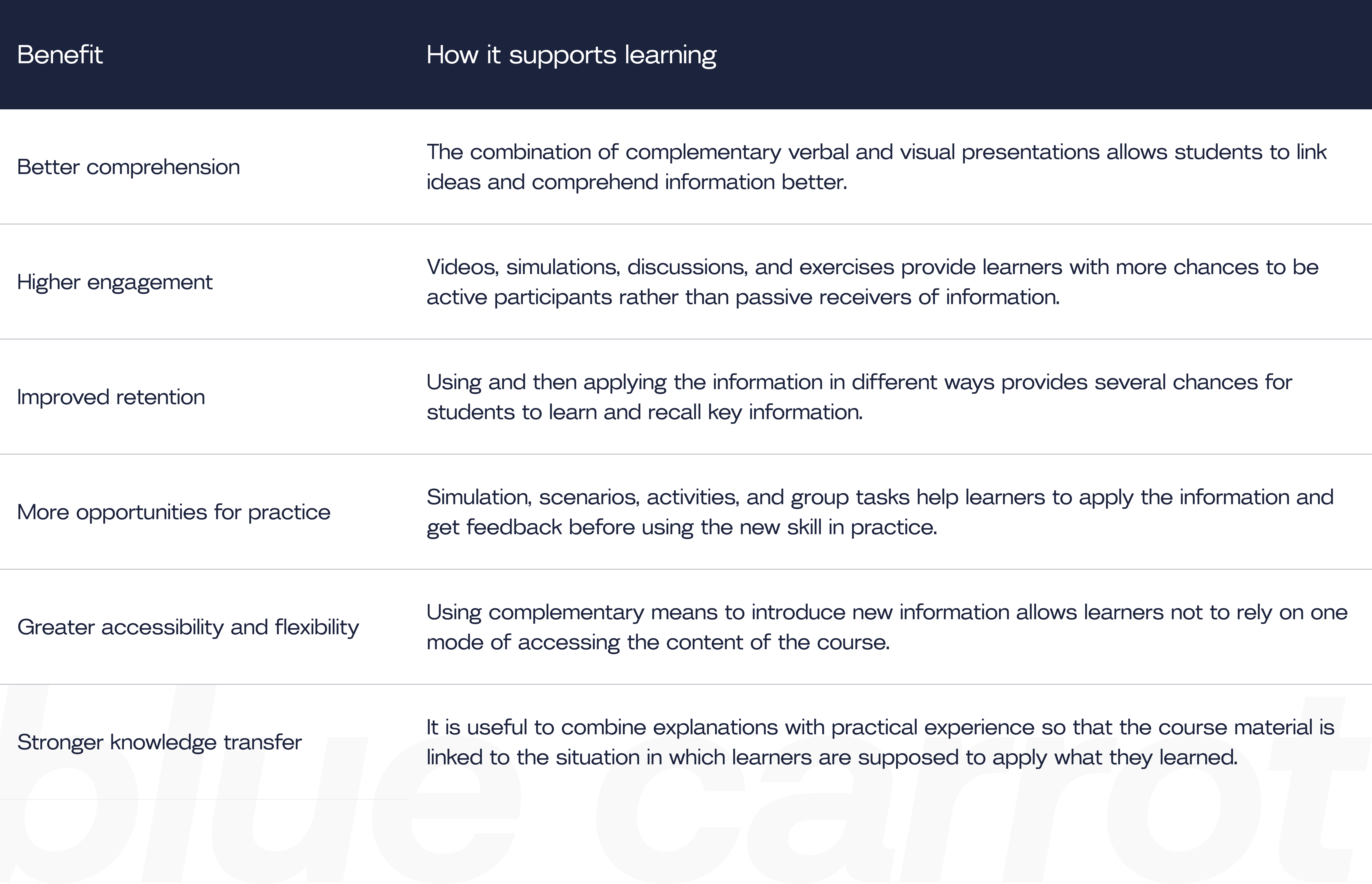
Importantly, these advantages depend on design rather than simply the number of formats included: Moreno and Mayer’s research on interactive multimodal learning environments emphasizes guided activity, feedback, reflection, and appropriate combinations of verbal and nonverbal representations as important principles for effective learning.
How to design an effective multimodal learning course
Good multimodal learning strategies begin with identifying the purpose of the lessons before choosing the modalities. This means that rather than deciding to teach something using video, animation, or simulation in a class, the instructor needs to find out what knowledge learners need to acquire before picking the appropriate mode. It is important to consider the type of audience and its specifics; for instance, what does the audience already know? What is the learning environment like? What devices can learners access?
The selected modalities should have a proper order and flow. One could start by having learners view a demonstration, engage in the process through an interactive activity, apply the lesson learned in a real-life situation, and get feedback for their decisions. Every step in this order should bring learners closer to meeting the objectives. The following are the five key steps for creating an effective multimodal course.
👉 Start with learning objectives
Learning objectives should indicate what learners are supposed to achieve before you plan for the way in which content should be delivered. If the objective is to retain key information, brief texts, diagrams, and knowledge tests could be enough. If a certain procedure should be performed, then its demonstration coupled with guided practice would be preferable. For behavioral objectives, there might be a need to include scenarios, role-play, or real-life work assignments.
Similarly, in corporate training, every medium used should be aimed at reaching the business goal. If customer support representatives need to improve their skills at handling tricky conversations with clients, viewing a video on basic communication techniques will not suffice. Learners will also need to analyze dialogues, make choices in a realistic scenario, and practice communication skills. Planning according to the objective helps avoid situations when learning teams just choose media based on how appealing it is.
👉 Match modalities to content
Depending on the type of content involved, certain presentation and practice formats may prove to be more effective than others. For instance, a complicated workflow could be more effectively represented by a diagram or an animation while software training could be best served with a demonstration followed by practice tasks. Decision-making and communication skills may require the learner to operate within a realistic scenario where they get to decide how to react.
This is another aspect where simulations become especially useful. Instead of explaining a difficult process solely through a textual description or a video, simulations allow learners to go through the whole process themselves and see what results follow from each decision they make. The idea is not to use as many presentation formats as possible, but to pick the one that would communicate each part of the content in the most efficient manner.

👉 Balance variety with simplicity
More modalities do not necessarily mean more effective learning. It does not make any sense to introduce narration into the text that users can easily read on their own, include decorations and animations for no reason, or create additional interaction options when the learner needs to make no decision at all. Sometimes, superfluous data can become distracting and even add to the cognitive load of users.
The most important thing is to find particular purposes for each modality in multimodal design. Diagrams should be used for the sake of explaining relationships, narration can help to direct learners’ attention to particular details, and exercises allow learners to apply and practice acquired skills. If both components have exactly the same purpose, then one of them is redundant. This way, we will also avoid complicating courses and making them more complicated to produce.
👉 Build opportunities for practice
Learning should not be confined only to the presentation of material. An opportunity for students to extract, interpret, and use the material they received throughout the lesson is essential for a successful learning process. Such activities may vary in complexity from simple knowledge checks and decision-making to more complex ones like branching scenarios, guided exercises, role-play, and practical tasks in the real working environment.
At that, practice must reflect situations in which learners are expected to use the acquired knowledge. For instance, the practice of a sales technique for employees can begin with reviewing a sample dialogue and replying to a virtual customer, followed by practicing with a coworker. Gamification features like challenges, progress, and feedback may be used in more sophisticated lessons, provided they help reach the goal of the lesson rather than divert from it. Thus, switching between the explanation and practice allows students to reveal and fill gaps in their knowledge.
👉 Measure and optimize
The process of course development must go beyond the actual use of the course. Data on assessment results, course completion trends, interactions, user feedback, and performance at work may help identify what works in the learning experience and what areas create problems for learners. Consistently wrong answers after a certain module might mean that the explanation and/or practice within the module requires modification.
In addition, such data can be helpful when developing personalized learning programs, as organizations will be able to offer various materials depending on the progress of learners. Advanced systems may incorporate the principle of adaptive learning, making changes automatically based on the performance of the learners. Nonetheless, optimization has to be linked to the goals originally set up: more actions on the website, more time spent on one module, and higher course completion rates do not mean improved learning; teams have to focus on the proof of acquisition of knowledge/skills by learners and application of their knowledge/skills in the relevant context.
Multimodal learning examples in practice
Below are multimodal learning examples that demonstrate how an organization can combine different types of formats aiming at developing certain skills instead of applying the same content mix for all needs.
- Employee onboarding. New employees can start with microlearning activities explaining the business and its processes, then proceed to interactive modules and knowledge checks, followed by sharing what they’ve learned with their manager. Such a combination provides needed information and connects formal training and actual employment.
- Compliance training. In order to avoid long text-based modules that present policies, organizations can use animations explaining basic principles, realistic scenarios showing potential violations of them, and then assess the understanding of these issues. At the same time, downloadable materials can be used as a quick reference by the employees facing similar issues.
- Software training. To familiarize learners with software, a product demonstration can be combined with guided activities to complete main processes. At the same time, additional materials can be provided after that, and hands-on exercises can help to practice the most common tasks in realistic environments. Such a format is especially useful when employees need to master procedural skills, but not memorize features of the software.
- Leadership development. This is one of the clearest examples of blended e-learning experience examples. Self-paced learning materials can be combined with instructor-led workshops, discussions among peers, coaching, and practical assignments in the workplace. This way, a blended e-learning experience is formed, where participants will be able to get necessary conceptual knowledge and then practice behaviors like providing feedback or conflict resolution in realistic conditions.
- Custom learning programs. Blue Carrot combines different formats, such as animation, video, Articulate Storyline modules, assessments, and instructor-led elements based on the project’s needs. Such blended e-learning solutions can help to connect independent study and practical implementation, and scale training across multiple teams. Blue Carrot has implemented different types of projects, from educational videos to upskilling programs consisting of over 140 hours of content in eight languages.
All these instances reveal that there is no one-size-fits-all modality combination in all types of training programs. The choice of modalities depends on what should be learned and practiced, and what skills the learners should acquire in the end.
Common multimodal learning design mistakes
It is easy to discuss and learn all the main principles of a multimodal learning style, but when it comes to designing the materials, even the most experienced professionals can make one or several of the following mistakes.
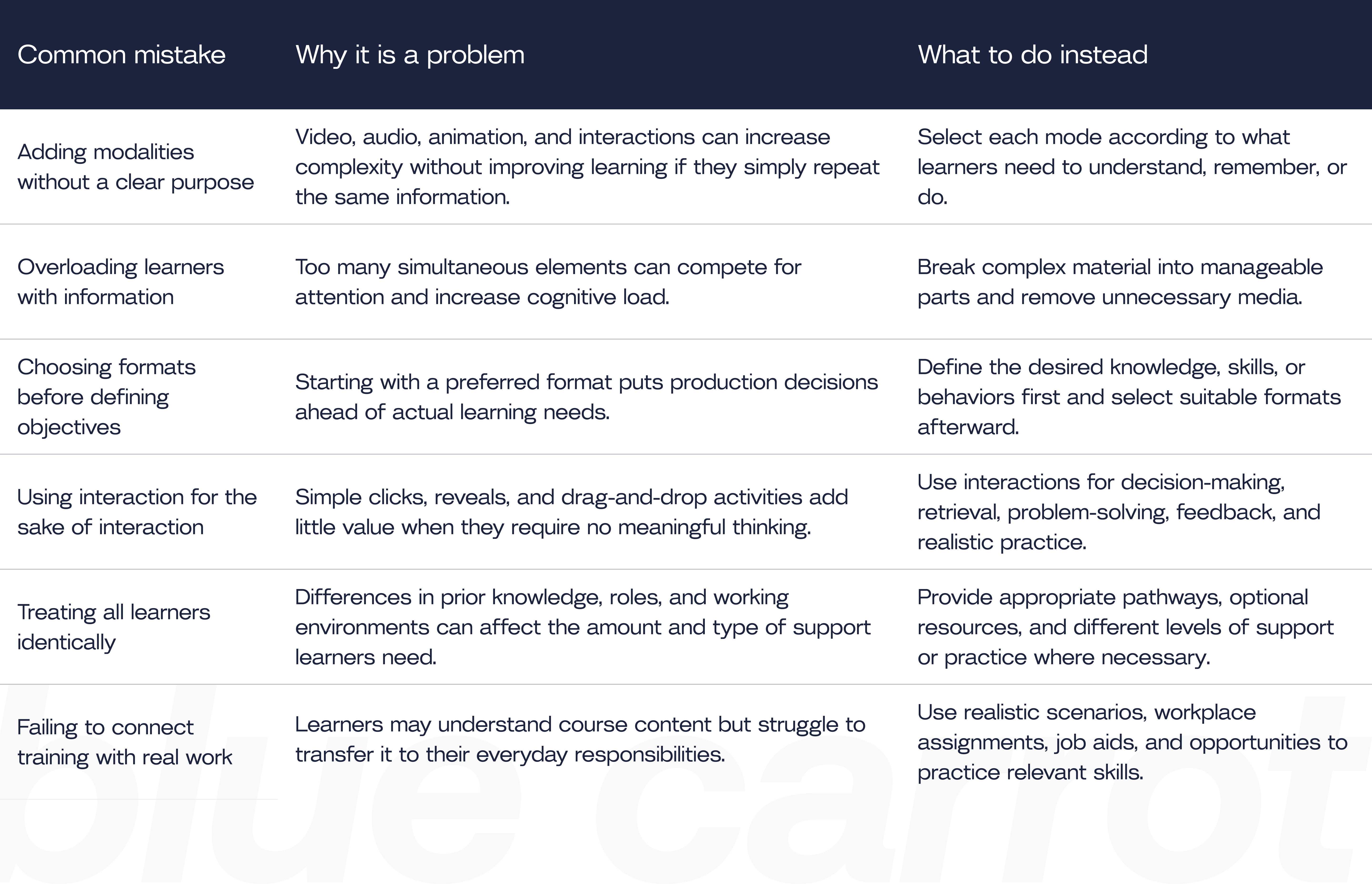
These design mistakes happen not because of the lack of expertise, but because such a complex structure as an online course should be carefully reviewed and analyzed many times, preferably by different professionals, before launch. This way, its effectiveness will be maximized and potential weak points detected before launch.
Conclusion
Multimodal e-learning does not mean cramming in as many modalities as you can. It becomes powerful when the selected modalities aid the achievement of particular objectives, offer chances to apply new knowledge, and allow the learner to practice the information learned.
Being an e-learning production company, Blue Carrot is able to offer the whole cycle of services from developing learning strategies and designing courses to creating videos, animations, interactions, localization, and distribution. Our e-learning content development services include all these elements in one comprehensive learning experience designed around the target audience and your business objectives. Get in touch with us to see how we can create the perfect learning experience for you.