
Clinical teaching occurs within the setting of treatment processes, unlike traditional classroom instruction. Clinical teaching often takes place in real time as clinicians balance patient care with limited time, competing responsibilities, and patient comfort. Most clinicians come to clinical teaching highly knowledgeable in their field, but without proper training in this aspect. Nevertheless, there is much more to it than ad hoc decisions.
Luckily, there is no lack of scientific literature and experience covering systematic approaches to uncovering clinical judgment, coaching procedures, demonstrating professionalism, and delivering feedback. This blog reviews well-known and emerging teaching methods in medical education. Each method will be described and explained, along with when to use it, evidence of efficacy, and drawbacks.
Summary
- Key takeaways
- What are clinical teaching methods?
- The foundations of effective clinical teaching
- Clinical teaching methods for developing clinical reasoning
- Clinical teaching methods for procedural and technical skills
- Methods for teaching communication, teamwork, and professional practice
- Modern digital methods in clinical teaching
- Matching the clinical teaching method to the setting and goal
Key takeaways:
- Clinical instruction strategies depend on the learners’ competence requirements, level of expertise, clinical environment, and risk exposure.
- Practice learning activities should always be employed where there is a need to put theoretical knowledge into use, execute certain actions, communicate with patients, or engage in clinical reasoning processes.
- Immediate and constructive feedback during the learning practice will give learners insights into areas requiring improvement and how to address them during subsequent attempts.
- Digital learning may supplement traditional clinical training with virtual case studies, video examples, and spaced repetition. Blue Carrot is capable of integrating multiple learning formats and designing scenarios around them.
What are clinical teaching methods?
By mentioning clinical teaching methods, we refer to straightforward approaches aimed at helping healthcare learners utilize theoretical knowledge when dealing with actual patients or during simulations. Learners develop their analytical thinking related to patient issues, physical examination, interaction with patients, decision-making, and practical interventions this way. This is what makes it different from the standard lecture-based approach.
The foundations of effective clinical teaching
The strategic decision does not come before considering the learning process itself. Learners’ objectives, prior experience, patients’ requirements, and potential risks shape the approaches and level of delegation. This is how clinical teaching operates according to the evidence-based research framework.
|
Foundation |
What it means in practice |
Application to a clinical case |
|
Clear learning outcomes |
Describe what skills learners must have at the end of the encounter. |
Have a learner come up with a most probable diagnosis and back it up with data obtained. |
|
Appropriate challenge |
Tailor your instructions according to learners’ skill levels. |
Provide trainees with straightforward tasks of data collection, whereas give more complex problems requiring analysis and evaluation of possible solutions to more experienced residents. |
|
Active participation |
Ensure that the learners actually analyze information or execute the planned action rather than just observe events. |
Learners have to choose between diagnostic alternatives or move to the next clinical step. |
|
Psychological safety |
Let learners feel comfortable asking questions and doubting without fear, except when this compromises patient safety. |
Ask students questions and analyze their errors as a part of the educational process only. |
|
Patient consent and comfort |
Clearly explain the nature of the training and get informed consent. Respect the patients’ right to refuse participation. |
Set clear expectations regarding the learner’s responsibilities at each stage before starting the examination. |
|
Aligned observation |
Assess knowledge, skills, or behavior you want to teach with the training activity. |
Observe and assess the examination from beginning to the end, not just review afterward. |
|
Progressive supervision |
Give learners growing independence once they prove competent enough, but never neglect supervision entirely. |
Transition gradually from observing the learner to supervising their actions and letting them work independently. |
The foundations described above provide a clear criterion for assessing the quality of any clinical training experience. Namely, it must ensure the learner has an observable chance to demonstrate the action safely. The convenience and familiarity of the approach alone do not mean anything without evidence of competency formation.
Clinical teaching methods for developing clinical reasoning
A learner might get a complete medical history yet have difficulties interpreting and drawing conclusions from their findings. The techniques below are aimed at reviewing and optimizing how learners interpret information, prioritize, and decide on what clinical action is to be taken next.
📌 The One-Minute Preceptor
The One-Minute Preceptor (OMP) refers to an instructional strategy involving five questioning approaches aimed at having a case discussion after a learner presents a clinical case.
- Commitment: Ask about the learner’s impressions.
- Probing: Find out what supports their conclusions.
- Principle: Provide a broader principle behind the issue.
- Reinforcement: Praise good thinking strategies demonstrated.
- Correction: Clarify mistakes made by the learner.
This framework is often used in preceptor development for outpatient appointments, ward rounds, and similar training contexts. Despite its name, OMP doesn’t imply that each discussion takes precisely one minute. Studies have found evidence that applying the OMP might improve the quality of feedback and the structure of instruction. Nevertheless, no robust evidence confirms positive impacts on clinical skills in the long term yet (Elizabeth Gatewood, Jennie C. De Gagne. The one-minute preceptor model: A systematic review. Pubmed.Ncbi.Nlm.Nih.Gov. 2019).
📌 SNAPPS
SNAPPS does not impose a format on how educators respond; instead, it helps structure the student’s presentation around their own case. It fits well when learners already possess sufficient background information to evaluate potential explanations and recognize gaps in their knowledge.
|
Step |
Learner action |
|
Summarize |
Present the relevant history and findings. |
|
Narrow |
Select the most likely possibilities. |
|
Analyze |
Compare evidence for and against them. |
|
Probe |
Ask about uncertainties or alternatives. |
|
Plan |
Suggest investigation or management. |
|
Select |
Choose an issue for further study. |
When compared to OMP, SNAPPS allows learners greater autonomy during discussions. According to a randomized controlled study comparing both approaches, SNAPPS elicited more questions from the learners, acknowledged more uncertainty, and promoted learner-led discussions. However, the duration of the session did not increase. It should be noted, though, that this research relied upon written scenarios under controlled conditions (Fagundes EDT, et al. Case presentation methods: a randomized controlled trial of the one-minute preceptor versus SNAPPS in a controlled setting. Perspect Med Educ. 2020).
📌 Bedside teaching and patient-centered rounds
This pedagogical strategy refers to integrating the actual patient experience through a combination of examination, diagnosis, communication, and professional behavior.
Scenario. A patient comes in complaining of shortness of breath. The trainee conducts an assessment involving interviewing and examination of the affected body systems and discussing changes in the differential diagnosis based on the obtained evidence.
First of all, prior to starting the interaction, the learner gets the necessary permission, and clarifies roles and objectives. Then, during the interaction, they communicate in understandable terms and accommodate patient preferences regarding active engagement. Finally, debriefing involves private discussions on sensitive matters and giving corrective feedback to the learner.
Positive outcomes of bedside teaching for certain diagnostic competencies, as well as its mutual appreciation among learners, educators, and patients are widely highlighted and discussed. At the same time, this strategy does not necessarily surpass classroom teaching since its efficacy strongly depends on the degree of preparation, patient participation, and educator performance (Burgess A, van Diggele C, Roberts C, Mellis C. Key tips for teaching in the clinical setting. BMC Med Educ. 2020).

📌 Case-based questioning and think-aloud modeling
Case-based learning is a type of educational approach where patient problems become the basis for structured investigations. This teaching method differs from problem-based learning (PBL) since case-based learning tends to have more limited goals. The instructor can control the conversation process better and lead students effectively.
Clinical Scenario. The patient reports fever, hypotension, and impaired consciousness.
Instructor: “Which aspects must you address immediately?”
Student: “Hypotension and altered mental status.”
Instructor: “What diseases might cause those symptoms? Which one seems to be the most probable?”
Instructor: “Would your conclusion differ if the patient was taking new medications?”
Having heard the answer, the educator thinks out loud and demonstrates their reasoning process, showing how the expert approaches interpreting data and making conclusions. The questions should target interpretation skills and reasoning abilities instead of memorization. It is acknowledged that case-based learning helps link theory and practice. Still, there are mainly self-reports on knowledge acquisition rather than real performance measurements (McLean SF. Case-based learning and its application in medical and health-care fields: A review of worldwide literature. J Med Educ Curric Dev. 2016).
Clinical teaching methods for procedural and technical skills
Aspects such as combining knowledge, making decisions, performing bodily movements, error detection, and requesting assistance are included in procedural competency. The types of clinical teaching methods used for procedural training should break medical processes into observable steps and allow learners to practice until they reach the required standard. Once learners demonstrate competence, the educator can gradually increase their autonomy.
👉 Peyton’s four-step approach
Peyton’s technique breaks down procedural teaching into four steps:

In the first stage, instructors demonstrate the procedure without pauses. Then, they repeat it gradually, describing every action performed during the process. During the third stage, learners verbalize each step while the educator guides them through it. Lastly, trainees perform and describe every move of the procedure on their own in the final phase.
This approach is especially effective for procedures involving physical manipulation, including suturing, catheterization, examinations, and surgery-related procedures. However, it is not enough simply to complete the exercise successfully to start performing independently in the clinical environment. It should be used only as part of a bigger teaching process.
👉 Deliberate practice and mastery learning
Deliberate practice focuses on addressing weaknesses via repetition and feedback, while mastery learning implies that each trainee must achieve certain performance benchmarks despite having different amounts of practice.
Clinical example: a medical resident practices their airway management technique repeatedly following feedback regarding insufficient mask seal during the procedure until meeting the predetermined standards.
Such approaches work well for teaching resuscitation techniques, physical examination skills, and other procedures that have observable criteria. However, these approaches are effective only when educators use direct observation to identify specific errors and require learners to act on the feedback.
👉 Simulation-based teaching
Simulation-based learning in medical education involves imitating the unsafe, uncommon, and tricky clinical cases within a simulated environment instead of practicing them directly in patient care settings. It is important that simulations always align with educational aims:
- Task trainers should be used for practicing individual procedures.
- Manikins can serve for assessment and treatment decisions.
- Immersive scenarios are good for reasoning and prioritization.
- Team simulations boost communication, coordination, and leadership, and are commonly used in patient safety training for nurses.
As our experience showed, a good-quality simulation includes three components: clearly defined goals, effective simulation practice itself, and comprehensive feedback afterward. Simulation conditions should reflect clinical practice only to the extent required by the learning objectives, while performance should be assessed against clear, observable criteria.
Methods for teaching communication, teamwork, and professional practice
Professional communication skills can only be developed through experience, teamwork, observation, and reflection. As such, methods of clinical teaching need to expose students to actual interaction scenarios, during which communication techniques could be practiced, collaboration carried out, and professionalism analyzed.

📌 Role-play and standardized patients
Role-plays and simulations help trainees practice communication skills prior to applying them in clinical settings involving actual patients. Such activities may include:
- History taking and counseling;
- Informed consents;
- Handovers;
- Error disclosures;
- Emotionally challenging dialogues.
Peer simulation is easier to implement since participants can perform it repeatedly while playing various roles. At the same time, standardized patient (SP) role-play offers increased reliability due to professional performers who replicate cases consistently and act like true patients.
As a result, either of these types can prove useful, depending on training goals. If repetition is crucial, simulation exercises will suit better, whereas SP sessions would work better if patient viewpoint matters. In addition, both formats require formative assessment focused on participants’ specific communication behaviors rather than their overall performance.
📌 Interprofessional and team-based scenarios
Team-based scenarios imply that multiple learners representing various professions collaborate on managing a certain clinical event. They must assume distinct roles with assigned pieces of information and responsibilities to accomplish the goal successfully.
Clinical scenario: an unstable condition of the patient demands that nurses identify it first and report it to physicians. The latter must bring another health care professional into play and make joint decisions concerning further actions. The whole activity aims to assess how effectively team members share information, distribute responsibility among each other, and escalate events according to established criteria.
Such kind of practice improves role clarification, leadership, escalation, communication, and shared decision-making. Ideally, such activity should focus precisely on cooperation since, in realistic conditions, physicians are to cooperate with each other to accomplish the clinical goal.
📌 Role modeling and guided reflection
Students learn professional behavior through the example set by experienced practitioners during their interactions. Nevertheless, such examples become valuable only when supplemented with explanations provided by educators.

Educators could clarify why they addressed patients’ complaints prior to presenting a treatment plan, how disagreements between colleagues should be resolved, and why certain cases have been referred upwards. Learners then reflect on the discussed interaction and determine how they are going to act when faced with a similar scenario.
Such discussion plays an essential role whenever there are discrepancies between observed practice and formally taught approaches. It helps students see beyond the surface of the hidden curriculum and critically evaluate observed behaviors.
Modern digital methods in clinical teaching
While discussing clinical teaching methods in detail, we still haven’t answered the question: what are the benefits of e-learning for healthcare? In fact, it can be taken further through digital approaches that allow trainees repeated exposure to particular cases and demonstrations. Blue Carrot’s instructional design services include scenario development and the creation of engaging courses aligned with each client’s educational objectives.
👉 Virtual patients and branching clinical cases
Virtual patients allow learners to evaluate their decision-making skills regarding certain situations without risking actual patients. They come especially handy while teaching clinical judgment, prioritization, and effective interaction with patients during rare or complicated cases.
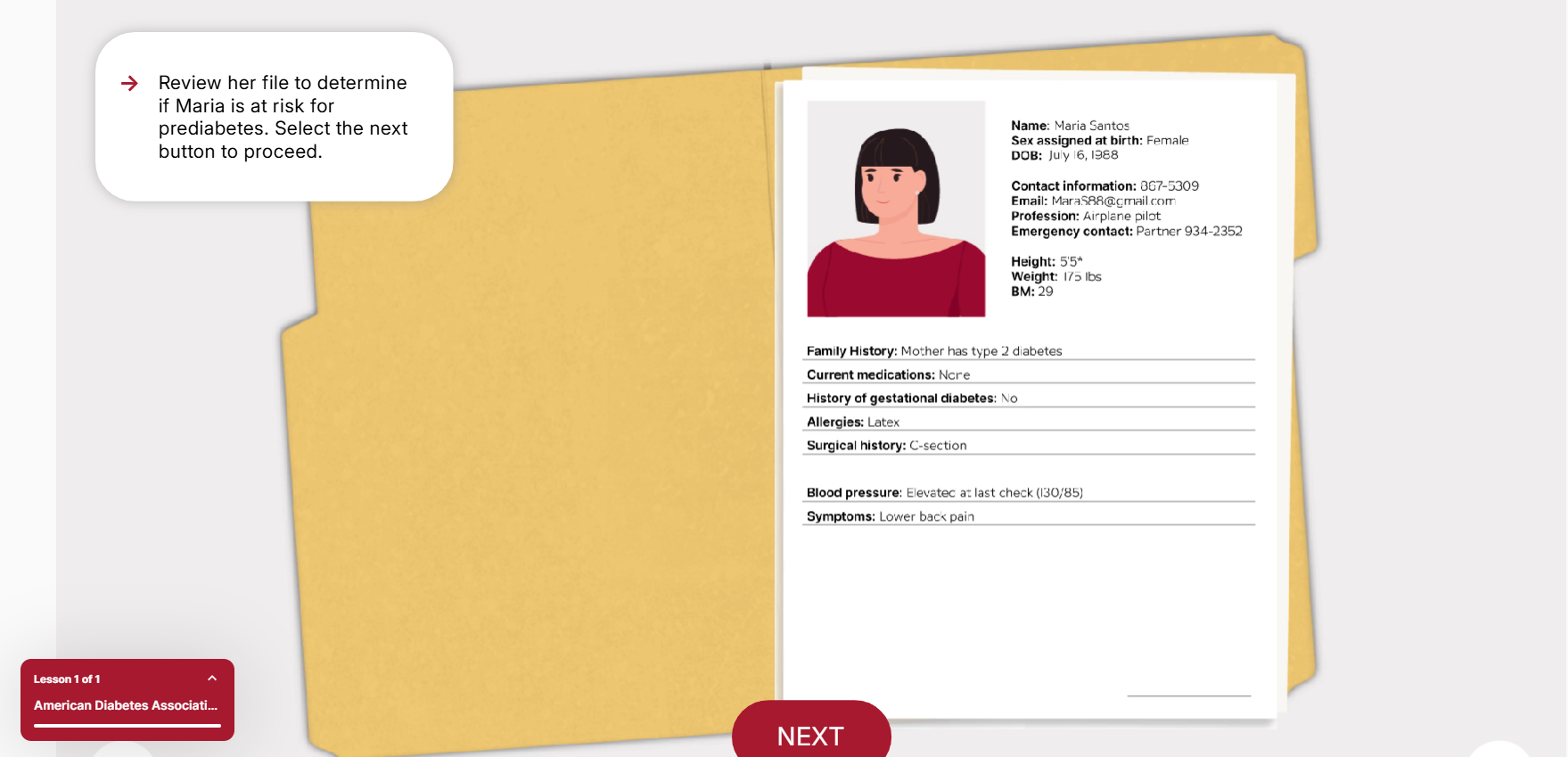
At Blue Carrot, we design branching scenarios where learners’ choices determine how the situation unfolds. Working on the course for the American Diabetes Association, for instance, we developed such scenarios based on real patient cases to make it more interactive and engaging, while staying on purpose. This way, we allow learners to review difficult decisions, work on the outcomes, and practice the same scenarios from different perspectives.
👉 Video-supported demonstration
Video-based learning in medical education can provide learners with a constant visual reference before practicing any clinical procedures supervised by instructors. Clinical learning videos can include:
- Steps segmentation;
- Detailed shots focusing on essential steps;
- Visual cues;
- Voiceover provided by experts;
- Repetition of tricky segments.
Blue Carrot uses instructional design, self-created medical content, animation, and videos to break down complicated procedures into understandable parts. As part of our project for an American medical center, we created training videos for a 70-hour blended medical training course. This provided learners with a consistent visual reference before applying the procedures in instructor-led and clinical workplace practice.
👉 Spaced digital reinforcement
Learning activities in digital form can be used to reinforce clinical knowledge acquired during training sessions between patient interactions. It could involve going over the previous material, answering questions based on the previous knowledge, or practicing application of a certain concept within several days after its first introduction.

Blue Carrot allows embedding digital reinforcement activities in broader clinical learning pathways via engaging interactive modules and scenarios along with customized graphic elements. This makes it possible to continue reinforcement outside separate course boundaries, ensuring alignment with initial learning outcomes.
However, although spaced reinforcement activities improve long-term retention and application, practical competence can only be demonstrated under direct supervision.
Matching the clinical teaching method to the setting and goal
Clinical education methods work best when several approaches are combined, depending on the environment and the desired learner performance level.
- Outpatient clinics: observation, questioning, supervision of consultation sessions, and brief feedback.
- Bedside teaching: demonstration, supervised examination, discussion, and reflection.
- Operating rooms: preparation prior to surgery, observation, incremental participation, and timely feedback.
- Simulation labs: scenario-based learning, deliberate practice, team exercises, and debriefing.
- Online education: virtual scenarios, video-based coaching, and spaced repetition between clinical settings.
Selection criteria include learners’ experience, patients’ vulnerability, time limitations, and availability of supervision. The educator should progressively increase participants’ involvement from observation to active engagement, depending on their competence level.