Medical device training carries a different weight than typical corporate training does. It has to comply with regulatory requirements, provide compliant messaging to sales teams, and train clinicians on how to use devices correctly. In some cases, it guides patients to perform procedures on their own. Generic e-learning templates were not designed for this combination of requirements.
The regulations and standards that apply to a medical device can affect every stage of the training production. The question that L&D leaders and teams ask is not only what the finished course looks like but also how to ship approved, accurate training without slowing the business or creating a safety risk.
At Blue Carrot, we produce custom e-learning for organizations that need precise medical device learning programs. This article breaks down how medical device e-learning creation works in practice, from defining the audience and regulatory requirements to choosing content formats and managing production. 🤓
Summary
- What medical device e-learning covers
- Who needs medical device e-learning
- Regulatory and quality requirements that shape the design
- Content types that work best for medical device e-learning
- The medical device e-learning creation process
- How long and how much medical device e-learning creation takes
- Choosing an internal team vs. a custom e-learning partner
- Conclusion
What medical device e-learning covers
Medical device e-learning instructs audiences how to use, assist, and communicate about medical devices. It is not the same as general e-learning for healthcare or Continuing Medical Education (CME), which supports the ongoing professional development of licensed healthcare professionals. Because it focuses on a specific device or use case, the content must match the approved labeling and Instructions for Use (IFU) for that device and market.
E-learning for medical devices covers product orientation, sales enablement instruction, clinician training, technician setup and troubleshooting courses, patient education, and software workflow walkthroughs. One device may need several training modules to address diverse user roles and learning objectives.
Importantly, errors in device use can harm patient safety and regulatory compliance. So, training must be accurate, current, and relevant to the learner’s responsibilities, not simply copied or adapted from a product manual.

Who needs medical device e-learning
The main learner groups in medical device courses are:
- Sales and business teams;
- Clinicians and procedural users;
- Technicians or operational staff; and
- Patients or caregivers.
They may need information about the same device but in a different vocabulary, depth, tasks, and level of understanding. Mixing these learner groups into one course is a common early mistake.
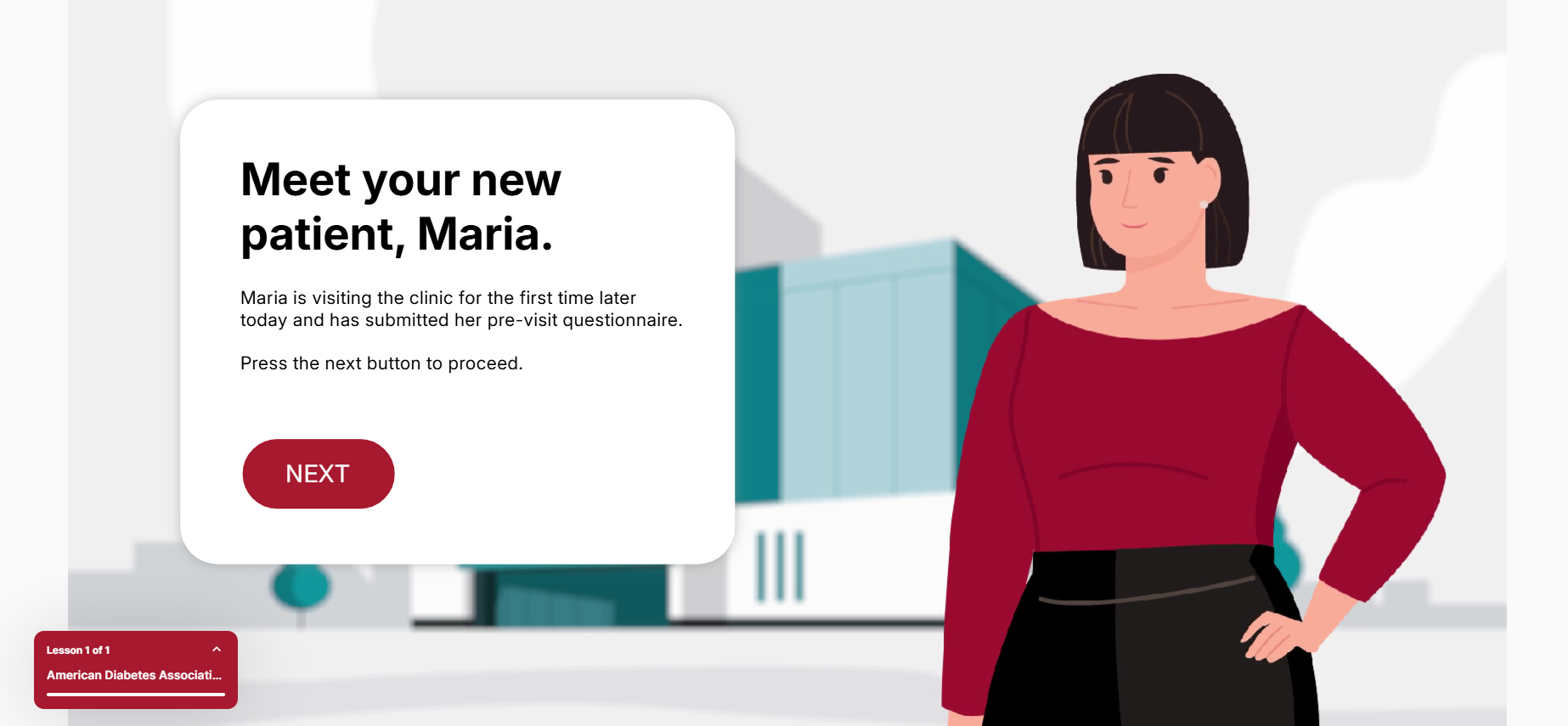
Defining each audience means knowing what each learner must know, do, or decide. That answer guides terminology, depth, examples, assessments, approval path, delivery requirements, and maintenance needs. Development teams can create a shared information module that everyone should know, then build specific modules for different roles.
|
Learner role |
What they may need to know, do, or decide |
Typical training focus |
|
Sales and commercial teams |
Explain the device accurately, understand what it is designed for, and how the team is using it. Sales may need to know how to properly communicate about it and what is not allowed to be disclosed. |
Product orientation, sales enablement training, scenario-based objection handling |
|
Clinicians and procedural users |
Understand device operation and how to apply procedures, warnings, and guidelines to use the device safely and correctly in a clinical setting. |
Device workflows, scenario-based practice |
|
Technicians or operational users |
How to properly set up, configure, maintain, or troubleshoot the device. Training must correspond to the updated device and software version. |
Technician setup and troubleshooting courses, software workflow walkthroughs |
|
Patients, caregivers, or home users |
Know how to perform tasks with the device at home as instructed. |
Patient education modules, plain language instructions, task walkthroughs, troubleshooting guidance |
Regulatory and quality requirements that shape the design
The requirements for a device depend on its class, intended user, market, and the manufacturer’s quality system. They can shape how the training is designed, reviewed, produced, and updated. A surgical robotic system and a home-use glucose monitor therefore require different design and production approaches.
This section explains the regulations, standards, and requirements that affect medical device e-learning creation and what each means for L&D teams.
Disclaimer: This article provides planning guidance, not legal, clinical, regulatory, or usability-engineering advice. Applicable requirements remain dependent on the device, market, role, intended use, and company quality system.
📌 FDA 21 CFR part 820 and the quality management system regulation (QMSR)
FDA 21 CFR Part 820 is the regulation for the QMSR used by manufacturers of finished medical devices intended for commercial distribution in the United States (PART 820—QUALITY MANAGEMENT SYSTEM REGULATION. Federal Register : Request Access. 2026).
Its purpose is to ensure that medical devices are consistently designed, manufactured, tested, packaged, labeled, stored, and serviced in a way that meets applicable requirements and specifications.
Build traceability and review structure 🤩
Before scripting begins, confirm which approved source materials and procedures govern the course. Identify regulatory, quality, clinical, and technical review teams at this stage because their involvement determines the content and the approval path.
During course development, record content versions, review decisions, approvals, and release information according to the relevant manufacturer’s procedures. After launching, training records (completion data, assessment scores, and course version history) may also be part of that documentation structure, depending on the manufacturer’s procedures. They connect individual learner performance to the current content version.
📌 EU MDR (medical device regulation) 2017/745
EU MDR 2017/745 establishes rules for placing, making available, and putting medical devices into service on the European Union market. It introduces enhanced procedures for conformity assessment and post-market surveillance aimed at improving patient safety. Under Article 83, manufacturers are required to implement and maintain a post-market surveillance system, subject to the regulation’s scope and applicable interpretation (Regulation – 2017/745 – EN – Medical Device Regulation – EUR-Lex. European Union Flag.2017).
Keep training aligned with regulatory changes 🤓
For L&D teams, EU MDR raises the importance of keeping course content consistent with post-market surveillance findings, updated labeling, and approved device documentation. This also makes it important to have a clear process for triggering training review when post-market information or controlled documentation changes. In practice, each course version should be traceable to its approved source and release version.
📌 IEC 62366-1 and usability engineering
IEC 62366-1:2015+A1:2020 specifies a manufacturer process for analyzing, specifying, developing, and evaluating medical device usability as it relates to safety (IEC 62366-1 Consolidated version. International Electrotechnical Commission. 2026). This process enables the manufacturer to assess and mitigate risks associated with correct use and foreseeable use errors.
Use usability engineering data to prioritize instructional design 🧐
For instructional designers, usability engineering data is a valuable input. The critical tasks, foreseeable use errors, and user interactions inform which content areas need the most attention and which formats are most appropriate. They clarify actions or decisions that could compromise safety.

📌 Instructions for use (IFU) and medical device labeling
An IFU is part of the information supplied with or accompanying a device when applicable. It communicates the device’s intended use, operation, warnings, precautions, and other applicable labeling requirements.
Anchor every content decision to the approved IFU version ✨
Map scripts, storyboards, visuals, warnings, and assessments to the relevant approved source materials, and record which IFU or labeling version was used during development and review. When simplifying content for learners, avoid introducing unsupported indications, steps, claims, or device behavior that are not present in the approved materials.
Content types that work best for medical device e-learning
The production format follows the learning objective. Some objectives require real-world procedural practice, while others require spatial understanding of an internal mechanism.
👉 3D animation shows hidden mechanisms and spatial relationships
3D animation is suited to internal device views, anatomy, invisible mechanisms, spatial relationships, and sequences that live filming cannot capture clearly. It explains to learners how a device works (not just what steps to follow).
For a joint replacement system, for example, 3D animation can walk a surgical team through implant sizing, fit, and fixation with anatomical precision.
👉 Photorealistic simulation recreates realistic procedures
Photorealistic simulation facilitates realistic practice when the learning task depends on environment, procedural sequence, and decision-making under real-world conditions. It closes the gap between watching a procedure and performing one.
Clinicians can use simulation to walk through procedures before live cases. Sales enablement teams use it to build product familiarity, understanding how the device handles or what the workflow looks like from the clinician’s perspective.
👉 Screen recording explains device software
As more medical devices incorporate software, such as configuration apps and connected surgical systems, screen recording proves useful in demonstrating device interfaces, configuration steps, and dashboards.
Plus, it is a cost-efficient format for training that updates frequently. When the software interface changes, screen recordings can be updated without revisiting the entire course.
👉 Scenario-based training lets learners practice decisions
Scenario-based training is useful when learners must choose an action, respond to a case, interpret feedback, or demonstrate judgment. For example, sales teams practice objection handling, clinicians work through contraindications and device selection criteria, and technicians make decisions when troubleshooting. The format shifts the learner from passive reception to active decision-making.

E‑learning course development – ADA
View demoThe medical device e-learning creation process
Like any online course creation, e-learning for medical devices progresses from knowing your audience to planning the content and building the course. What’s different is that each step is built with traceability of the source material and regulatory review in mind.
- Define audience, use case, and learning objectives. This step drives every subsequent decision (vocabulary, depth, format, assessment, review path, and delivery).
- Assemble subject matter experts (SMEs) and reviewers. Confirm review ownership across device, clinical, regulatory, QMS, instructional design, technical, and business stakeholders.
- Audit source materials and establish traceability. Map the working source set: IFU, approved claims, device specifications, software versions, procedures, and warnings. Every script claim should trace to an approved source.
- Design the learning architecture. Identify the shared and role-based modules, assessments, reference resources, maintenance ownership, and any separate patient-facing experience. An instructional design storyboard at this stage catches structural problems early.
- Write the script and storyboard. Specify narration, visuals, interactions, warnings, on-screen text, captions, accessibility needs, source references, and review gates before full production begins.
- Select media and begin production. Match the delivery formats or a combination to the learning objectives and the sourced content.
- Build and conduct review. Separate instructional, technical, clinical, regulatory, QMS, and language reviews where appropriate. Ensure to plan for a couple of regulatory review passes as a baseline assumption.
- Localize and test. Cover translation, text expansion, approved terminology, voiceover, captions, visual timing, accessibility checks, browser behavior, and functional interactions.
- Package and deliver. Verify SCORM packaging, LMS behavior, completion tracking, assessment reporting, release version, and handoff documentation.
- Maintain the course. Define update triggers, ownership, archive rules, review history, and communication protocols for changes to the device, software, IFU, or procedure.
How long and how much medical device e-learning creation takes
Cost and timeline vary by production format, content complexity, number of review cycles, and language count. You may use the estimated timeline and costs below as a baseline, and contact us for an exact quote and project timeline.
📌 A six-week production timeline
Plan six weeks as a rough starting point for typical educational video production services.
- Weeks 1–2: Scoping and source alignment. Define each audience, use case, and learning objective; confirm the SME and review team; and complete the source-material audit and learning architecture.
- Weeks 3–4: Script, storyboard, and production. Develop and review the script and storyboard, then move into media production alongside regulatory and clinical review.
- Weeks 5–6: Review, localization, and release. Complete the build review, conduct QA, and verify LMS packaging and release documentation before handoff.

📌 Cost drivers and estimated price ranges
Drawing on our own experience, the primary e-learning cost drivers are:
- Production format is the largest variable in corporate training rates. 3D animation and photorealistic simulation cost more per minute than screen recording or videos because they require modeling, rendering, and expert review.
- The number of languages compounds the total expense. E-learning localization costs can increase overall development costs by 30–70 percent.
- Review cycles add time and SME coordination costs for regulatory or clinical review. Late-stage script changes that require re-recording voiceover or re-rendering animation multiply costs quickly.
Below are estimated price ranges by content type based on Blue Carrot’s e-learning content development services.
Custom e-learning development usually costs between $10,000 and $20,000 per learning hour. The price is based on elements such as learning level, complexity, interactivity, and production needs.
A basic module with text, visuals, and simple knowledge checks will cost less. Courses with custom interactions, scenarios, branching, simulations, or richer media will be more expensive.
For medical device training, the final price can also be affected by how complex the source materials are, the SME and review process, localization needs, and any specialized media like 3D animation or photorealistic simulation assets.
This price range covers instructional design, production, quality assurance, and review cycles.
Teams commonly underestimate cost and time when reviewing cycles, source-material revisions, and mid-production device or software changes. Localization in several languages widens the scope further. 🤓
Choosing an internal team vs. a custom e-learning partner
How you build the course usually comes down to capacity and timing. The right model depends on what your team can build and review, how complex the device is, how many languages you need, how fast you must launch, and who will own the course long term.
|
Model |
When to choose and trade-offs |
|
In-house |
An organization with a mature training function, in-house 3D and video capability, and dedicated regulatory review capacity. Trade-off: Skills, review capacity, and maintenance bandwidth may lag the content pipeline in high-volume or complex production. |
|
Custom e-learning partner |
A project needs specialized formats, multilingual production, faster launch, or bandwidth the internal team can’t cover. Trade-off: Source access, decision rights, and review ownership must be defined up front. A partner without a standard regulatory review workflow may add risks. |
|
Hybrid |
The internal team owns strategy, governance, approved source materials, and SME coordination; a partner handles specialized media, build, QA, or delivery. Trade-off: Unclear ownership of review, approval, or version control causes most delays. |
Based on our experience, the hybrid model is common for mid-size companies launching a new device or entering a new market. The internal team owns the regulatory and clinical source materials, while healthcare e-learning companies deliver the courses and take on the e-learning providers industry challenges.
Blue Carrot built a 70-hour training university for a U.S.-based medical center network. The program covered clinical procedures, complex medical equipment, and diagnostic results in various formats, including live virtual classes, web-based courses, and videos. 🧐
Conclusion
Like any effective training, medical device training creation starts with clear learning objectives, a solid understanding of audiences, and thoughtful instructional design. What sets it apart is the regulatory and quality context: content must be traceable to approved sources, reviewed by the right stakeholders, and kept current as the device or labeling changes.
The production formats require specialist capability to get the content approved and keep it current across multiple languages and markets. As a rapid e-learning development company, Blue Carrot helps organizations produce custom medical device courses in different formats. We have delivered over 500 learning projects for clients globally, including regulated training programs in the healthcare and life sciences space.
Book a call with us to discuss your medical device training project.