

Nurse onboarding can help reduce high turnover, which considerably strains healthcare systems. First-year turnover is particularly high due to transition shock and inadequate peer support. According to the recent meta-analysis, the turnover rates range from 8 to 36.6 percent globally (Hui Ren, Pan Li, Yingchun Xue, Wenhao Xin, Xin Yin, Hongyan Li. Global Prevalence of Nurse Turnover Rates: A Meta-Analysis of 21 Studies from 14 Countries. National Library of Medicine. 2024).
To improve nurse retention, healthcare organizations design onboarding training to make the transition to a new job smoother. They launch programs for new nurse orientation, onboarding, supervised practice, and ongoing professional development. Such initiatives bring tangible results. In some cases, turnover rates drop dramatically, such as at Sentara Northern Virginia Medical Center, where they went from 46 percent before practice pathway adoption to 5.1 percent after (Michele M D Lee. Improving New Graduate Nurse Retention With a Transition to Emergency Nursing Practice Program. Pubmed.Ncbi.Nlm.Nih.Gov. 2024).
This article provides best practices for developing a nurse onboarding training that works. Learn the core training components, suitable formats, including the benefits of e-learning in healthcare, and steps to launch a program.
Summary
- What nurse onboarding training actually covers
- Why structured nurse onboarding training matters
- Core components of an effective nurse onboarding training program
- Learning formats to use for nurse orientation programs and onboarding
- A step-by-step process to design a nurse onboarding program
- Revise your current nurse onboarding process (if you have one)
- Define the purpose and scope of the updated program
- Understand existing resources
- Identify competencies and set measurable learning objectives
- Design the logical flow for orientation and onboarding
- Develop learning materials
- Add assessment and feedback mechanisms
- How to measure the effectiveness of nurse onboarding training
- Common mistakes in nurse onboarding training programs
- The bottom line
What nurse onboarding training actually covers
Nurse onboarding training is a structured program that helps newly hired or transitioned nurses develop the knowledge, skills, and organizational understanding required to work effectively and safely in a specific healthcare facility. The onboarding timeline takes from three months to a year, depending on prior experience and qualifications. It may start before the nurse’s first day to verify certifications and licenses, share credentials, assign a dedicated preceptor, and provide a new nurse orientation schedule. For nurses who recently graduated, onboarding often overlaps with the start of a nurse residency program, supporting a smooth transition to independent practice.

📌 Nurse onboarding vs. nurse orientation difference
Nurse onboarding training and new nurse orientation are often used interchangeably. However, these are different stages of integrating a nurse into a healthcare facility. A hospital orientation typically lasts several days and includes organizational compliance, HR paperwork, and initial facility navigation. Onboarding can take anywhere from 90 days to a year. It covers a full transition, with competency assessment, unit-specific training, and preceptor shadowing. Thus, clinical orientation is only the first step in the long-term onboarding process.
Why structured nurse onboarding training matters
Structured nurse onboarding training helps create a program that meets specific organizational goals. It turns messy first months into a clear path for new graduate nurses and specialists changing jobs. A good onboarding program equally benefits nurses, patients, and organizations in several ways:
- Faster transition and lower burnout. For newly graduated nurses, onboarding can help fill the gap between academic education and clinical practice, allowing them to gain missing skills. This makes them feel more competent and ready for work in a highly stressful environment. For experienced nurses, structured onboarding helps with adaptation to a new setting, workflows, and the organization’s equipment. For both groups, it creates a safe environment, and nurses can feel more prepared for workdays.
- Improved nurse retention. Better preparation and support may contribute to higher retention during the transition period. Thus, healthcare organizations can meet their staffing needs and spend fewer resources on hiring new employees again.
- Consistent and standardized training. Structured nurse onboarding means everyone follows the same onboarding stages and receives similar training. This helps maintain consistent healthcare training quality across multiple departments.
- Higher efficiency and faster operations within a healthcare facility. Quality onboarding programs are carefully tested and regularly improved to meet specific organizational needs and better prepare nurses for their first shifts. Proper training helps healthcare specialists perform their work more efficiently.
- Improved patient safety and healthcare quality. Structured onboarding provides a way to teach and assess nurses’ understanding of clinical protocols, escalation procedures, and unit-specific workflows before they interact with patients.
The research confirms the positive impact of structured nurse onboarding training. Research evaluating the TIPS program for transition of novice nurses to independent practitioners showed high program satisfaction rates. The training, based on the Kirkpatrick Model, also improved self-reported confidence, skill acquisition and application, and clinical performance (Charissa Cordon, Desa Dlugosz, Lorena Lopez, Rona Gelacio, Kate Smith-Eivemark, Shannon Maier, Amir Ginzburg, Kevin Hua, Dian Williams, Terri Irwin. Supporting Novice Nurses’ Transition to Independent Practice: Evaluation of the TIPS Program Using the Kirkpatrick Model. 2025). Another systematic review evaluating transition-to-practice programs for newly graduated registered nurses showed an increase in critical thinking, competency, and retention (Isomi M Miake-Lye, Amelia E Schlak, Jessica Thies, Payten S Higgins, Mary Pat Couig. A Landscape of Evidence on RN Transition to Practice Programs. National Library of Medicine. 2025).
Core components of an effective nurse onboarding training program
Nurse onboarding training has some standard components to cover in your program. These are interconnected stages of the nurse transition pathway that help prepare new hires for their everyday duties. The core components typically include the following:
👉 Baseline assessments
These usually happen during the orientation phase to understand the current knowledge and skills of a new hire. Depending on the role, assessments may cover clinical knowledge (diseases, interventions, medication safety), psychomotor skills (wound care, ventilator management, line placement), and behavioral readiness to work as part of a team and with patients. Having such assessments early on allows medical organizations to develop a personalized training plan. A baseline check is also a useful tool to track progress throughout onboarding.
👉 Organizational and clinical orientation
These are introductory modules that share details on how an organization works, its units, policies, workflows, and expectations. They also cover patient safety, infection prevention, documentation, emergency procedures, interpersonal teamwork, communication standards, and escalation pathways. Organizational and clinical orientation is necessary to ensure consistency across the workforce and help nurses adapt to a new workplace. The modules are not purely theoretical. Nurses must be able to perform the standard procedures safely and demonstrate basic competencies.
👉 Role-specific clinical competencies
After covering the foundations, the nurse onboarding training program must develop competencies required for a specific role and care setting. You should also train nurses to use specific equipment and perform specialty-specific interventions.
👉 Supervised practice
Nurse onboarding should incorporate a strong preceptor program. Preceptors provide new nurses with the necessary support, guiding them and acting as role models. Nurses can demonstrate their practical skills under supervision and receive immediate feedback. Effective precepting prepares nurses for greater independence and allows them to learn from more experienced colleagues.
👉 Ongoing evaluation and feedback
Once nurses show the expected competencies, they can start working more independently. Ongoing evaluation and regular preceptor check-ins still happen. Drawing on each program independently, instructional designers in the medical field may choose for nurses to undergo competency reassessments, engage in peer-to-peer activities, and complete post-orientation surveys that measure training efficiency and job satisfaction, among other things.
You can find more details on the ANCC PTAP website, including the nurse onboarding checklist with the main sections of a nurse orientation program.
Learning formats to use for nurse orientation programs and onboarding
Because many activities run easily online, medical organizations often launch blended programs combining online and offline formats. E-learning courses for medical care specialists can complement offline training by providing self-paced learning and more flexible schedules. Below are the core types of activities suitable for nurse orientation programs.
Offline nurse onboarding formats:
- Instructor-led classroom training. The main benefits of instructor-led training are real-time interaction and direct feedback. It allows active student engagement and works well for narrow, complex topics.
- Simulation-based training and hands-on practice. Instructors demonstrate a specific skill like catheterization, and nurses repeat it using equipment or task trainers.
- Bedside clinical training. Preceptors or managers share the case and explain what needs to be done, guiding nurses on how to assist the real patient. It’s usually supervised practice, and more experienced colleagues can intervene if something goes wrong.
- Preceptorship and shadowing. Nurses observe preceptors to see how they work and receive structured supervision, coaching, and feedback.
- Case-based group discussions. A group of nurses receives a real or fictional patient case and discusses the nurse’s responsibilities and interventions. This helps develop clinical judgment, problem-solving, and decision-making.
Online nurse onboarding formats:
- Virtual instructor-led training. VILT is an alternative to classical instructor-led classroom training, but it happens fully online. Read more about what is virtual instructor-led training in our dedicated post.
- Video-based clinical demonstrations. Nurses watch recordings of clinical procedures to understand the steps and sequence of actions before performing them in a clinical setting. Video-based demonstrations allow learners to rewatch the same procedure multiple times and are useful for building confidence.
- Virtual simulations. Virtual simulations are suitable for training under different patient scenarios. Nurses can get immediate feedback without the pressure of clinical settings. It’s a great tool for developing technical literacy, like working with EHR records or medical equipment.
- Online quizzes and knowledge checks. Online testing is a convenient way to check theoretical knowledge and standardize assessments.
- Microlearning modules. Microlearning delivers information in small portions, allowing nurses to engage when they have time. It’s a nice fit for busy healthcare schedules.
When creating a nurse onboarding program, you will most likely combine several of these learning formats. Onboarding, and residency where applicable, may require a complex set of skills, which can be developed through multiple types of learning activities, both online and offline. Therefore, creating a proper program typically requires learning and development expertise and instructional design skills.
A step-by-step process to design a nurse onboarding program
Although nurse onboarding has some standard components, every organization needs to customize a program to fit its unique workflows. Organizations can use internal L&D resources, external learning partners, or a combination of both to get help with program development. The typical program design process includes the following steps:
📌 Revise your current nurse onboarding process (if you have one)
You probably already have a flow to onboard nurses and organize their first day. Review what you have and what works to understand the baseline. It’s useful to measure the current efficiency, including retention rates, turnover intention, satisfaction score, and other metrics, to understand the impact of the new onboarding flow later on.
📌 Define the purpose and scope of the updated program
Outline desired nurse roles and specialties to tailor the training. Factor in the experience of participants and the clinical settings where they will transition to independent practice. At this point, you also need to estimate onboarding length and specify the responsibilities of educators, preceptors, managers, and nurses.

📌 Understand existing resources
Launching a nurse onboarding program requires prior experience and an L&D team. You will need someone to analyze learning needs, set program objectives, develop an instructional design, produce learning materials, and manage other tasks. Therefore, you must determine whether in-house program development is possible. In some cases, it’s more feasible to hire an external e-learning provider for tasks that require narrow expertise, like creating blended e-learning solutions.
📌 Identify competencies and set measurable learning objectives
Specify what skills the training is intended to develop. Nurse onboarding training typically focuses on practical skills and teaching organizational policies to help new hires work independently. Once you have a list of competencies, outline specific learning objectives based on it (e.g., by the end of onboarding, a nurse must be able to enter and update patient records in an EHR system). These will lay the foundation for your course documentation.
📌 Design the logical flow for orientation and onboarding
Organize the outlined objectives into a sequence of steps nurses must complete as part of onboarding. Start with organizational orientation and gradually move to practical training and supervised clinical practice. Make sure to involve preceptors in the process to support nurses and share knowledge.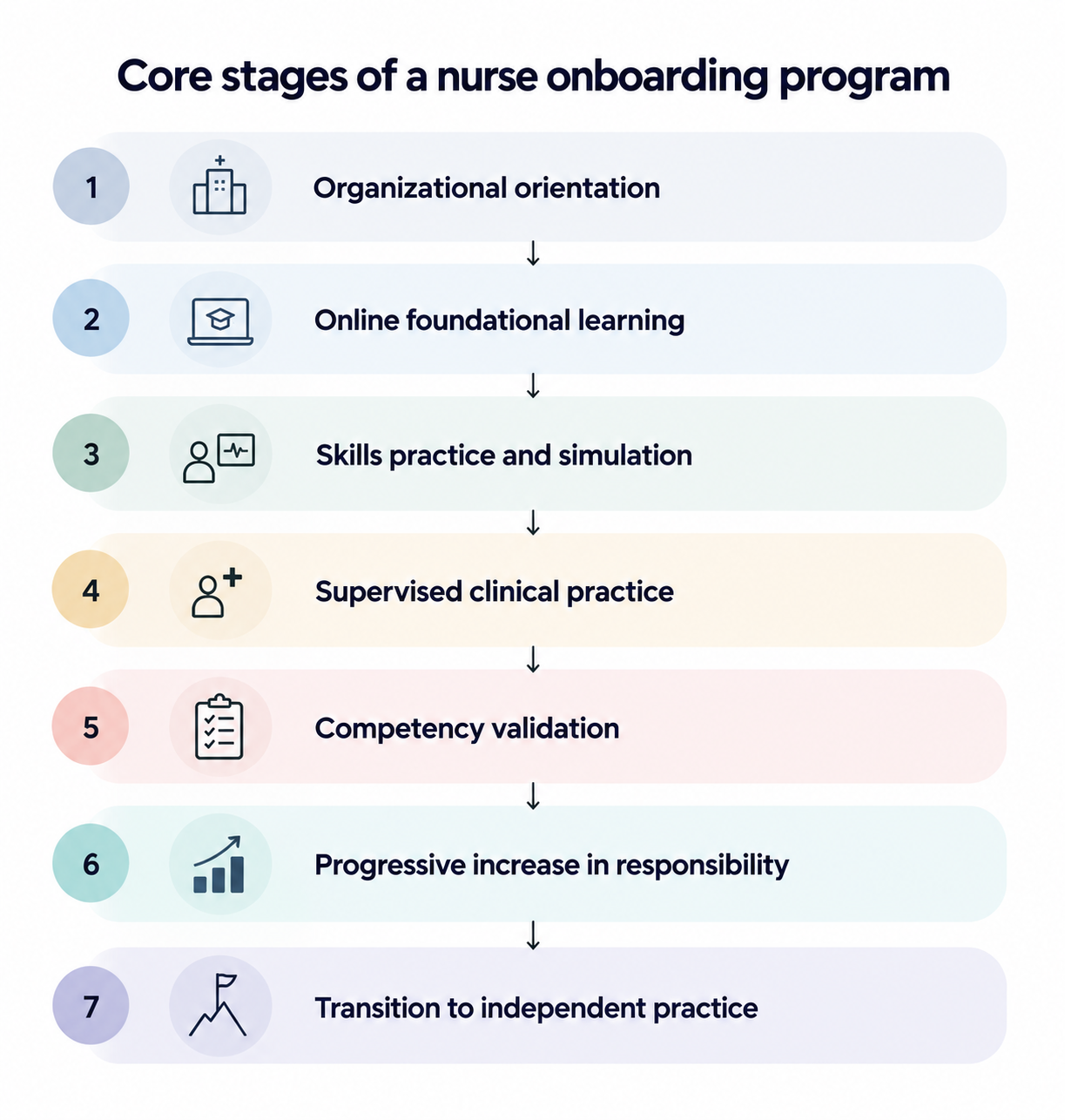
📌 Develop learning materials
Select suitable types of activities and formats for different stages of the orientation and onboarding flow. Blended nurse training that combines healthcare e-learning services with offline activities is now common, as it lets you optimize resources and scale training. Based on our experience at Blue Carrot, different formats work best for different learning needs, so the key is to use each where it brings the most value.
E-learning is a great way to share theoretical and foundational knowledge, distribute simulation videos, incorporate microlearning modules, and conduct assessments.
📌 Add assessment and feedback mechanisms
Incorporate regular assessments into the program, including initial competency checks. They must combine knowledge tests, observation, simulations, and return demonstrations. It’s useful to include them in a nurse orientation checklist to make the process smoother and more transparent.
Once the nurse onboarding training goes live, you will need to regularly review and update it. Proper design planning helps minimize changes, but some flaws will still emerge. Also, be ready to regularly update the content since nursing protocols and medical equipment change.
How to measure the effectiveness of nurse onboarding training
First of all, you need to know the baseline. Make sure to measure the following KPIs before launching the program so you can track the change over time:
- Knowledge and skills (pre- and post-training knowledge tests with skill assessments, simulation performance, and competency checklists).
- Confidence and perceived preparedness (self-report measures covering confidence in clinical skills and decision-making, escalating concerns, and overall readiness for independent practice).
- Time to independent practice (average time to specific competency/overall readiness, number of extensions required, number of attempts needed to build competence).
- Nurse retention and turnover (3-, 6-, and 12-month retention, voluntary vs. involuntary turnover, turnover by unit and specialty, turnover intention).
- Learner experience (direct feedback, satisfaction scores).
It may also be useful to know industry averages and trends at your location to compare your organization to others. The latest NSI National Health Care Retention report states that the US national hospital turnover rate is 18.5 percent, with a 17.6 percent RN turnover rate (Brian Colosi. 2026 NSI National Health Care Retention & RN Staffing Report. NSI Nursing Solutions, Inc. 2026).
Common mistakes in nurse onboarding training programs
Since the quality of nurse onboarding programs directly affects hiring outcomes and nurse productivity, mistakes are costly. Below are the main pitfalls and how to avoid them:
👉 Overloading nurses with information
Providing too much information at the start of onboarding means learners will most likely skip some material. Or they just won’t manage to remember everything. You need to evenly distribute the load, starting with essentials only and gradually moving to other theoretical modules.
👉 Prioritizing tasks over clinical judgment
Another common mistake is when learning teams design the onboarding program as a checklist of tasks. Of course, nurses must know how to perform specific tasks, but they also need to understand when and why to do them. Therefore, the transition to independent practice must also develop and evaluate skills like clinical reasoning and decision-making.
👉 Overly standardized onboarding plans
Since nurses work in different departments and teams, a lack of customization results in insufficient training. To make a program truly efficient, you adapt some modules to different levels of experience, skills, and specialties.
👉 Unnecessary focus on theory
When onboarding becomes overly focused on organizational policies and safety rules, nurses lack the opportunities to hone their practical skills. While theory provides the foundation, it must be followed by practicing patient monitoring, decision-making, clinical judgment, medical procedures, and communication skills.
The bottom line
Nurse onboarding training is a great way to facilitate nurses’ transition to independent practice. It gives nurses a clear set of competencies to develop and continuous support. This reduces tension and makes medical staff less likely to quit during their first years of practice.
Creating such training requires expertise in selecting the right formats and combination of learning activities. At Blue Carrot, we draw on our experience in the healthcare learning sector to design training that combines the right formats, activities, and content for each learning goal. Our services cover instructional design, e-learning development, educational videos, and other custom learning content.
If you’re looking to build or improve a nurse onboarding program, our team can help.