
As a learning leader in 2026, chances are, you are dealing not with one overarching problem, but with a bunch of seemingly unrelated ones.
Learner engagement, changing skills, content updates, and personalization expectations are the “good old” problems from previous years. On top of that, broader shifts in the corporate world are prompting more L&D responses, straining resources. In ATD’s 2026 State of the Industry research, 46 percent of talent development professionals cited prioritizing multiple demands as one of the top three challenges (2026 State of the Industry Report Indicates Latest TD Trends. Association for Talent Development. 2026).
Plus, there is AI. Not that it doesn’t help — but it also accelerates the pace at which workplace skills change.
In this guide, we look at 12 of the biggest L&D challenges circulating in professional circles as of 2026 — and that are likely to shape 2027, as well. For each one, we’ll draw on our own experience at Blue Carrot in addressing the more technical e-learning industry challenges for corporate training and development to suggest working solutions. 🤩
Summary
- Why the environment for learning leaders has intensified in 2026
- Training doesn’t automatically translate into behavior at work
- Learner engagement is getting harder to sustain
- Skills gaps are widening while the target keeps moving
- Prioritizing L&D efforts with limited budgets
- Proving ROI beyond completion rates
- Personalization is expected, but hard to deliver at scale
- Content becomes outdated faster than L&D can update it
- Building a culture of continuous learning is easier said than done
- Learning isn’t always connected to career growth and internal mobility
- Managers don’t have the time or tools to reinforce learning
- L&D has to keep learning connected to the flow of work
- AI is entering L&D faster than organizations can build a strategy around it
- L&D solutions that sound right but don’t really solve anything
- How to prioritize L&D challenges when you cannot solve them all
- Key takeaways
Why the environment for learning leaders has intensified in 2026
The current learning and development challenges landscape is trickier than in previous years — with several factors at play.
- First, the target is moving faster: skills are changing, while tasks and roles around them are being reorganized. The 2026 LinkedIn Talent Report found that 86 percent of companies lack adequate talent velocity — the ability to identify, build or acquire, and deploy skills quickly enough (2026 Talent Velocity Advantage Report | LinkedIn. 2026 Talent Velocity Advantage Report | LinkedIn. 2026).
- Second, the learning production cycle has sped up with GenAI. This may seem like a relief — “prompt AI to update the materials, that’s all” — but in practice, it’s the expectations that have changed the most. Content still needs human review and approval, but the comfortable “we update it once a year” routine is gone.
- Finally, higher expectations don’t mean the resources have grown proportionally. ATD’s report found that formal learning hours increased in 2025, but direct learning expenditure per employee fell from $1,254 to just $846 (2026 State of the Industry Report Indicates Latest TD Trends. Association for Talent Development. 2026).
Against this background, seemingly disconnected challenges arise — but ultimately, they share a common root. This tension between demand for faster adaptation vs. complex decisions about what to build is arguably the one “top L&D challenge for 2026.”

1. Training doesn’t automatically translate into behavior at work
There is a difference between completing a training course and actually changing how work gets done. ATD reports that 83 percent of organizations experience a skills gap (83 Percent of OrganizationsHave Skills Gaps, According to ATD Research. Association for Talent Development. 2018), with communication, critical thinking, and managerial and supervisory skills among the most commonly reported areas.
The problem is turning learning into reality, which largely happens through practice opportunities, reinforcement, etc. A manager may complete a course on difficult feedback, but have no time for one-on-ones; a salesperson can learn a new process but stick with whatever the customer relationship management (CRM) reinforces, and so on.
📌 How to fix it
Design for transfer — give learners realistic tasks and opportunities to make decisions in context. In our work at Blue Carrot, this is where scenario-based learning can help, but the learning experience should also create a bridge back to the workplace — assignments, job aids, checklists, etc.
2. Learner engagement is getting harder to sustain
The problem of competing for attention is not new: workplace learning has always competed against meetings, messages, deadlines, etc. What is new is that the overall pace of work has shifted to near-obligatory multitasking, meaning learning is now subconsciously deprioritized even more.
Sometimes this is aggravated by poor instructional design — long modules, generic examples, lack of connection to the learner’s role are common culprits.
📌 How to fix it
Relevance over entertainment is a good principle within any L&D strategy. There are perfectly valid answers to the question of why use video in e-learning, but “shouting louder” isn’t one of them. Instead, ask why the learner should care and what they need to be able to do. Making learners do something meaningful with the material is key: realistic scenarios, practice tasks, and feedback drive engagement because they shift learning from passive consumption to practical application.
3. Skills gaps are widening while the target keeps moving
As work changes, skills must stay aligned. According to LinkedIn’s 2025 Work Change Report, LinkedIn members now add new skills at a 140 percent higher rate compared to 2022 — and 70 percent of the skills used in most jobs will change by 2030 (Work Change Report: AI is Coming to Work. LinkedIn. 2025.)
As tasks and roles are reorganized without a clear picture of the future, the traditional skills-gap cycle is harder to sustain. By the time a large learning program is developed, things may have moved on, and L&D may risk training for yesterday’s version of the job.
📌 How to fix it
When working with rapidly changing skill sets and role definitions, we recommend looking at the next 6–18 month horizon: how work is changing, and what skills will still be (or newly) relevant.
It’s also a good idea to keep learning content modular where possible so it’s easier to update or replace without rebuilding the entire program. Building the course to balance holism with modularity is a tricky task for an experienced custom e-learning content development company — but it saves a lot of effort and investment later on.
4. Prioritizing L&D efforts with limited budgets
L&D teams rarely have the resources to respond to every learning request at once. SHRM’s 2026 L&D Executive Benchmarking data (2026 Learning and Development Executives Benchmarking: Developing Critical Talent. SHRM. 2026.), based on more than 4,600 organizations, found that median L&D spending per employee fell by 28 percent from the previous year, while median training hours stayed flat at eight per full-time equivalent (FTE).
At the same time, because of the higher speed of change, requests keep coming from different directions — IT, legal, marketing, HR, etc. — everyone believing theirs is of the highest importance. This turns into portfolio sprawl: multiple simultaneous initiatives, overlapping content, higher burden on SMEs, etc.
📌 How to fix it
There are two facets to the question: one is overall prioritization, and it’s important enough to deserve a separate treatment (we’ll return to it below).
The other is what we can do at the content level. Instead of letting every training be its own learning product, it is possible to break the materials into reusable components: foundational content, role-specific modules, scenarios, job aids, etc. This makes adaptation easier. Then you can distinguish between content to create and content to assemble from existing modules.

5. Proving ROI beyond completion rates
A typical situation: an L&D team reports 94 percent of employees completed a new customer service training program — this sounds like a successful rollout until someone asks whether customer service actually improved. Completion rates are easy to measure but tell executives practically nothing about business impact.
Which, in turn, fuels the budgeting problem — stakeholders need information on whether errors went down, whether sales improved, and ultimately whether the program delivered training ROI. Without this evidence, it is tempting to deprioritize L&D as a whole.
📌 How to fix it
Start with the intended change at the instructional design level: e.g., if a program is supposed to reduce errors, define what “fewer errors” means and establish a baseline. Then map learning measures with practical evidence.
This means involving business stakeholders when you define success measures. If nobody can explain what should change as a result of the learning, it will be difficult to demonstrate its value later.
6. Personalization is expected, but hard to deliver at scale
Learners reasonably expect training and development to be relevant to their role and experience — and while personalized learning was previously difficult to afford, GenAI seems to make it easier.
This is partly true. For example, producing some 40 five-minute training videos would previously require about 480 production hours (scripting, production, editing, basic post-production); with AI-assisted workflows and reusable templates, about 120 hours is a realistic estimate. However, supposing each video needs two SMEs to spend 30 minutes for review, plus business owners another 30 minutes, that means around 100 additional hours. The bottleneck has simply moved from production to governance.
📌 How to fix it
Design the content pipeline around the new bottleneck. Establish clear ownership and approval rules before scaling production. What needs to be defined is which content needs SME review, which can use a lighter QA routine, and who has authority to approve changes.
7. Content becomes outdated faster than L&D can update it
Content is now becoming outdated faster. In Deloitte’s 2026 Global Human Capital Trends survey, only eight percent of respondents believe their organizations are highly effective at meeting continuous learning needs (Sue Cantrell, Chloe Domergue, Allyson Dake, Jeroen Van Eeghem, Matt Stevens, Ishani Purohit. Staying Relevant in a World That Won’t Sit Still. Deloitte 2026). Polished content that no longer reflects the job realities is common.
📌 How to fix it
First, stop treating content updates as ad hoc. In our practice, a more sustainable approach is to assign important assets to a defined owner, a review trigger (regulatory change, process redesign, etc.), and a lifecycle. It also helps to distinguish between content that changes frequently and relatively stable foundational materials — this supports an ongoing update routine.
Another good idea is to make it easier for people outside L&D to flag outdated content. SMEs, managers, and learners often notice discrepancies first, so a simple feedback mechanism makes it much easier.
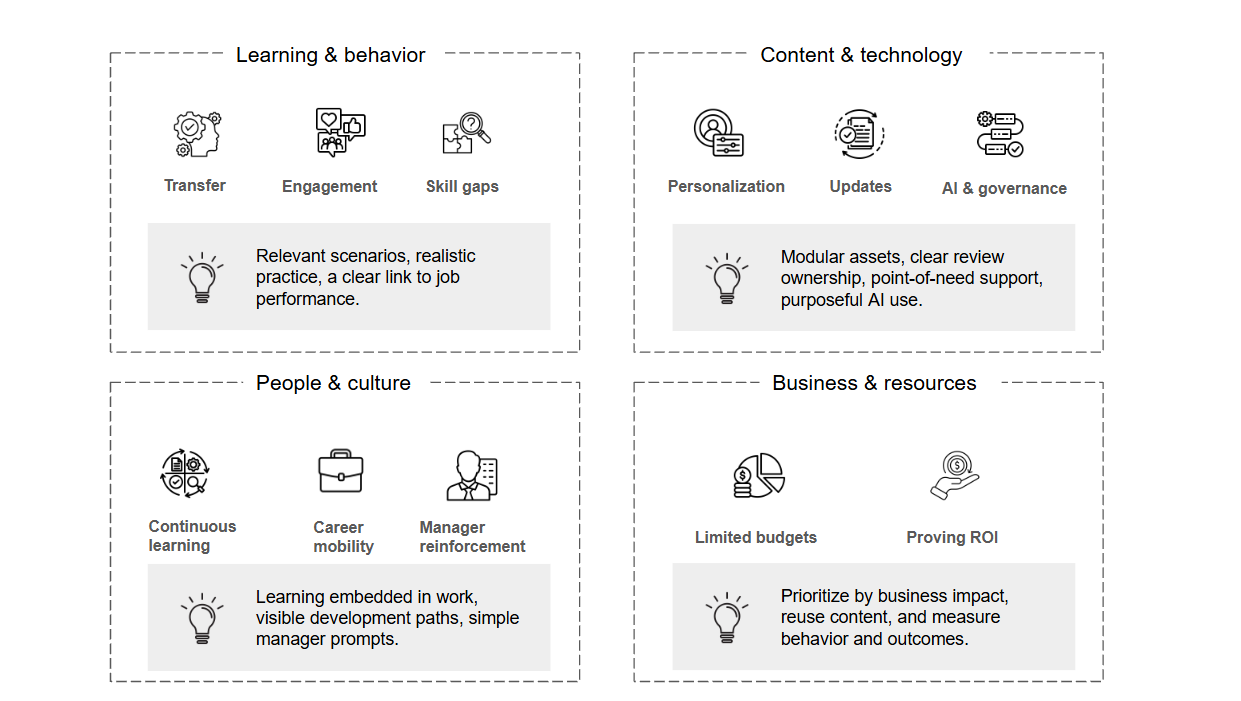
8. Building a culture of continuous learning is easier said than done
Continuous learning sounds like an obvious goal; in practice, it competes with actual work unless there is a clever mechanism of integrating one into the other. An employee may agree this is important, but postpone the course because a deadline is approaching.
📌 How to fix it
Integrate workplace learning into the daily workflows. It’s not just about protected learning time — smaller opportunities matter, like short practice activities, peer knowledge-sharing, coaching, or tactical assignments.
Managers can reinforce learning by discussing development goals and creating opportunities to apply new skills, as well as recognizing improvement along the way.
9. Learning isn’t always connected to career growth and internal mobility
Learning is easier to take seriously when employees can see where it leads — change in responsibilities, change in role, promotion, etc. This is what is often unclear.
On the other hand, companies themselves often lack a clear way to identify their employees’ skills or match them to emerging needs beyond rigid job descriptions, resulting in unnecessary courses or positive but unused learning outcomes.
📌 How to fix it
Connecting learning to skills and opportunities is not about “everyone gets a promotion upon completing the course.” In practice, the connection can be preparation for a particular type of project, upskilling, reskilling, etc.
It is also a good idea to connect internal mobility with the learning ecosystem through closer collaboration between learning leaders and talent management.
10. Managers don’t have the time or tools to reinforce learning
Managers are supposed to ensure new skills become routines — but they are typically under time pressure and/or unsure about how to do that. Asking them to become another layer of training delivery is often unrealistic.
📌 How to fix it
Don’t make managers help deliver learning — just reinforce it in clearly defined ways. A manager’s role can be built into the learning experience from the start. For example, after a scenario-based activity, the learner may receive a practical task in a real environment, while the manager receives a short briefing: “Here are two behaviors to look for during the next customer meeting + one question to ask afterward.”
11. L&D has to keep learning connected to the flow of work
The closer learning is to its practical application, the easier it is to reinforce — as opposed to taking a course in September and remembering it in February. However, creating two-minute microlearning modules for everything would hardly be feasible. Some capabilities do require structured courses and time away from immediate work.
Hence, there can be a gap between knowing and doing: an employee may understand everything well in a training environment but forget or struggle to apply it in the middle of their workday.
📌 How to fix it
In our experience, the key is linking observation to course design: recurring errors, frequent questions, bottlenecks, and tasks that trigger information lookups point to opportunities for course improvement. From here, you can use microlearning content solutions, short reference guides, decision trees, job aids for reinforcement, and scenarios or simulations within the deeper course — or embedded in the actual workflow.

12. AI is entering L&D faster than organizations can build a strategy around it
Organizations are now using AI more often, but that doesn’t mean the proper use cases are already defined, let alone written in stone. With AI, it is often tempting to produce more content than the organization can properly review and maintain (or even use). Organizationally, too, AI is changing workflows too fast for L&D to adapt the training processes. Deloitte’s 2026 research found only six percent of leaders say their organizations are making progress in purposefully designing human-AI interactions (Deloitte: In a New Era of Work, Winning Organizations Will Build the Human Advantage. Deloitte. 2026).
📌 How to fix it
Don’t start with the AI capability and search for problems it might solve — this leads to poorly defined use cases. The opposite approach is better: start with the learning or performance problem, then search for AI tools. This way, it makes it easier to define where AI for employee training actually adds value.
Finally, L&D gains a lot by participating in the organization’s broader AI strategy to understand where AI fits into the company’s routines; this helps integrate learning with workplace activities more organically.
L&D solutions that sound right but don’t really solve anything
Not every L&D problem is solved by adding more learning. Some seemingly logical responses can make things worse by addressing the wrong problem.
👉 Adding more training when performance is falling
This sounds intuitive, but only if the problem is actually a gap in knowledge or skills. This doesn’t work to fix convoluted processes, unclear expectations, inadequate tools, etc.
Instead: Diagnose the problem first, then see if learning is a viable solution at all.
👉 Hoping more interactivity solves engagement
Relevance comes first. If learners cannot see what they are supposed to do with the material, interactivity and gamification are just a distraction.
Instead: Embed pragmatism in instructional design, so that practical relevance is obvious.
👉 Personalizing everything
Marketing has created an aura of magic around personalization, but selling and teaching are different things. Personalizing everything for everyone can quickly snowball into a maintenance problem.
Instead: Personalize where it changes the learning outcome and you see the mechanism.
👉 Inflating the content library
Larger catalogues contain more information, but are also harder to navigate and use. Sometimes, it defeats the whole purpose.
Instead: Always consider the entry point to every material produced — when, how, and why.
👉 Mechanically scaling everything with AI
Content production or learner support is cheaper with AI, but sometimes, a lot of context is lost during automated scaling.
Instead: Keep the context for the role and problem in mind when applying AI to scale any assets or course flows.
How to prioritize L&D challenges when you cannot solve them all
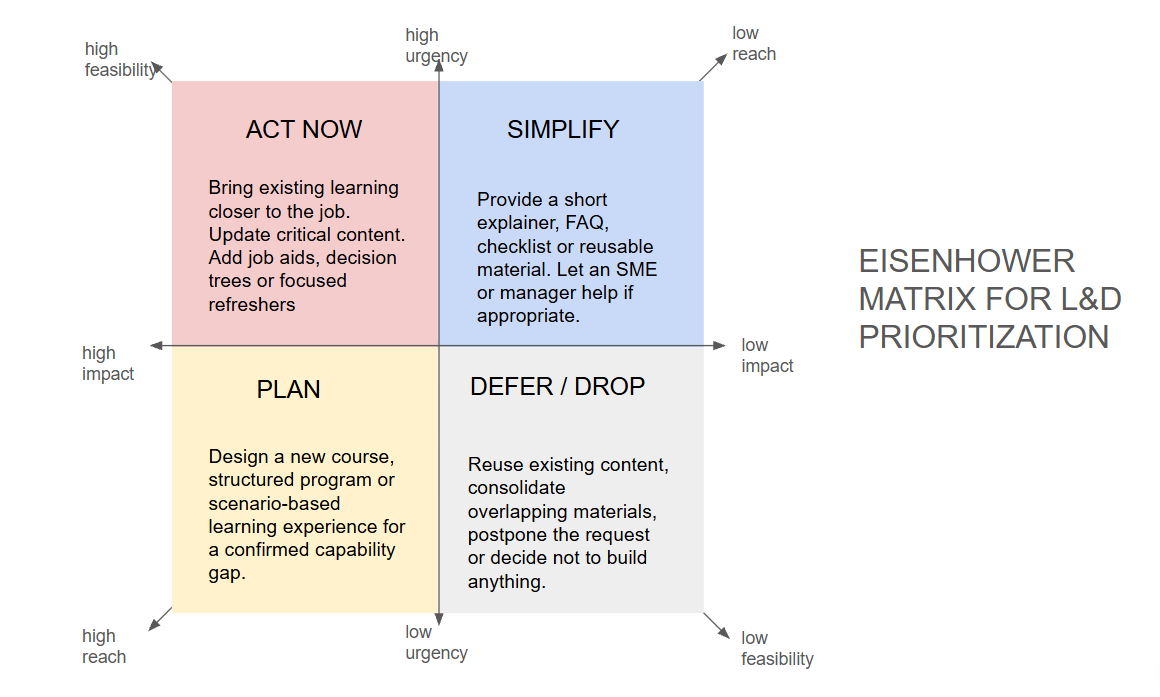
With 12 challenges on the table, the obvious temptation is to create 12 initiatives. That is usually a good way to make L&D even busier without making it much more effective.
A more useful approach is to assess each challenge against four questions:
- Business impact: What happens if we do nothing? What does this affect: revenue, risk, customer outcomes?
- Urgency: How quickly is the situation changing? How fast is the skills gap growing?
- Reach: How many people, teams, or processes are affected?
- Feasibility: What can L&D realistically influence with the available time, L&D budget, expertise, and organizational support?
None of these criteria is absolute in and of itself — a high-reach but low-impact problem will rank lower than something that affects two or three critical roles — but in combination, this gives L&D a picture of what should be handled and how.
Another question worth adding is, “Which problems are connected?” Sometimes, a single intervention can address several challenges in learning and development at once. For example, solving the equation for relevance may improve engagement, while connecting learning to the company’s role distribution helps solve for relevance.
Key takeaways
L&D teams cannot solve every challenge at once, and more training, more content, or more technology is not automatically the answer. The goal is to identify where learning can make the greatest difference, then design experiences that connect learning to practice and real business needs.
For the content-heavy parts of that work, the right production partner can help L&D move faster without turning speed into a compromise.