
A clinician may leave medical school with solid knowledge and practical skills — but these skills need to be applied to actual workplace realities. The same can be said for nurses, medical science liaisons (MSLs), and other medical roles. Unlike in academia, in clinics and companies, things tend to change abruptly: new policies, regulations, equipment, and guidelines often require focused learning effort.
All of this requires clinical skills training to be more than just a college recap. The difference between instruction and practice matters a lot here — and research confirms the practical component is crucial. For example, in a 2022 systematic review of 19 studies involving 2,459 medical students (Niall McInerney, D Nally, MF Khan, H Heneghan, RA Cahill. Performance Effects of Simulation Training for Medical Students – a Systematic Review. National Library of Medicine. 2026), every study included reported improved performance following simulation-based training.
This doesn’t mean every competency needs a simulator — but the opportunity to see, practice, apply, and demonstrate skills is what makes a clinical skills training course valuable.
In this article, we draw on Blue Carrot’s experience in instructional design and multiple learning formats to look at how to turn available clinical content — presentations, guidelines, standard operating procedures (SOPs), etc. — into a usable training program for building practical competencies. 🤩
Summary
- What clinical skills training actually covers
- Tailoring clinical skills training to the learner’s role
- Why a structured clinical skills training program matters
- Core methods used in clinical skills training programs
- A step-by-step process to design a clinical skills training program
- Choosing formats for clinical skills training content
- How to assess competence in a clinical skills training program
- Reducing friction in clinical skills training
- The bottom line
What clinical skills training actually covers
Clinical skills training is focused on the practical competencies that people need to perform their roles effectively and safely in their actual clinical situations. Instead of teaching the “why” and the “what,” it focuses on the “how” and applies it to the actual setting.
Depending on the role (general practitioner [GP], specialist, nurse, MSL, etc.) this might include:
- Procedural skills: performing examinations, administering treatments, operating medical devices, or carrying out clinical procedures.
- Clinical reasoning and decision-making: interpreting findings, identifying risks, prioritizing actions, and applying evidence to realistic cases.
- Communication skills: communicating with patients and families/caregivers, conducting handoffs, discussing clinical information with colleagues, etc.
- Safety and teamwork: following infection-control and medication-safety procedures, responding to clinical deterioration, escalating concerns, and working effectively within a care team.
- Role-specific competencies: applying clinical knowledge in ways that match the learner’s responsibilities.
Clinical skills training can take place across skills labs, simulation centers, hospital wards, clinics, operating rooms, virtual environments, and blended programs — depending on the balance between the need to be close to the actual work situations and the practical feasibility.

Tailoring clinical skills training to the learner’s role
Since there’s no “universal clinician” role, there can be no universal clinical skills curriculum. The treatment of the same topic will be different based on what the employee is supposed to do (not just know).
That’s why, when designing, for example, clinical skills training for nurses or health care providers (HCPs), role considerations must take precedence over content and format, such as:
- What the learner already knows/can do;
- What they actually do on the job;
- How much autonomy they have;
- What level of risk their routines involve;
- Where and in which circumstances they perform the skill in question.
This isn’t to say that every subject needs a separate course for every role. In practice, there are e-learning courses for medical care specialists that have a shared core and role-specific modules. Defining where this is possible is an intricate but very useful point in course design, relying on understanding of prior knowledge, competency overlap, and practical routines.
Why a structured clinical skills training program matters
There may be multiple ways to build clinical competence; however, a structured clinical skills program helps make competence consistent, current, and demonstrable. Organizing clinical training around these three goals can help secure multiple clinical and operational results.
First of all, clear performance standards and opportunities to identify gaps can reduce variation in critical tasks and support patient safety. Evidence from simulation-based training illustrates this: a 2024 systematic review found that adding in-situ simulation to existing educational practices was associated with lower mortality (OR 0.66, 95% CI 0.55–0.78) (Aaron W Calhoun, David A Cook, Gina Genova, Seyed Mohammad Kalantar Motamedi, Muhammad Waseem, Rob Carey, Amy Hanson, Jacky C K Chan, Cheryl Camacho, Ilana Harwayne-Gidansky, Barbara Walsh, Marjorie White, Gary Geis, Anne Marie Monachino, Tensing Maa, Glenn Posner, David Li Li, Yiqun Lin. Educational and Patient Care Impacts of In Situ Simulation in Healthcare: A Systematic Review. Pubmed.Ncbi.Nlm.Nih.Gov. 2026). Moreover, with a defined pathway, new hires and residents can progress toward independent performance more systematically.
Another important point is compliance with regulatory and accreditation requirements like the ACGME Milestones. The Joint Commission also distinguishes education and training from competency: the latter requiring the ability to synthesize and correctly apply knowledge and technical skills to a task. CMS requirements (Regulations and Guidance. Centers for Medicare & Medicaid Services CMS Newsroom CMS Newsroom. 2026) and guidance likewise include competency-based training in specific areas.
Pharma and medtech companies, meanwhile, may benefit from standardizing how MSLs and other employees apply clinical knowledge in conversations: consistency is a long-sought goal here.
Finally, there’s risk management and documentation. While a record of course completion per se is hardly informative, once objectives, practice, etc. are documented, there is a clear understanding of what the organization expects employees to know.
Core methods used in clinical skills training programs
Clinical skills training needs a proper selection of learning methods. These are not the same as delivery formats — for example, a scenario might be delivered through interactive e-learning, a live session, or a simulation. The format serves the learning method, not vice versa.
In our experience, effective learning programs combine several of the following methods:
📌 Scenario-based and case-based learning
Learners work through realistic clinical situations, analyzing them and making decisions while considering the consequences of their choices. Scenarios work well for clinical reasoning, prioritization, and communication, including non-obvious choices to make. For example, Blue Carrot’s healthcare projects have used patient cases and simulation-based learning to ensure practicality.
The method has one important limitation: a case can reproduce the thinking around a clinical situation more easily than how to perform the action in detail, so more hands-on activities typically need another form of practice.
📌 Demonstration and modeling
Demonstration is especially useful as the step between explanation and attempting a new skill. Depending on the level of realism for the particular skill, this can be done through video, live, or in an instructor-led session. The main limitation is, of course, that watching is not the same as performing, so it’s rarely a standalone method.
📌 Deliberate practice
This is where learners perform a defined task repeatedly with feedback and opportunities for correction. This is the method of choice for procedures and technical skills — competencies with identifiable steps. Deliberate practice takes time and requires clear criteria, so the program should provide enough opportunities to practice for it to work.
📌 Simulation and hands-on practice
Simulations recreate relevant elements of a clinical environment to allow learners to perform tasks without putting real patients at risk. This might involve task trainers, manikins, device setups, or virtual environments. Simulations are particularly useful for high-risk, complex, and rarely performed skills that still require realistic context. They have their constraints, too: namely, balancing resources with realism.
📌 Workplace-based learning and coached practice
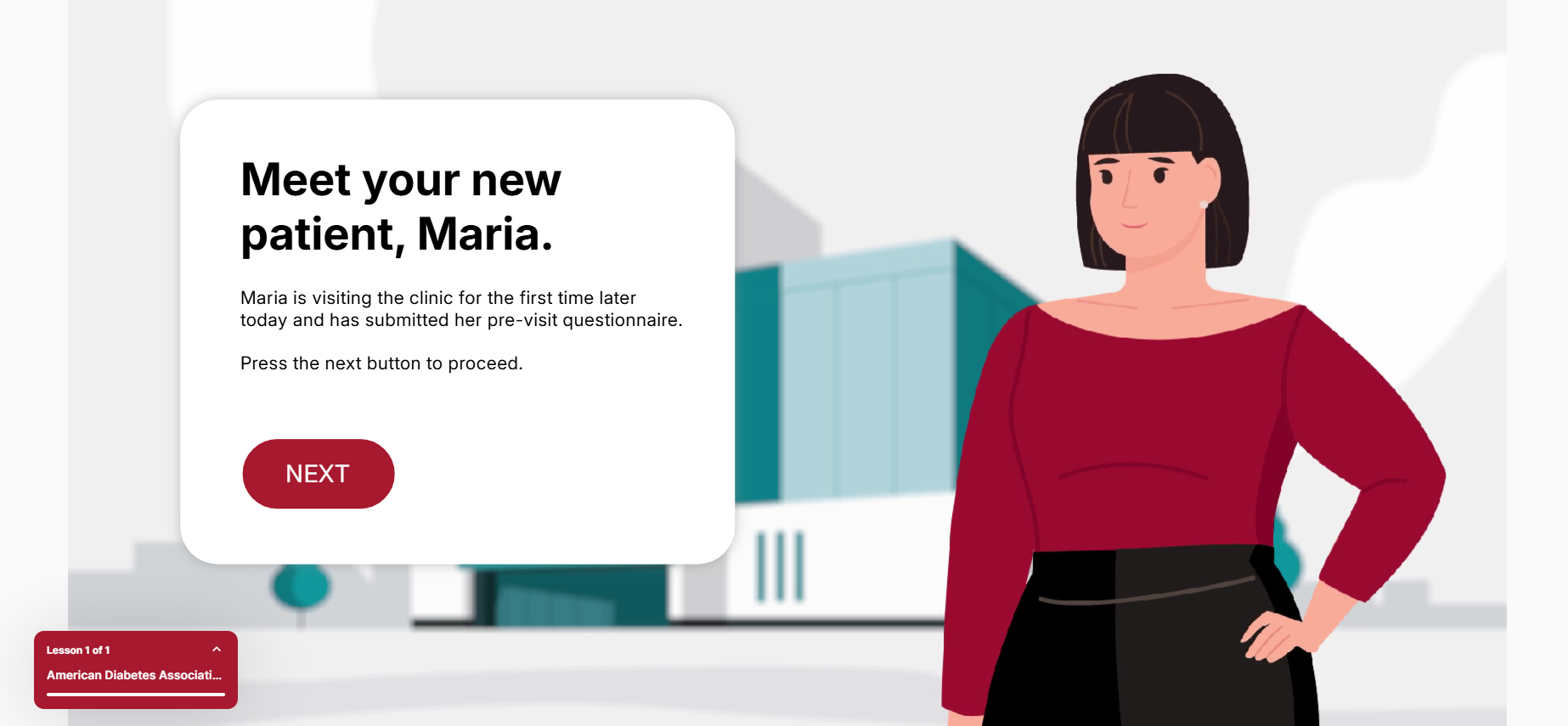
Especially in healthcare, some competencies may require in situ practice under appropriate supervision to be fully developed. Workplace-based learning thus remains relevant when it comes to real workflows, equipment, some patient interactions and team dynamics — the main limitation being that they are less controlled than simulations and more reliant on supervision.
📌 Feedback, debriefing, and coaching
Feedback is often imagined as a separate stage at the end of training, but in reality, it permeates everything, from demonstrations to practice. Debriefing is particularly useful after scenarios or simulations, while coaching provides more individualized guidance.
In digital training, feedback can be designed within the learning activities, making it more structured. Application exercises, branching scenarios, and other interactions can show users where they went wrong, or what part of an answer can be improved. Blue Carrot’s instructional design approach incorporates assessment and reinforcement across various activities.
The main challenge is the quality of feedback: vague feedback like “try again” is of little value, so there need to be defined criteria and a clear way for learners to improve.
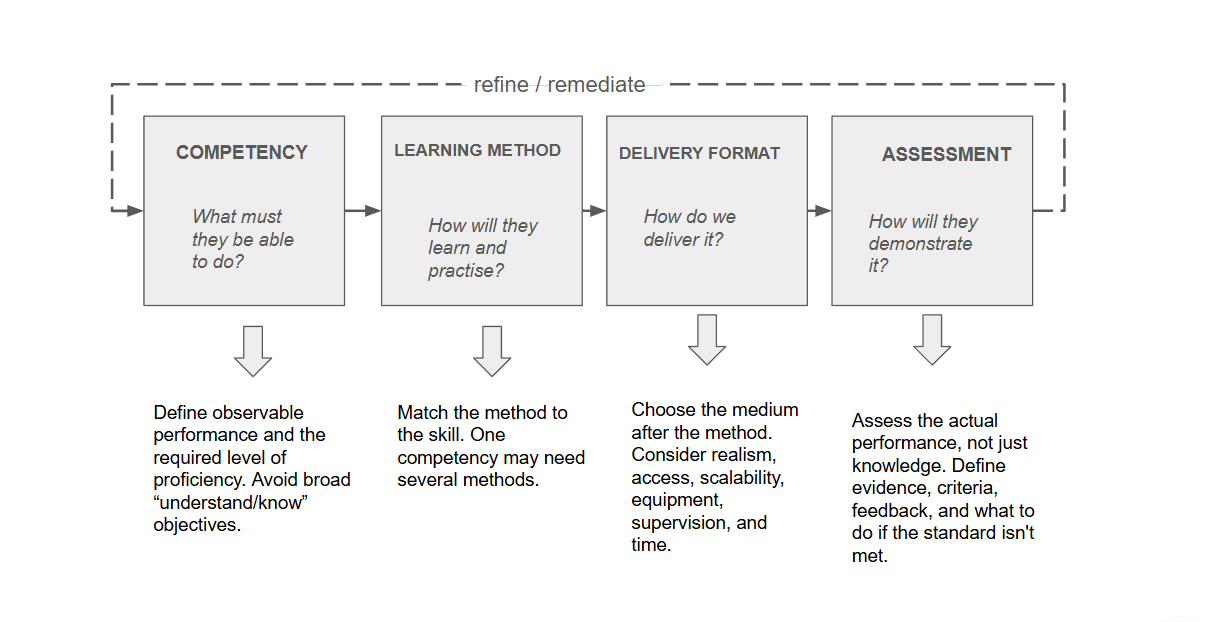
A step-by-step process to design a clinical skills training program
The main challenge of turning materials into a ready-to-teach course is staying true to the goals and not getting distracted by the content itself. This principle should be observed throughout all the steps. Here is the general sequence that helps systematize the approach:
- Define the competency and the performance standard. Avoid broad objectives like “understand wound care” — instead, use observable criteria, e.g., for nursing clinical skills training, “the nurse can perform a sterile wound dressing change according to this protocol.” This helps establish the basis for assessment later on.
- Audit the available content/expertise: SOPs, guidelines, presentations, videos, documentation, input from SMEs, and the like — and decide what the course actually needs.
- Select the learning methods by competency. In our example with wound dressing, learners may need to watch a demonstration, then practice repeatedly against a checklist, then perform in a simulated setting.
- Build practice and assessment into the program — strategically placed moments for the learners to perform the target skill. For instance, after practicing the dressing procedure, the nurse completes an observed assessment with a checklist for preparation, aseptic technique, application, disposal, and documentation.
- Choose the delivery formats. This step is often placed too early, but in practice, the format should come after the choice of method. Things to consider here are also learner location, resources, level of realism, scalability, and opportunities for supervision. For example, learners may watch a wound dressing demonstration on video before the session. They can then practice the procedure in an instructor-led skills lab.
- Pilot the program with real learners to see where they may become confused, skip steps, or need more practice.
- Maintain and update the program. Establish who owns the content, when it needs revision, and what will trigger updates.
Choosing formats for clinical skills training content
The choice of format affects what exactly can realistically be taught, how many people can be reached at once, how much practice is possible, and how the assessment happens. There is no universally “best” format — each one comes with its benefits and tradeoffs, so a careful choice is important.
👉 Video and animation
In healthcare training, videos are effective for showing procedures and behaviors. With proper pacing, learners can pause and replay them, while animations help visualize what’s difficult to reproduce in a classroom. For example, Blue Carrot’s healthcare work often includes clinical skills training video creation with procedure animations, medical illustrations, and patient-oriented videos.
Video scales relatively well and can be reused, but is rarely self-sufficient: it almost always needs a separate component for hands-on practice.
👉 Interactive e-learning
Interactive e-learning for healthcare helps turn clinical content into structured practice using an arsenal of tools like:
- Branching scenarios;
- Knowledge checks;
- Decision-making activities;
- Interactive cases;
- Simulated workflows.
This makes the format good for teaching clinical reasoning, protocols, product knowledge, and onboarding — but doesn’t always substitute hands-on training. The main advantage is scalability: the same module can be delivered to large numbers of learners. Blue Carrot has also used case-based scenarios and interactive simulations to enable self-paced learning, reducing friction in the clinical skills training process and reflecting broader e-learning trends in medical education.
👉 Virtual simulation
Virtual simulations help avoid having to physically reproduce the clinical setting every time practice is needed — which is useful, but also imposes realism-related constraints: one has to decide which details of the clinical environment are relevant to the performance aspect in focus. There are several successful types of such simulations, among them:
- Virtual patients and branching clinical scenarios;
- Simulated device & system interfaces;
- Immersive 3D or VR environments.
The required level of fidelity depends on the learning objectives. The virtual simulation should include elements that matter for on-the-job decisions, actions to complete, or behaviors that need to be changed.
👉 Live instructor-led training
Instructor-led training can be integrated into digital and blended clinical training through what is called virtual instructor-led training (VILT). The ways to get the benefits of instructor-led training include linking scheduled sessions to the learner’s LMS pathway, using video conferencing with screen sharing and breakout rooms, incorporating polls or interactive cases, and providing pre- and post-session activities. Blue Carrot’s VILT experience involved making live sessions one component of a larger learning journey.

Studio SE – Online course
View demo👉 Hands-on simulation
Hands-on practice is often indispensable, and even in blended learning programs, it is often included as a layer on top of e-learning. The main question that instructional design has to solve here is how to connect these sessions to the digital parts of the course. E-learning and virtual simulations can do the explanation and demonstration parts, but the relevant connections between the two need to be considered at the design stage.
👉 Blended learning
Blended e-learning solutions combine formats so that explanation, preparation, practice, live interaction, and workplace application are placed in the formats most suited to each learning objective. This helps balance scalability with the need for hands-on practice, but only provided that the e-learning and live parts are connected by design. In other words, the two shouldn’t be designed independently and stitched together; they need to form a coherent whole.
👉 Microlearning and performance support
Microlearning addresses specific questions through short videos, step-by-step guides, checklists, or just-in-time resources. It is scalable and easy to update, but works mainly as reinforcement rather than a substitute for initial competency development.

How to assess competence in a clinical skills training program
Assessment criteria should be tied to the performance goals, otherwise there’s the risk of relying on generic metrics like completion rates, etc. Evaluation can include not only knowledge tests, but observed checklists, case-based assessments, OSCE/OSPE-style exams, simulations, or systematic workplace observation.
An often overlooked aspect is that the assessment should also define what to do when the standard is not met: feedback, targeted practice, reassessment, etc., especially for high-risk skills.
Reducing friction in clinical skills training
It’s important to remember that a significant part of the course will be taught in the time between attending to patients and on top of an already demanding workload. This creates a certain level of friction, and uneven levels of prior experience across staff add to that.
Reducing this friction is an important instructional design task: removing unnecessary content, adapting pathways to existing clinical competence, breaking complex skills into steps, and making learning activities bite-sized where appropriate, are all ways to reduce this friction.
The bottom line
Effective clinical skills training for hospitals starts with competencies, not content — and only after the learner profiles and goals are defined does the format choice become relevant. Proper instructional design can make the learning experience scalable without losing the practice component. Blue Carrot’s healthcare e-learning solutions support that production process while keeping the content aligned with the learning objectives and the realities of clinical practice.