
Employee retention remains the key challenge for learning and development professionals. According to the LinkedIn Learning 2025 Workplace Learning Report, 88 percent of companies surveyed expressed concern about employee turnover, while training emerged as the top factor in keeping employees engaged (2025 Workplace Learning Report 2025| LinkedIn Learning. LinkedIn Corporation 2026. 2025).
Yet simply providing more courses is unlikely to be enough to motivate employees to join and remain dedicated to their job. Therefore, this article attempts to clarify what kind of learning experiences can be beneficial and help to improve retention. 🤓
Summary
- Key takeaways
- What does training and development for employee retention mean?
- Why training and development affect employee retention
- What employees actually want from L&D programs
- Types of learning programs that can support employee retention
- How to design a retention-driven training and development program
- How to measure the impact of training on employee retention
- Examples of retention-focused learning programs in practice
- Conclusion
Key takeaways:
- Training is more likely to support retention when it is aimed at solving actual organizational workforce issues. Simply having courses accessible for employees is not sufficient for achieving this goal. Learners need opportunities to acquire necessary skills, advance in their careers, and experience realistic chances of progression within an organization.
- Different learning programs can target different retention-related challenges, such as onboarding, skill improvement, career guidance, etc. Thus, selecting one should depend on addressing a particular problem and improving retention rates.
- In order to design effective learning programs, instructors need to start by analyzing organizational and individual needs and identifying competency gaps. Next steps involve designing training curricula focused on filling identified gaps, selecting adequate delivery formats, and ensuring practice opportunities.
- Training’s impact on retention can be evaluated through chains of evidence. Specifically, learning processes must be analyzed, followed by measuring skill acquisition, implementation of new skills in daily activities, talent results like internal promotions, and ultimately financial metrics related to savings associated with employee retention.

What does training and development for employee retention mean?
By defining training and development for employee retention, we mean organized efforts focused on building skills and supporting career development. Rather than treating learning opportunities as optional bonuses, retention-linked training and development should focus on professional development. This may include career progression, better performance, preparation for upcoming roles, and more.
As a result, the priority shifts from encouraging learners to participate in educational initiatives. Instead, the goal is to help them realize their potential and develop personally while contributing to organizational success. We believe that retention training and development are most useful when approached from the standpoint of mutual benefits to succeed.
📌 Training vs. development
Training involves acquiring the competencies and knowledge staff members need now or will soon need to perform specific tasks or achieve certain outcomes. Onboarding, compliance, technical training, skills training, and other types fall under the training umbrella.
Development involves preparing for increased accountability, upcoming promotions, career shifts, and similar processes, such as mentoring, coaching, and succession planning.
Retaining employees requires addressing both training and development concerns. Training helps meet today’s demands, while development offers insight into future opportunities for personal growth within the company.
Why training and development affect employee retention
The relationship between training and employee retention matters when learning changes why employees stay or leave an organization. The connection lies not in having access to courses, but in whether the learning actually helps employees move forward and become more employable within the organization.
👉 Career growth becomes visible
A lack of development opportunities can be a strong reason for employees to seek jobs outside the organization. According to Work Institute’s 2026 Retention Report, career issues drive the most turnover, accounting for 19.2 percent of departures in 2025 alone. Therefore, implementing career pathing solutions allows companies to address the problem by outlining the experience, knowledge, and learning required to reach specific positions in organizational hierarchies.
👉 Internal mobility becomes a realistic alternative to leaving
Learning becomes especially valuable when employees can use acquired competencies within the organization and build their careers around them. Internal mobility gives people ways to transfer between positions, take on broader roles, or advance professionally while staying with the same company.
👉 Employees are better prepared for change
Roles, technology, and skills needed constantly evolve. Continuous learning helps employees keep up with changes and stay one step ahead, rather than finding that their skills no longer match changing role requirements.
👉 Managers can turn learning into career progress
Just signing up for training classes won’t mean development per se. Managers must help workers find valuable training opportunities, allocate time for them, provide feedback, and offer chances to apply what they learn in practice. According to Gallup surveys, as many as 39 percent of Chief Human Resources Officers (CHROs) perceive lack of direct manager support as a key barrier to employee development (Corey Mulherin. Addressing the Barriers Blocking Employee Development. Gallup. 2025). Gallup also found that having a supervisor perceived as getting in the way of an employee’s growth is the strongest predictor of turnover intent. Manager engagement is vital to turning training courses into real career development.

👉 Investment in development can strengthen commitment
Employees evaluate how their learning opportunities reflect their place within an organization. Continuous development efforts tied to real career growth can strengthen employee engagement by showing the organization is willing to invest in people beyond immediate productivity needs. This positive reinforcement effect is weaker when learning paths resemble nothing more than catalogs of unrelated courses.
What employees actually want from L&D programs
Employees have fairly consistent expectations of workplace learning: it should feel relevant, accessible, and linked to real development opportunities. From a learning and development perspective, the key challenge is turning those expectations into reality.
|
What employees want |
What it means for L&D |
|
A clear connection to career opportunities |
Show how learning relates to specific roles, competencies, promotions, or internal opportunities rather than offering courses with no visible next step. |
|
Skills they can use |
Prioritize learning that solves current performance needs or prepares employees for capabilities they are likely to need next. |
|
Time to learn |
Build learning into working time instead of assuming employees will complete it on top of their existing workload. |
|
Flexible access |
Make training easier to use across different schedules, locations, and workflows through formats such as microlearning or blended learning where appropriate. |
|
Choice over development |
Give employees more choice over learning based on their roles, experience, and desired career paths rather than giving them the same training pathway to everyone. |
In sum, we can conclude that high-quality training materials alone cannot guarantee efficiency. Training must be convenient, meaningful, and adaptive for personal growth. Therefore, from an L&D team standpoint, content development should be addressed alongside timing, relevance, engagement, and methods. The same principle applies when deciding how to create engaging training videos for the same purpose: engagement should come from relevance, clear structure, and useful application rather than visual effects alone.

Types of learning programs that can support employee retention
Each challenge requires unique approaches. Employee retention training and development gains relevance when learning approaches align with the challenges of retaining employees. Otherwise, no matter the topic, it may not address retention challenges.
📌 Onboarding and early-career development
Structuring onboarding training means tailoring the process to position-specific duties, expectations, and objectives. It helps new employees understand development opportunities within the company. Depending on the role, onboarding may combine self-paced materials with live sessions, especially where the benefits of instructor-led training — real-time clarification, guided practice, and immediate feedback — are important. This solution can help when your company struggles to retain new hires or has overly long induction periods.
📌 Upskilling and reskilling programs
Upskilling upgrades employees’ current competencies, while reskilling moves workers into new roles by equipping them with skills suited to those roles. You will find this training useful when you need to adapt to evolving requirements in certain positions or address skill shortages without recruiting new candidates.
📌 Career development and internal mobility programs
Career development refers to learning initiatives tied to specific career paths, skills frameworks, certification requirements, and other criteria for promotion within the company. As you might expect, these solutions work best when a talent mobility scheme already exists, or when plans are in place to implement one.
📌 Manager and leadership development
Leadership development implies increasing managers’ competence in coaching employees, giving effective feedback, developing communication, mastering delegation, etc. We believe this type of initiative may come in handy for most workplaces.
📌 Mentoring and coaching
Mentoring and coaching offer more personalized development opportunities than traditional training solutions. These approaches are especially effective for addressing pipeline challenges, specialist roles, career changes, and other needs where individualized feedback and reflection become crucial parts of training.
At Blue Carrot, we look at these approaches as ways to help talent development teams address retention challenges from different perspectives. The key decision point is whether a training approach solves a problem and fills a specific gap, not how popular the approach is.
How to design a retention-driven training and development program
An employee retention training and development initiative should start by identifying organizational issues and working backward to design learning interventions. The entire design process requires establishing the connection between business objectives, the skills needed to achieve them, the learning modalities that build those skills, and how they’ll be applied in practice.
👉 Start with the retention problem, not the course
Do not start designing anything until you understand where retention breaks down. Check employee turnover rates by position, tenure, region, or career stage. Afterward, cross-reference them against engagement results, exit interviews, career progression statistics, and performance indicators. The idea is to discover whether there is a learning opportunity that could help fix at least some portion of the issue and find out how.
👉 Map competencies to roles and progression criteria
After establishing your focus, set out what skills and abilities should be demonstrated by employees in specific roles or at particular career levels. You should align learning tasks and evaluations to skill requirements to ensure progression is based not only on completing certain courses. As a result, you will have a clearly defined structure with all parts having purposeful objectives.

👉 Build content around required capabilities
Topic selection must reflect learner capabilities defined within the pathway, not the other way around. You should deconstruct every capability into constituent elements — knowledge, skills, behaviors, application, and evaluation needed to prove competency. For example, if responsible AI use becomes a required workplace capability, AI ethics training for employees should address the decisions, risks, and responsibilities employees actually encounter in their roles. For larger programs, custom e-learning content development can translate these capability requirements into role-specific learning rather than relying on generic off-the-shelf materials.
👉 Choose formats based on the learning need
Format selection must depend on employees’ learning objectives and expectations for application. E-learning is suitable for scalable delivery of information, whereas instructor-led instruction should be applied in situations where interaction, discussion, or practical guidance matter.
When a video is appropriate for demonstration, explanation, or scalable delivery, the same principle applies: decisions about how to create engaging training videos should start with the learning objective rather than the format itself. Microlearning is helpful as supplementary reinforcement or a timely source of information. Blended learning solutions may incorporate self-study with practice, application, and coaching.
👉 Create opportunities to apply new skills
Learning becomes truly valuable when learners can exercise their capability within a particular business environment. Simulations, assignments, stretch projects, mentoring, or role-based exercises can provide these opportunities. This approach lets an organization verify whether its training program builds tangible capability in its workforce, or whether employees just complete another learning program.
👉 Give managers defined responsibilities within the program
It is essential to clarify what role managers play in your training program during the implementation phase itself. Set the parameters within which managers must work – for instance, whether they approve practice assignments, evaluate how skills were used, endorse progress points, etc. Also, give managers the materials they need to do these responsibilities effectively so they cannot rely only on personal motivation.
How to measure the impact of training on employee retention
The relationship between employee training and retention cannot be measured through a single metric. Retention is a lagging indicator, so instead of looking for direct cause-and-effect proof, focus on whether employees gain relevant capabilities, apply them at work, and show stronger talent outcomes over time.
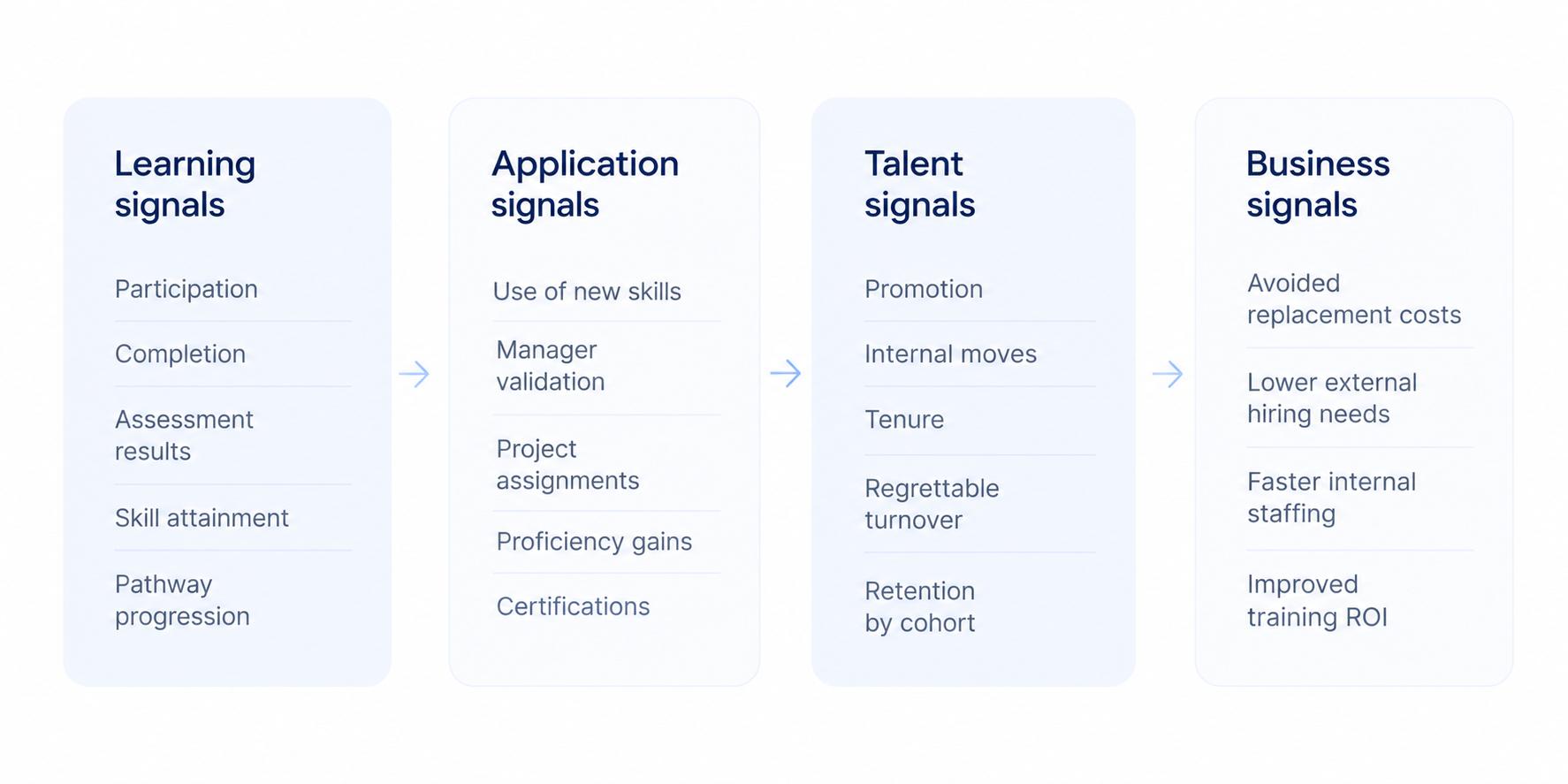
Based on our experience at Blue Carrot, comparing similar groups of employees can provide more useful insights than looking at company-wide averages.
Namely, L&D professionals could compare participants in a training program with peers in similar positions and with similar tenure. They could then check for potential discrepancies related to internal career movements, promotions, or turnover rates.
Examples of retention-focused learning programs in practice
The proof of impact from internal learning interventions takes different forms depending on organizational practices. Some studies provide direct evidence of employee retention rates or placement results. Others offer evidence of secondary indicators, including internal transfers, skill acquisition, or improved access to education. Understanding this distinction matters because it affects how much of the observed effect you can attribute to training.
📌 Amazon – Mechatronics and Robotics Apprenticeship
Problem: Amazon needed more employees with technical skills for robotics and maintenance roles.
Program: The company created a paid apprenticeship combining classroom instruction, on-the-job training, and industry certifications. Employees who complete the program move into permanent technical positions.
Outcome: Amazon reported a 100 percent job-placement rate for program graduates and a retention rate above 95 percent among employees placed through the program (Connie Chen. An Amazon Apprenticeship Program Pays Employees to Gain Skills and Learn about Robotics. Here’s How to Apply. About Amazon. 2023).
📌 AT&T – Future Ready
Problem: AT&T’s transition from hardware-based infrastructure to software created demand for skills in areas such as coding, cloud computing, and data science.
Program: Future Ready was built to retrain the existing workforce for emerging roles. Employees could see which competencies particular jobs required and access courses, nanodegrees, and other resources to develop them. AT&T initially set out to retrain 100,000 workers through the broader initiative (William Kerr. AT&T, Retraining, and the Workforce of Tomorrow ^ 820017. HBR Store. 2019).
Outcome: The initiative created a structured route for employees to prepare for jobs created by AT&T’s changing business model. Public sources describe the program’s scale and design but do not provide a comparable retention rate, so it is better treated as an example of large-scale internal reskilling rather than direct proof of reduced turnover.
📌 Blue Carrot and Studio SE – scalable systems engineering training
Problem: Studio SE relied on a six-day expert-led program, which limited scalability and made it difficult to reproduce hands-on practice in a self-paced format.
Program: Blue Carrot started redesigning the foundational training as an online learning experience with realistic scenarios, personalized pathways, automated feedback, and a custom software simulator for practicing SysML modeling.
Outcome: Studio SE reported strong interest in the new learning experience. During the event, attendees also highlighted the uniqueness of the solution, with several saying they had never seen anything like it in the industry.
The case does not directly measure employee retention, but it shows how to design a development program that supports practical skill application. These learning opportunities can support retention when they give employees relevant skills and opportunities for professional growth.

Studio SE – Online course Case Study
View demoConclusion
Training may be an effective retention strategy provided it addresses actual needs of workers, builds their competencies, and creates chances for application of acquired skills. The importance of a comprehensive learning ecosystem, rather than simply increasing course counts, cannot be overstated.
If you need help turning your retention strategy into actionable learning material, we at Blue Carrot can help you design instruction, create e-learning courses, produce videos, develop simulations, and implement other elements needed for an L&D program.